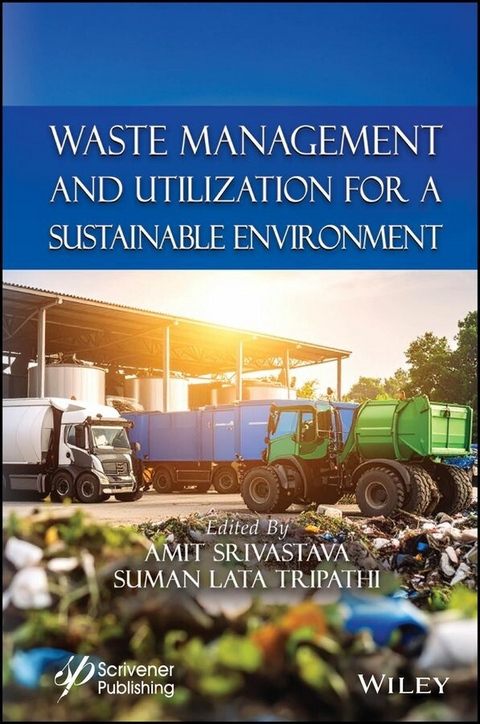
Waste Management and Utilization for a Sustainable Environment (eBook)
340 Seiten
Wiley-Scrivener (Verlag)
978-1-394-29301-8 (ISBN)
Waste Management and Utilization for a Sustainable Environment is an essential guide to understanding how cutting-edge technologies and innovative engineering solutions can transform waste management into a cornerstone of a sustainable future.
Civilized society produces enormous amounts of waste that must be managed to avoid negative impacts on the environment and ecosystem. Future generations depend on us for a sustainable future, bringing attention to this growing problem. Waste management and its utilization should be given paramount importance in technological development and innovation, where technology like AI, machine learning, computer vision, automation, and sensor technology has a vital role to play. Waste Management and Utilization for a Sustainable Environment provides a comprehensive overview of the latest research on innovative technologies shaping a more sustainable future. Through real-world case studies and expert insights, this book demonstrates that the future can be made sustainable through innovative engineering solutions for managing the enormous waste generated by society.
Amit Srivastava, PhD is a professor in the Department of Civil Engineering at Graphic Era University with over 20 years of teaching, research, and industry experience. He has published one book and over 80 papers in international journals and conference proceedings. His research interests include geotechnical engineering, foundation analysis and design of super structures, and the stability of natural or manmade slopes, earth dams, and the design of retaining walls.
Suman Lata Tripathi, PhD is a professor at Lovely Professional University with over 19 years of experience in academics. She has published over 74 research papers in refereed science journals and conferences, 15 books, 13 Indian patents, and two copyrights. Her area of expertise includes microelectronics device modeling and characterization, low-power VLSI circuit design, advanced FET design for IoT, and embedded system design.
1
Empowering E-Waste Management: A Framework for Collaboration among Stakeholders in India
Balaji Ravi1*, Prabhakaran Duraisamy2 and Thirumarimurugan Marimuthu2
1Department of Civil Engineering, PSG Institute of Technology, and Applied Research, Coimbatore, India
2Department of Chemical Engineering, Coimbatore Institute of Technology, Coimbatore, India
Abstract
Consumption of electronic devices and consumer demand for them continue to rise, opening the door to the production of electronic waste. Before being dumped into an open landfill or dump yard, the hazardous electronic waste (e-waste) needs to be properly handled. The purpose of this chapter is to examine the practical challenges associated with inventorying, handling, and processing the hazardous e-waste. The use of a questionnaire made it easier to identify and control the flow of electronic waste among various levels. A total of 300 responses from the general public addressed the questionnaire, which included a variety of handling-related factors. The majority of respondents were literate, but they were unaware of authorized recycling facilities in their area, e-waste dumping sites, or both. A case study on the authorized dismantling and simultaneous monitoring of the dump yard in the Coimbatore region was carried out to quantify and assess the flow of e-waste among recyclers. A framework for enhancing the existing e-waste policy is also proposed to manage the electronic waste.
Keywords: E-waste, e-waste management, questionnaire-based survey, flow prediction of e-waste and policy enhancement
1.1 Introduction
The electronics industry has experienced remarkable growth over the past two decades. The components of the information industry, namely, televisions, mobile phones, computers, and other devices are demonstrating a rapid expansion in the electronics market. Electric and electronic goods are now a fact of life. At one point, people only talked about these items as a luxury. Today, however, they are an undeniable part of success and advancement; a tool that every industry, banking, government, entertainment, daily life, industry, education, and administration desperately needs. Not only have they made the work more efficient, they also produce excellent results. Technology has changed how people live, but it has also had a direct impact on the environment. Over the past two decades, the volume of electronic waste generated has skyrocketed in tandem with the expansion of the electronics market. E-waste is quite possibly the quickest developing waste stream in India due to expanding “market penetration” in developing nations, “replacement market” in developed nations and “high obsolescence rate.” The products that make up e-waste vary widely in composition and fall into various categories. E-waste contains over a thousand distinct substances that are classified as “hazardous” or “non-hazardous.” Given the volume of e-waste generated and the presence of both toxic and valuable materials in it, e-waste is both an emerging problem and a growing business opportunity.
Generation of e-waste turns out to be important for our living. Increased utilization of Electrical and Electronic Equipment (EEE) items and their diminished life expectancy make electronic items obsolete. Various international treaties, including from the European Union (EU), the Basel convention, and the SteP Initiative (Solving the E-Waste Problem), provided an explanation for the term “e-waste.” “Waste material consisting of any broken or unwanted electronic appliance which includes computers, entertainment electronics, mobile phones, and other electronic items that have been discarded by their original users” is the definition of e-waste from the Waste Electrical and Electronic Equipment directive of the EU. From the Basel Action Network, the definition is “E-waste encompasses a broad and growing range of electronic devices ranging from large household devices such as refrigerators, air conditioners, cell phones, personal stereos, and consumer electronics to computers which have been discarded by their users.” According to SteP initiative, “E-Waste is a term used to cover items of all types of electrical and electronic equipment (EEE) and its parts that have been discarded by the owner as waste without the intention of re-use.”
The electronic devices are thrown away when their useful lives are up, resulting in an enormous amount of e-waste (Kazancoglu et al. 2022). The e-waste in India was comprehensively grouped into two significant classifications during the E-waste (Amendment) Rules 2018. The E-Waste (Management) Rules, 2022, which were later published by the Indian government in the Ministry of Environment, Forest, and Climate Change, were divided into seven major categories (E-Waste (Management) Rules 2022). Some examples of these categories are given in Table 1.1.
Table 1.1 Categories of EEE and its sources.
| S. no. | Categories | Sources |
|---|
| 1 | Information Technology and Telecommunication Equipment | Laptops, PCs, printers including cartridges, copying equipment and so on |
| 2 | Consumer Electrical and Electronics and Photovoltaic Panels | TVs, refridgerators, washing machines, air conditioners, and so on |
| 3 | Large and Small Electrical and Electronic Equipment | Large cooling appliance, dish washing machines, electric cookers, electric stoves, microwave, and so on |
| 4 | Electrical and Electronic Tools | Drills, saws, sewing machines, tools for welding, and so on |
| 5 | Toys, Leisure and Sports Equipment | Electrical trains, car racing sets, video games, computers for biking, driving, and so on |
| 6 | Medical Devices | Magnetic Resonance Imaging (MRI), Positron Emission Tomography (PET) Scanner and ultrasound equipment along with accessories |
| 7 | Laboratory Instruments | Gas analyser and equipment having electrical and electronic components |
1.2 E-Waste Characteristics
In 2019, 53.6 MT of electronic waste were produced worldwide, equivalent to an average of 7.3 kg per person. It is anticipated that the amount of e-waste will rise to 74.7 MT in 2030 and 110 MT in 2050, respectively, unless and until we alter our practices. Developed regions like Europe and USA are likely to generate 18 million tonnes of e-waste each by 2025. Similarly, developing countries like India and China play a significant role in generating e-waste. In India, the generation of e-waste has been a growing concern due to the rapid growth of the country’s technology sector and increasing consumerism. The amount of e-waste in India was estimated to rise to 3.23 MT in 2030 and 47.52 MT in 2040 (Baldé et al. 2022; Siddharth Ghanshyam Singh, 2020; Forti et al., 2020; Balde et al., 2017). In China, it is expected to generate 21 million tonnes of e-waste by 2025.
Despite having a large amount of e-waste produced, India employs fewer authorized dismantlers and fewer authorized recycling units to process the hazardous e-waste. Formal recycling facilities only handled 5% of e-waste, leaving the remainder in the hands of the informal recycling sector. The presence of the precious metal in the e-waste caused exponential growth in informal units. E-waste has Printed Circuit Boards (PCBs), and they are the key component which controls each and every EEE. Valuable metals like copper, gold, silver, palladium and platinum were found in e-waste PCBs, subsequently urban mining could foster an economy (Bidini et al., 2014; Ding et al., 2019; Meng et al., 2018). PCBs had become a significant source of metal components contrasted from primary ore (Ravi, 2021). When compared to the energy used to extract the primary ore, the metal recovery process used less energy. Because PCB is made of precious metals, resource recovery results in a high money recovery (Awasthi et al., 2017; Awasthi and Li, 2017). In this instance, the recovery operation’s organization should adhere to e-waste regulations to provide and guarantee safety for workers, employees, and even the organization (Nithya, Sivasankari, and Thirunavukkarasu, 2020). The safe disposal of e-waste should be the responsibility of each company or organization (Garlapati et al., 2016; Ravindra et al., 2019). In India, the Environmental Protection Act (The Environment (Protection) Act 1986) had been regulating this flow by adopting and enforcing regulations for the management of hazardous electronic waste (Agamuthu, 2012; Zhang, 2012). Rack pickers gather the e-waste for their day-to-day pay. Their source of revenue relies upon the day-to-day compensation earned through rack picking. The hazardous waste was primarily picked up with their hands. These workers lack a safety kit to safeguard themselves from this potentially harmful e-waste. For removing the electric wire’s toxic insulation, some workers had used direct fire, which releases dioxins and furans. Inhalation of the dioxins and furans over a prolonged period or breathed in with legitimate safety respiratory unit would prompt a few medical problems (Balaji et al., 2019; Balaji et al., 2020;...
| Erscheint lt. Verlag | 11.9.2025 |
|---|---|
| Sprache | englisch |
| Themenwelt | Technik ► Bauwesen |
| Schlagworte | Agro- and Aqua Waste Utilization in Concrete • Electronic Waste and Its Utilization • Industrial Byproduct and Its Utilization • Integration Waste Management System • Introduction to Waste Management and Utilization • Recovery and Recycling of Waste • Solid waste management • Technological Intervention for Waste Segregation • Waste Characterization • Waste Recovery and Utilization • Waste Recycling for Ocean Water • Waste to Energy • Waste Utilization for Binary, Ternary, and Quaternary Concrete Production • Waste Utilization in Construction Industry • Waste Utilization in Construction Materials |
| ISBN-10 | 1-394-29301-1 / 1394293011 |
| ISBN-13 | 978-1-394-29301-8 / 9781394293018 |
| Informationen gemäß Produktsicherheitsverordnung (GPSR) | |
| Haben Sie eine Frage zum Produkt? |
 EPUB (Adobe DRM)
Kopierschutz: Adobe-DRM
Adobe-DRM ist ein Kopierschutz, der das eBook vor Mißbrauch schützen soll. Dabei wird das eBook bereits beim Download auf Ihre persönliche Adobe-ID autorisiert. Lesen können Sie das eBook dann nur auf den Geräten, welche ebenfalls auf Ihre Adobe-ID registriert sind.
Details zum Adobe-DRM
Dateiformat: EPUB (Electronic Publication)
EPUB ist ein offener Standard für eBooks und eignet sich besonders zur Darstellung von Belletristik und Sachbüchern. Der Fließtext wird dynamisch an die Display- und Schriftgröße angepasst. Auch für mobile Lesegeräte ist EPUB daher gut geeignet.
Systemvoraussetzungen:
PC/Mac: Mit einem PC oder Mac können Sie dieses eBook lesen. Sie benötigen eine
eReader: Dieses eBook kann mit (fast) allen eBook-Readern gelesen werden. Mit dem amazon-Kindle ist es aber nicht kompatibel.
Smartphone/Tablet: Egal ob Apple oder Android, dieses eBook können Sie lesen. Sie benötigen eine
Geräteliste und zusätzliche Hinweise
Buying eBooks from abroad
For tax law reasons we can sell eBooks just within Germany and Switzerland. Regrettably we cannot fulfill eBook-orders from other countries.
aus dem Bereich