


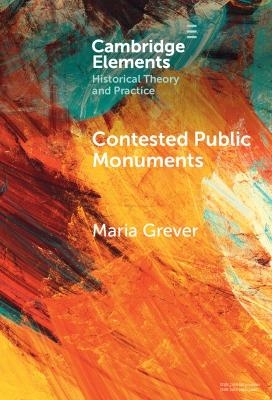
Contested Public Monuments
Global perspectives on landscapes of memory
Seiten
2025
Cambridge University Press (Verlag)
978-1-009-51568-9 (ISBN)
Cambridge University Press (Verlag)
978-1-009-51568-9 (ISBN)
In the new millennium, many public monuments and statues around the world have become the target of protest. These monuments play a major role in the struggle of social movements against inequality and discrimination. This Element approaches current conflicts over public monuments to transform the mnemonic regime in memory landscapes.
In the new millennium, many public monuments around the world have become the target of protests as part of social movements' struggles against inequality and discrimination. Despite research into the significance of toppled statues or damaged monuments and the motives of activists, little attention has been paid to the extent to which iconoclastic activism changes the narratives of public spaces or landscapes of memory. This Element approaches current conflicts over public monuments as an attempt to transform the mnemonic regime of public spaces. It examines global cases involving colonialism, Black slavery, world wars, and women's oppression. Using theoretical concepts, such as monumental narrativity, necropolitical space, white innocence, and the implicated subject, four current contexts of contestations will be highlighted: the fabric of landscapes of memory; the relationship between the living and the dead of a community; the power of visual language, iconography, and multiplication; the importance of dialogical monuments.
In the new millennium, many public monuments around the world have become the target of protests as part of social movements' struggles against inequality and discrimination. Despite research into the significance of toppled statues or damaged monuments and the motives of activists, little attention has been paid to the extent to which iconoclastic activism changes the narratives of public spaces or landscapes of memory. This Element approaches current conflicts over public monuments as an attempt to transform the mnemonic regime of public spaces. It examines global cases involving colonialism, Black slavery, world wars, and women's oppression. Using theoretical concepts, such as monumental narrativity, necropolitical space, white innocence, and the implicated subject, four current contexts of contestations will be highlighted: the fabric of landscapes of memory; the relationship between the living and the dead of a community; the power of visual language, iconography, and multiplication; the importance of dialogical monuments.
1. Introduction; 2. Landscapes of memory and monumental narrativity; 3. Monuments and necropolitical space; 4. Iconography, visual language, and multiplication; 5. Dialogical monuments in a global media network; 6. Conclusion; References.
| Erscheinungsdatum | 01.11.2025 |
|---|---|
| Reihe/Serie | Elements in Historical Theory and Practice |
| Zusatzinfo | Worked examples or Exercises |
| Verlagsort | Cambridge |
| Sprache | englisch |
| Gewicht | 281 g |
| Themenwelt | Kunst / Musik / Theater |
| Geisteswissenschaften ► Geschichte ► Hilfswissenschaften | |
| Geschichte ► Teilgebiete der Geschichte ► Wirtschaftsgeschichte | |
| Technik ► Architektur | |
| ISBN-10 | 1-009-51568-3 / 1009515683 |
| ISBN-13 | 978-1-009-51568-9 / 9781009515689 |
| Zustand | Neuware |
| Informationen gemäß Produktsicherheitsverordnung (GPSR) | |
| Haben Sie eine Frage zum Produkt? |
Mehr entdecken
aus dem Bereich

aus dem Bereich
wie Tech-Konzerne und Großmächte die Welt unter sich aufteilen
Buch | Hardcover (2025)
C.H.Beck (Verlag)
CHF 39,20


