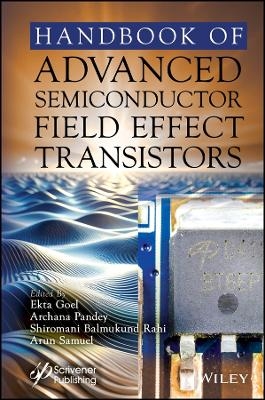
Handbook of Advanced Semiconductor Field Effect Transistors
Wiley-Scrivener (Verlag)
978-1-394-41257-0 (ISBN)
Advanced nanoscale semiconductor field-effect transistors (FETs) represent a pivotal advancement in semiconductor technology, catering to the growing demand for energy-efficient low power electronic devices for emerging applications. This development has significantly impacted the electronics industry, particularly in the design and fabrication of integrated circuits for applications ranging from portable electronics to Internet of Things (IoT) devices. This book provides a comprehensive look at the modelling, simulation, characterization, and fabrication of modern semiconductor FET transistors to improve performance in terms of reduced weight and size, improved subthreshold characteristics and switching performance, and lower power consumption. Handbook of Advanced Semiconductor Field Effect Transistors provides deep insight into the evolving possibilities and challenges of emerging advanced nanoscale FETs. By focusing on the fundamentals of nanoscience and expert knowledge on advanced nanoscale semiconductors, this book serves as a well-rounded guide for novices and professionals looking to innovate in this growing field.
Ekta Goel, PhD is an assistant professor at the National Institute of Technology Warangal. She has published one book chapter and over 50 research articles in peer-reviewed journals and conferences. Her areas of research include modeling and simulation of advanced nanoscale MOS devices, VLSI circuit simulation, photodiodes, and photovoltaic cells. Archana Pandey, PhD is a senior assistant professor in the Department of Electronics and Communication Engineering at the Jaypee Institute of Information Technology. She has published numerous articles in peer-reviewed international journals and conferences. Her research areas include novel semiconductor devices, FinFETs, device modeling, delay modeling of digital circuit modules, VLSI device-circuit co-design, nanosheet FETs, and FET biosensors. Shiromani Balmukund Rahi, PhD is an assistant professor at the Mahamaya College of Agriculture, Engineering, and Technology. He has published 25 research papers, two conference proceedings, and 20 book chapters in addition to editing seven books. His work focuses on the development of IoTs for smart applications ultra-low power devices such as tunnel FETs, negative capacitance FETs, and nanosheets. Arun Samuel, PhD is a professor at the National Engineering College in Kovilpatti, India. He has over 90 publications to his credit and is a lifetime member of the Institute of Engineering and the Institute of Electrical and Electronics Engineers. His research interests include modelling and simulation of multi-gate transistors and tunnel field-effect transistors.
Preface xix
1 Semiconductor Reliability Analysis and Modeling 1
Reinhard S. Park
1.1 Introduction 2
1.2 History and Fundamental of Semiconductors 2
1.3 Brief Overview of Semiconductor Fabrication 3
1.4 Definition and Explanation of Bathtub Curve 5
1.5 Failure Mechanisms in Semiconductor 9
1.6 Failure Mechanism Modeling and Prediction 9
1.7 Design for Reliability Strategies for Semiconductor 11
1.8 Conclusion 14
References 14
2 Unveiling the Potential of FinFETs: An Alternative Paradigm to MOSFET 19
Nitish Vashishth, Neha Goel and R. K. Yadav
2.1 Introduction to Transistor Technology 20
2.2 Implementation of Inverters and NAND Gates Using FinFETs 25
2.3 Implementation of Latches and Flip-Flops Using FinFETs 32
2.4 Implementation of SRAM Using FinFETs 33
2.5 Implementation of DRAM Using FinFETs 35
2.6 Challenges and Limitations of FinFET Technology 35
2.7 Potential Future Developments in FinFET Technology 37
2.8 Conclusion 39
References 39
3 Prospects of Negative-Capacitance Ferroelectric Field-Effect Transistors in Low-Power Electronics and Beyond 43
Ningombam Ajit Kumar, Khuraijam Nelson Singh, Sisira Hawaibam, Sushmita Dandeliya and Sonal Agrawal
3.1 Introduction 44
3.2 The Fundamentals of Negative Capacitance Ferroelectric FET 49
3.3 Modeling 57
3.4 Applications 59
3.5 Performance Optimization and Challenges 61
3.6 Comparative Analysis with Other Transistor Technologies 63
3.7 Future Prospects and Trends 64
3.8 Summary 66
References 66
4 Unleashing the Potential of Negative Capacitance Field Effect Transistors: A Paradigm Shift in Low-Power Electronics 73
Malvika, Jagritee Talukdar, Bijit Choudhuri and Kavicharan Mummaneni
4.1 Introduction 74
4.2 A Brief Survey 79
4.3 Simulation Strategy of NCFET and its Application in Circuit 81
4.4 Analysis of Device Performance and its Application as an Inverter 83
4.5 Conclusion 84
References 85
5 The Future of Low Power Electronics: Tunnel Field-Effect Transistors 89
Sourav Das, Ekta Goel and Kunal Singh
5.1 Introduction 90
5.2 Fundamental Principles of TFET Operation 90
5.3 Applications of TFETs 96
5.4 Literature Review 98
5.5 Simulation of Dual Metal Double Gate Hetero Pocket V-tfet 99
5.6 Conclusion 101
References 101
6 Novel Gate All Around FET with Enhanced Performance and Improved Process Sensitivity 107
Mandeep Singh Narula, Archana Pandey and Ajay Kumar
6.1 Introduction 108
6.2 Proposed Structure 110
6.3 Device Performance 113
6.4 Process Sensitivity 115
6.5 Conclusion 117
References 117
7 Rise of Tunnel FETs as a Revolutionary MOSFET Alternative 119
G. Munirathnam and Y. Murali Mohan Babu
7.1 Introduction to Tunnel FETs 120
7.2 Working Principles of Tunnel FETs 127
7.3 TFET Device Structure and Fabrication 135
7.4 TFET Performance Metrics 143
7.5 Applications of TFETs 149
7.6 Challenges and Future Directions 152
7.7 Case Studies and Practical Implementations 157
7.8 Conclusion 165
References 165
8 Tunnel Field Effect Transistors: Harnessing Light Sensitivity for Optical Sensing 169
Jagritee Talukdar, Malvika, Basab Das and Kavicharan Mummaneni
8.1 Introduction 170
8.2 A Brief Overview 172
8.3 Photo Sensing in TFETs: Principle of Operation and Geometry 173
8.4 Simulation Strategy for TFET-Based Photosensor 175
8.5 Sensitivity Parameters of Photosensor 175
8.6 An Extended Source TFET-Based Photosensor 177
8.7 Conclusion 180
References 180
9 2D Material Based FET Sensors 183
Archana Pandey, Jyoti Pant, Medha Joshi, Nitanshu Chauhan and Mandeep Singh
9.1 Introduction 183
9.2 Properties and Applications of 2D Materials 185
9.3 Sensing Mechanisms 188
9.4 Challenges and Future Directions 191
9.5 Conclusion 195
References 195
10 2D Material-Based FETs for Next Generation Integrated Circuits 199
Aruru Sai Kumar, V. Bharath Sreenivasulu, K. Sarangam, P. Ravi Sankar and K. Nishanth Rao
10.1 Introduction 200
10.2 Literature Survey 203
10.3 Proposed Methodology 205
10.4 Result Analysis 206
10.5 Conclusion 213
Acknowledgments 213
References 214
11 MOSHEMT—Device Background, Materials, and Structures for Different Applications 217
Ananya Dastidar, Tapas Kumar Patra and Sushanta Kumar Mohapatra
11.1 Classical MOSFETs and their Issues 218
11.2 HEMT and Its Challenges 219
11.3 Moshemt 220
11.4 MOSHEMT Structural Engineering 228
11.5 MOSHEMT for Biosensing Applications 234
11.6 Summary 241
References 242
12 Quantum Computing and Digital Twins with Development of Semiconductor Field Effect Transistors 255
Shiromani Balmukund Rahi and Young Suh Song
12.1 Introduction to Quantum Computing: Concept, History, and Principles 256
12.2 Understanding Digital Twins 258
12.3 Semiconductor Development: Past, Present, and Future 264
12.4 Integration of Quantum Computing and Digital Twins 266
12.5 Applications and Impact Across Industries 268
12.6 Ethical and Societal Implications 270
12.7 Future Directions 271
12.8 Conclusion 272
Acknowledgment 273
References 273
13 Low Voltage Circuit Design with FinFETs 277
Sarita Yadav and Nitanshu Chauhan
13.1 Introduction 278
13.2 Advent of FinFETs 279
13.3 Critical Device-Circuit Co-Design Challenges in Low-Voltage Domain for FinFETs 282
13.4 Inverter Capacitances in Low-Voltage Region of Operation 287
13.5 Minimum Supply Voltage for FinFET Logic Gates 294
13.6 Conclusion 299
References 300
14 A Novel Low-Power Approach of 8-Bit Vedic Multiplier Using Reversible Logic Gates 305
Aruru Sai Kumar, K. Sarangam, P. Ravi Sankar, K. Nishanth Rao and Yashika Gaidhani
14.1 Introduction 306
14.2 Literature Survey 309
14.3 Proposed Methodology 310
14.4 Result Analysis 317
14.5 Conclusion 320
References 320
15 64-Bit High Speed Parallel Prefix Adder Architectures 323
B. Harish and M.S.S. Rukmini
15.1 Introduction 323
15.2 Implementation of PPA in 64-Bit 327
Results and Discussion 331
Conclusion 335
References 335
16 Design and Implementation of High-Performance Adaptive Baud Rate Generator for IoT Applications 337
B. Harish, N. Jahnavi, M. Brammani, Md. Karishma and N. J. L. S. Manasa
16.1 Introduction 338
16.2 Fundamentals of Baud Rate Generation 340
16.3 Requirements and Challenges in IoT Baud Rate Generation 345
16.4 State-of-the-Art Techniques in Baud Rate Generation 349
16.5 High-Performance Adaptive Baud Rate Generators 351
16.6 Results and Discussion 354
16.7 Future Directions and Challenges 359
16.8 Conclusion 360
References 362
17 Biomedical Applications in VLSI Field 365
Jyoti Kandpal, Divya Sharma and Ekta Goel
17.1 Introduction 365
17.2 Role of VLSI in Biomedical Application 367
17.3 Application 369
17.4 Conclusion 380
References 380
18 Self-Powered Biosensor Field-Effect Transistors 383
Archana Pandey and Shradha Saxena
18.1 Introduction to Biosensors 383
18.2 Field-Effect Transistor (FET)-Based Biosensors 386
18.3 Label-Free Detection with FET Biosensors 392
18.4 Need for Self-Powering Mechanisms in Biosensors 393
18.5 Energy Harvesting in Biosensor FET Technology 394
18.6 Applications of Self-Powered Biosensor FETs 395
18.7 Conclusion 395
References 395
19 Vertical Tunneling FETs (V-TFETs): A Novel Approach in Biosensing Technology 401
Sourav Das, Ekta Goel and Kunal Singh
19.1 Introduction 401
19.2 Types of Biosensors 403
19.3 Comparison of FET- and TFET-Based Biosensors 404
19.4 Dielectric Modulation in TFETs: Principle and Design 405
19.5 Literature Review 408
19.6 Simulation Methodology for a DM TFET as a Label-Free Biosensor 408
19.7 Sensitivity Parameters 409
19.8 Non-Idealities in Dielectric-Modulated Biosensors 410
19.9 Impact of Charged Biomolecules on Sensitivity 411
19.10 Device Architecture and Simulation of Model 412
19.11 Conclusion 414
References 414
20 Micro-Electromechanical System (MEMS) and Field-Effect Transistor (FET)–Coupled Sensors 419
Shradha Saxena and Archana Pandey
20.1 Introduction to Micro-Electromechanical System (MEMS)–Based Sensor 420
20.2 Introduction to Field-Effect Transistor (FET)–Based Sensors 422
20.3 Introduction of MEMS-FET Sensor 426
20.5 Self-Powered MEMS-FET Sensors 433
20.6 Future Direction and Challenges 435
20.7 Conclusion 436
References 436
21 Memory Design Using Conventional DRAM Unit Cell 439
Husien Salama, Zina Guesmi, Faouzi Nasri, Billel Smaani, Khalifa Ahmed Salama and Ahmed Gawa
21.1 Introduction 440
21.2 Conventional DRAM Unit Cell Structure 443
21.3 Design Considerations for Conventional DRAM 450
21.4 Challenges and Limitations of Conventional DRAM 455
21.5 Conclusion and Future Directions 457
References 459
22 Ensuring Robustness: Reliability Analysis of 4H-SiC Trench MOSFETs in High-Performance Analog Applications 465
Ajay Kumar, Mandeep Singh Narula, Neha Gupta, Aditya Jain, Kaushal Kumar and Amit Kumar Goyal
22.1 Introduction 466
22.2 Device Design and Its Parameters 468
22.3 Methodology 469
22.4 Results and Discussion 469
22.5 Conclusion 475
References 476
About the Editors 479
Index 481
| Erscheinungsdatum | 25.11.2025 |
|---|---|
| Sprache | englisch |
| Themenwelt | Technik ► Maschinenbau |
| ISBN-10 | 1-394-41257-6 / 1394412576 |
| ISBN-13 | 978-1-394-41257-0 / 9781394412570 |
| Zustand | Neuware |
| Informationen gemäß Produktsicherheitsverordnung (GPSR) | |
| Haben Sie eine Frage zum Produkt? |
aus dem Bereich