


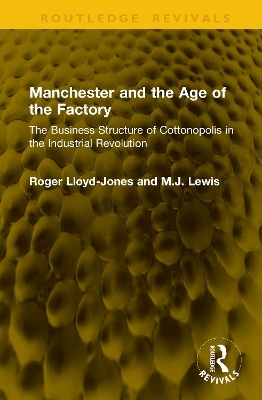
Manchester and the Age of the Factory
The Business Structure of Cottonopolis in the Industrial Revolution
Seiten
2026
Routledge (Verlag)
978-1-041-16994-9 (ISBN)
Routledge (Verlag)
978-1-041-16994-9 (ISBN)
- Noch nicht erschienen (ca. Januar 2026)
- Versandkostenfrei
- Auch auf Rechnung
- Artikel merken
This book (originally published in 1988 and now with a new preface) explores Manchester’s transformation into ‘Cottonopolis,’ the world’s first industrial city. Focusing on the factory’s relationship with the warehouse, it examines competing production systems, business trends, and the factory's impact on political economy and development.
Manchester and the Age of the Factory (originally published in 1988 and now with a new preface by the authors) focuses on Manchester, the world’s first industrial city, and its transformation into ‘Cottonopolis.’ The book explores the contribution of the factory and the firm to the business structure and political economy of ‘Cottonopolis’. The factory is not examined in isolation but in terms of its relation to a range of economic components. A major, and indeed, new emphasis of the work is centred on the relationship between factory and warehouse. These two components are identified as symbolic of two different systems of production, whose political economy at the nodal point of the Industrial Revolution was associated with a struggle over the merits of the mechanised factory as opposed to the manufacturing putting-out system.
To investigate the interdependence of economic components, the authors reconstruct Manchester’s business structure for the years 1815 and 1825. The first reconstruction allows for the examination of the city’s variegated business structure at a point midway through the classic Industrial Revolution and the ramifications of the empirical findings provide a focus of discussion in the subsequent chapters. The second reconstruction provides a comparative basis for exploring shifting business trends, identifying conflicting business interests and assessing the direct and indirect impact of the factory on the pattern of business development.
For instance, the evolving business relationship between the factory and warehouse after 1815 played a pivotal role in shaping a new political economy, examined at both local and national levels. This transformation prompted cotton firms to develop distinctive business strategies focused on managing the factory’s human and physical resources.
Manchester and the Age of the Factory (originally published in 1988 and now with a new preface by the authors) focuses on Manchester, the world’s first industrial city, and its transformation into ‘Cottonopolis.’ The book explores the contribution of the factory and the firm to the business structure and political economy of ‘Cottonopolis’. The factory is not examined in isolation but in terms of its relation to a range of economic components. A major, and indeed, new emphasis of the work is centred on the relationship between factory and warehouse. These two components are identified as symbolic of two different systems of production, whose political economy at the nodal point of the Industrial Revolution was associated with a struggle over the merits of the mechanised factory as opposed to the manufacturing putting-out system.
To investigate the interdependence of economic components, the authors reconstruct Manchester’s business structure for the years 1815 and 1825. The first reconstruction allows for the examination of the city’s variegated business structure at a point midway through the classic Industrial Revolution and the ramifications of the empirical findings provide a focus of discussion in the subsequent chapters. The second reconstruction provides a comparative basis for exploring shifting business trends, identifying conflicting business interests and assessing the direct and indirect impact of the factory on the pattern of business development.
For instance, the evolving business relationship between the factory and warehouse after 1815 played a pivotal role in shaping a new political economy, examined at both local and national levels. This transformation prompted cotton firms to develop distinctive business strategies focused on managing the factory’s human and physical resources.
1. Introduction 2. The Factory and the Industrial Revolution 3. The Business Structure of Manchester in 1815 4. From Factory to Warehouse: The Warehouse System and the Yarn Market in Manchester 5. Schisms in the Cotton Trade: The Political Economy of Factory and Warehouse 6. In Defence of the Factory 7. The Growth of Cottonopolis: Manchester’s Business System, c. 1815–1825 8. The Business Community and Political Economy in Manchester, c. 1815–1825 9. The Modern Sector: The Metal, Chemical and Finishing Trades in Manchester 10. Business Strategy and the Firm in the Industrial Revolution
| Erscheint lt. Verlag | 30.1.2026 |
|---|---|
| Reihe/Serie | Routledge Revivals |
| Verlagsort | London |
| Sprache | englisch |
| Maße | 156 x 234 mm |
| Themenwelt | Geisteswissenschaften ► Geschichte ► Regional- / Ländergeschichte |
| Geschichte ► Teilgebiete der Geschichte ► Wirtschaftsgeschichte | |
| Technik | |
| ISBN-10 | 1-041-16994-9 / 1041169949 |
| ISBN-13 | 978-1-041-16994-9 / 9781041169949 |
| Zustand | Neuware |
| Informationen gemäß Produktsicherheitsverordnung (GPSR) | |
| Haben Sie eine Frage zum Produkt? |
Mehr entdecken
aus dem Bereich


aus dem Bereich
wie Tech-Konzerne und Großmächte die Welt unter sich aufteilen
Buch | Hardcover (2025)
C.H.Beck (Verlag)
CHF 39,20
Aufstieg und Fall der Deutschland AG
Buch | Hardcover (2025)
Suhrkamp (Verlag)
CHF 41,95


