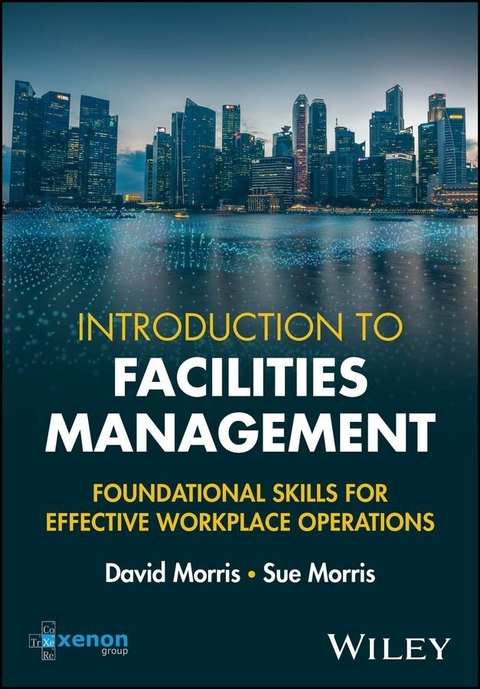
Introduction to Facilities Management (eBook)
Provides the essential skills required for effective facilities management
Facilities Management (FM) plays a vital role in ensuring the smooth operation of workplaces, balancing strategic goals with day-to-day operational needs. Introduction to Facilities Management is a structured and comprehensive introduction to the key functions of FM, equipping professionals with the foundational skills necessary to excel in this evolving field. Covering a wide range of essential topics, this comprehensive guide enables readers to understand the diverse responsibilities of FM and apply practical knowledge to workplace challenges.
Introduction to Facilities Management is designed for those new to the industry, offering a clear and practical exploration of FM's core principles and functions. It bridges the gap between theory and practice by incorporating real-world scenarios and examples, helping learners develop the confidence to tackle operational challenges. By covering key areas such as workplace safety, resource management, and service coordination, the highly experienced authors provide a solid foundation for those pursuing professional qualifications, including the IWFM Level 3 Mandatory Units.
Written for professionals aiming to enhance their skills and contribute to workplace efficiency and organisational success, Introduction to Facilities Management:
- Covers all key operational aspects of FM, making it an ideal study companion for certification
- Offers a step-by-step approach to developing essential FM skills to ensure workplace efficiency and operational success
- Highlights the growing professionalisation of FM and its increasing influence on organisational effectiveness
- Supports career development by equipping readers with the foundational knowledge needed for advancement in FM roles
With a focus on day-to-day operational effectiveness, Introduction to Facilities Management: Foundational Skills for Effective Workplace Operations is ideal for individuals working in Facilities Management at a junior level, as well as students pursuing industry qualifications. It is a valuable resource for those studying workplace operations, property management, and organisational efficiency in vocational training programs and professional development courses.
David Morris is the Managing Director of The Xenon Group, where he oversees Facilities Management Consultancy, Training, and Recruitment. With extensive experience in FM strategy and operations, he is dedicated to advancing professional standards in the field.
Sue Morris is the Training Director at The Xenon Group and a senior tutor for IWFM courses at Levels 3, 4, 5, and 6. She specialises in FM education and professional development, helping learners build the skills needed for success in the industry.
Provides the essential skills required for effective facilities management Facilities Management (FM) plays a vital role in ensuring the smooth operation of workplaces, balancing strategic goals with day-to-day operational needs. Introduction to Facilities Management is a structured and comprehensive introduction to the key functions of FM, equipping professionals with the foundational skills necessary to excel in this evolving field. Covering a wide range of essential topics, this comprehensive guide enables readers to understand the diverse responsibilities of FM and apply practical knowledge to workplace challenges. Introduction to Facilities Management is designed for those new to the industry, offering a clear and practical exploration of FM s core principles and functions. It bridges the gap between theory and practice by incorporating real-world scenarios and examples, helping learners develop the confidence to tackle operational challenges. By covering key areas such as workplace safety, resource management, and service coordination, the highly experienced authors provide a solid foundation for those pursuing professional qualifications, including the IWFM Level 3 Mandatory Units. Written for professionals aiming to enhance their skills and contribute to workplace efficiency and organisational success, Introduction to Facilities Management: Covers all key operational aspects of FM, making it an ideal study companion for certificationOffers a step-by-step approach to developing essential FM skills to ensure workplace efficiency and operational successHighlights the growing professionalisation of FM and its increasing influence on organisational effectivenessSupports career development by equipping readers with the foundational knowledge needed for advancement in FM roles With a focus on day-to-day operational effectiveness, Introduction to Facilities Management: Foundational Skills for Effective Workplace Operations is ideal for individuals working in Facilities Management at a junior level, as well as students pursuing industry qualifications. It is a valuable resource for those studying workplace operations, property management, and organisational efficiency in vocational training programs and professional development courses.
Chapter 1
What Is Facilities Management?
Facilities management (FM) encompasses a very diverse range of multidisciplinary activities within the built environment and the management of their impact on people and the workplace.
It is vital that all these activities are managed efficiently and cost-effectively in support of an organisation’s strategic and operational objectives and, thereby, promote the realisation of these objectives.
On a day-to-day level, effective FM provides a safe and efficient working environment, which is essential to the performance of any business – whatever its size and scope.
Within this fast-growing professional discipline, facilities managers have extensive responsibilities for providing, maintaining and developing a myriad of services ranging from property strategy, space management and communications infrastructure to building maintenance, administration and contract management.
These activities can be categorised under four broad functional areas and described as the provision and operation of services required in support of any, or all, of the following:
- Property
- Business Assets
- Business Support
- Staff Support
The FM sector is large and complex, comprising a mix of in-house departments, specialist contractors and large multi-service companies delivering the full range of design, build, finance and management.
Defining Facilities Management
The definition of FM varies depending on who you talk to, but perhaps the best definition is that provided by the International Organisation for Standardisation and adopted by the Institute of Workplace and Facilities Management (IWFM):
‘FM is the organizational function which integrates people,
place and process within the built environment with the
purpose of improving the quality of life of people and the
productivity of the core business’.
The scope of FM is enormous. Michel Theriault, in his book Managing Facilities and Real Estate, presents a pie chart which considers all the various functions and responsibilities of the Facilities Manager.
See how many differing FM roles you can identify.
The FM Wheel in Figure 1.1 shows the incredibly wide diversity of functions a Facilities Manager may be involved with.
Figure 1.1 Michel Theriault’s wheel of FM services.
How many did you identify?
Core Business and Support Services: For most organisations, FM is a ‘Support Service’. So, what do we mean by Support Services and how do these differ from the Core Business?
The core business of an organisation includes those activities which bring income into a business. Let’s consider a few examples. Price Waterhouse Cooper ‘sells’ their accountancy services to make a profit, and so these services are ‘core’ to their business and their survival. British Gas sells gas to households and businesses, again to make a profit, so the sale of gas is ‘core’ to their business. Schools provide education for the children who attend, and so again, teaching is the ‘core’ activity for all schools and funding is granted by the government based on the number of pupils who attend the school in the public sector and by the fees paid for children to attend schools in the private sector.
The ‘sale’ of these services directly contributes to income. Conversely, any activity which does not directly contribute to income should be considered as ‘non-core’ and would be classed as a ‘support service’.
One of the primary reasons for identifying the distinction is to concentrate the attention of the organisation’s management on those parts of the business – the core business – that form an essential part of the end product. Once the distinction has been achieved, the remaining operations might be classified as non-core business and then could be provided internally or by external suppliers. From this point on, core business is ‘ring-fenced’.
So, we have considered what the core business of the above organisations might be. We now need to consider some examples of what might be considered ‘non-core’. Look at the list in Figure 1.2.
| Restaurant services | Human resources |
| Procurement | Reception services |
| Accounts department | Building maintenance |
| Space planning | IT services |
| Workplace nurseries | Occupational health |
| Mobile phone management | Car fleet |
| Concierge services | Cleaning |
Figure 1.2 Examples of non-core activities within an organisation.
If you look at this list carefully, you will see that some come under the umbrella of FM, but others have little, if anything, to do with FM – Human Resources, for example.
Nevertheless, they are still a non-core function and therefore, by definition, a Support Service. All these activities would not directly bring income into a company and, therefore, are not considered core business.
Another important point is that it does depend on what the core business is. For example, for a restaurant, catering would be the core business. Similarly, if you are an accountancy firm, accounts would be core business, but for most companies, the examples above would be considered as Support Services.
If you look back at Theriault’s wheel, the examples form most support services linked to FM. Support services can, and often are, outsourced to another company. This rarely happens with the core service and so this is one way to distinguish between the two.
As an example, you might decide to outsource your cleaning to a cleaning company or your catering to a specialist catering company. You might outsource your Human Resources to a specialist company who are experts in Employment Law, for example. This means your company can devote all its attention to its core business and does not have to worry about ensuring that the contracts for staff are compliant with current legislation because this is done by experts in their field.
Key Point: If you work for an FM service provider, such as Sodexo or Mitie, then providing FM services is your core business. However, from the perspective of your clients and customers, the service you provide is non-core. They have outsourced the provision of FM services to your company so that they can focus on their core business, whatever that may be.
So, to summarise then, all organisations have a core business. This is what brings the income or is the raison d’etre for organisations like hospitals and schools, where the customer is not paying directly for the end product into the company.
All services which do not bring money into the organisation are classed as support services. These may be FM services or other services, such as Human Resources, for example.
Another differential is the fact that core services are never outsourced – why would a restaurant wish to outsource its catering - whereas support services might be?
How FM Supports an Organisation
So, for the most part, FM is considered a Support Service. Its role is to support an organisation to allow it to deliver its core business. It does this in several ways. Firstly, the FM department provides services to meet end-user requirements – to provide services that allow the employees of the business to undertake their primary role, selling energy, managing external customers’ accounts, improving education for students and so on.
Another role for the Facilities Manager is to look for ways to reduce operating costs. The more costs can be reduced, the more profit the business will make or the more money a public sector company will have to administer their core business.
The Facilities Manager is involved in ensuring that the business can continue to operate in the event of an incident, such as flooding or power failure. This would be considered as Disaster Planning.
FM is not an uncontrolled service. As a discipline, it is governed by a wide range of legislation, and part of the role of the Facilities Manager is to ensure that the business remains compliant with the various legislations and regulations.
Finally, the Facilities Manager plays a key part in supporting Corporate Social Responsibility (CSR) within the business. Let’s have a look at each of these roles in a little more detail.
Meeting End-user Requirements
Whatever service the Facilities Manager is responsible for, that service will have an end user – someone who requires that service to function effectively in their role. They will have clients, customers and users, and it is important that we understand the difference between the three to enable us to identify their needs and meet their requirements.
There is often confusion between the clients, the customers and the users. In most cases, the FM teams assume that they are loosely the same, but there is a major difference.
Clients are the people who specify and authorise the service levels and then approve the invoices for external providers or who are the line managers in the case of internal FM service...
| Erscheint lt. Verlag | 26.8.2025 |
|---|---|
| Sprache | englisch |
| Themenwelt | Technik ► Bauwesen |
| Schlagworte | facilities administration • facilities management certification • facilities management guide • facilities management operational efficiency • facilities management professional development • FM skills development • FM training • IWFM Level 3 guide |
| ISBN-13 | 9781394316052 / 9781394316052 |
| Informationen gemäß Produktsicherheitsverordnung (GPSR) | |
| Haben Sie eine Frage zum Produkt? |
 EPUB (Adobe DRM)
Kopierschutz: Adobe-DRM
Adobe-DRM ist ein Kopierschutz, der das eBook vor Mißbrauch schützen soll. Dabei wird das eBook bereits beim Download auf Ihre persönliche Adobe-ID autorisiert. Lesen können Sie das eBook dann nur auf den Geräten, welche ebenfalls auf Ihre Adobe-ID registriert sind.
Details zum Adobe-DRM
Dateiformat: EPUB (Electronic Publication)
EPUB ist ein offener Standard für eBooks und eignet sich besonders zur Darstellung von Belletristik und Sachbüchern. Der Fließtext wird dynamisch an die Display- und Schriftgröße angepasst. Auch für mobile Lesegeräte ist EPUB daher gut geeignet.
Systemvoraussetzungen:
PC/Mac: Mit einem PC oder Mac können Sie dieses eBook lesen. Sie benötigen eine
eReader: Dieses eBook kann mit (fast) allen eBook-Readern gelesen werden. Mit dem amazon-Kindle ist es aber nicht kompatibel.
Smartphone/Tablet: Egal ob Apple oder Android, dieses eBook können Sie lesen. Sie benötigen eine
Geräteliste und zusätzliche Hinweise
Buying eBooks from abroad
For tax law reasons we can sell eBooks just within Germany and Switzerland. Regrettably we cannot fulfill eBook-orders from other countries.
aus dem Bereich