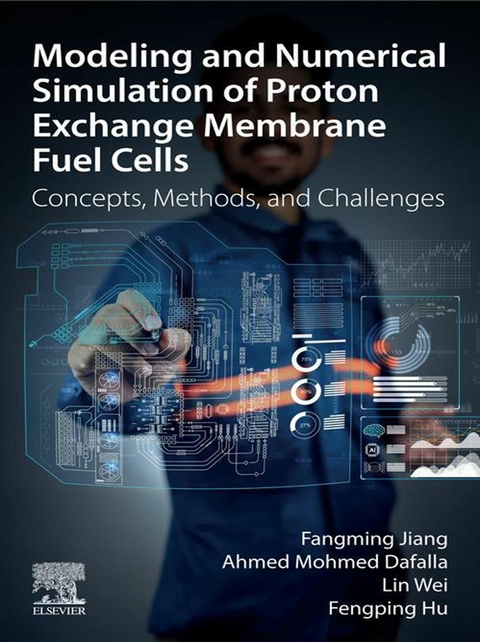
Modeling and Numerical Simulation of Proton Exchange Membrane Fuel Cells (eBook)
300 Seiten
Elsevier Science (Verlag)
978-0-443-24119-2 (ISBN)
Prof. Jiang is the first author and chief editor of this book. He worked in US and German fuel cell industries/institutions for many years before taking on a leadership role in Guangzhou Institute of Energy Conversion (GIEC), CAS. Prof. Jiang has been active in the research fields of fuel cell and battery science and technology, thermo-fluids, heat, and mass transfer enhancement, and CFD etc. He has authored about 200 peer-reviewed journal papers, 2 books, and 6 book chapters. He holds 30 China invention patents and 30 computational softwares. During his work (with Prof. Chao-Yang Wang) in the Electrochemical Engine Center at the Pennsylvania State University, he, as a major investigator, developed the computational modeling software for PEM fuel cell s, which has been widely adopted by Toyota, Honda, Nissan, GM etc. and used for the research & development of advanced automotive PEM fuel cell engines.
Modeling and Numerical Simulation of Proton Exchange Membrane Fuel Cells: Concept, Methods, and Challenges provides a concise guide to the modeling of PEM fuel cells. The book offers detailed methodologies, codes, and algorithms on every aspect of PEM fuel cells, from cold start to degradation. Chapters cover the development, basic principles, and components of PEM fuel cells, discuss the transport phenomena and mathematical formulation of macro-scale PEM fuel cell models, single cell and stack-level models, and model validation, and explain multi-phase transport modeling in PEM fuel cells, including different multiphase models like flow in gas flow channels, porous electrodes, and multi-phase model validation.The book also addresses multiphase mixture formulation, finite-volume, direct numerical simulation, Lattice Boltzmann, and pore network models, along with a section on modeling the cold start process of PEM fuel cells, including the non-isothermal transient cold start model, reduced-dimensional transient model, and the impact of different parameters on the cold start performance. Final sections cover the degradation and lifetime modeling of PEM fuel cells, including stress-induced degradation mechanisms, physics-based and data-driven modeling methods, and coupled performance-degradation models. Finally, recent progress on multi-scale and multi-dimensional modeling of PEM fuel cells, including micro and nano-scale modeling and multi-scale coupled models, is covered. - Explains fuel cell modeling techniques and approaches, from fundamental principles that govern fuel cells to advanced modeling approaches that simulate fuel cell behavior- Offers case studies on the application of the most recent modeling and numerical simulation- Provides a guide for readers to develop their own models and simulations and apply them to specific design and optimization challenges- Integrates multidisciplinary knowledge from materials science, chemistry, physics, and engineering
| Erscheint lt. Verlag | 21.8.2025 |
|---|---|
| Sprache | englisch |
| Themenwelt | Naturwissenschaften ► Physik / Astronomie |
| Technik ► Elektrotechnik / Energietechnik | |
| ISBN-10 | 0-443-24119-8 / 0443241198 |
| ISBN-13 | 978-0-443-24119-2 / 9780443241192 |
| Informationen gemäß Produktsicherheitsverordnung (GPSR) | |
| Haben Sie eine Frage zum Produkt? |
 EPUB (Adobe DRM)
Kopierschutz: Adobe-DRM
Adobe-DRM ist ein Kopierschutz, der das eBook vor Mißbrauch schützen soll. Dabei wird das eBook bereits beim Download auf Ihre persönliche Adobe-ID autorisiert. Lesen können Sie das eBook dann nur auf den Geräten, welche ebenfalls auf Ihre Adobe-ID registriert sind.
Details zum Adobe-DRM
Dateiformat: EPUB (Electronic Publication)
EPUB ist ein offener Standard für eBooks und eignet sich besonders zur Darstellung von Belletristik und Sachbüchern. Der Fließtext wird dynamisch an die Display- und Schriftgröße angepasst. Auch für mobile Lesegeräte ist EPUB daher gut geeignet.
Systemvoraussetzungen:
PC/Mac: Mit einem PC oder Mac können Sie dieses eBook lesen. Sie benötigen eine
eReader: Dieses eBook kann mit (fast) allen eBook-Readern gelesen werden. Mit dem amazon-Kindle ist es aber nicht kompatibel.
Smartphone/Tablet: Egal ob Apple oder Android, dieses eBook können Sie lesen. Sie benötigen eine
Geräteliste und zusätzliche Hinweise
Buying eBooks from abroad
For tax law reasons we can sell eBooks just within Germany and Switzerland. Regrettably we cannot fulfill eBook-orders from other countries.
aus dem Bereich