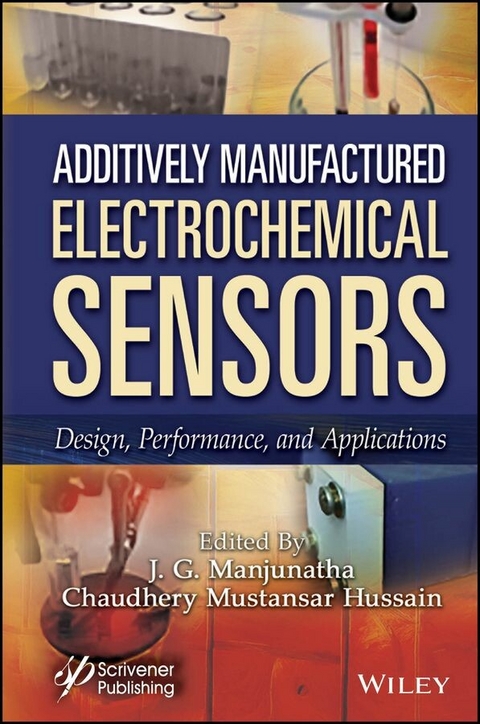
Additively Manufactured Electrochemical Sensors (eBook)
450 Seiten
Wiley-Scrivener (Verlag)
978-1-394-30338-0 (ISBN)
This book is an essential guide to mastering 3D printed electrochemical sensors, offering a comprehensive roadmap from foundational principles and fabrication techniques to cutting-edge applications and real-world solutions.
The rapid advancement of additive manufacturing technologies, commonly known as 3D printing, has revolutionized various fields of science and engineering. Among these, the development of electrochemical sensors has particularly benefited from additive manufacturing's unique capabilities. This book provides an exhaustive exploration of 3D printed electrochemical sensors, from foundational principles to cutting-edge applications. By meticulously detailing design considerations, fabrication techniques, and performance evaluation metrics, it offers readers a roadmap to navigate the complexities of this interdisciplinary domain. Furthermore, with its emphasis on real-world applications and case studies, the book ensures that the knowledge imparted is not just theoretical but has practical relevance. This comprehensive guide empowers readers to harness the potential of 3D printing in the realm of electrochemical sensing, driving innovations and solutions for real-world challenges.
Readers will find the book:
- Provides an in-depth exploration of the design principles and fabrication techniques specific to 3D printed electrochemical sensors;
- Features knowledge to innovate and develop customized sensors tailored to specific applications, ensuring improved sensitivity, selectivity, and longevity of the sensors;
- Offers insights into calibration, sensitivity assessment, durability considerations, and validation protocols, highlights challenges in performance assessment, and suggests strategies to overcome them;
- Explores practical applications of 3D printed electrochemical sensors across sectors like medical diagnostics, environmental monitoring, and food quality control.
Audience
Researchers, academics, and professionals in the fields of additive manufacturing, electrochemistry, and sensor design.
J. G. Manjunatha, PhD, is an Assistant Professor of Chemistry at Field Marshal K.M. Cariappa College. He has published 13 books and special journal issues, and over 160 research articles in reputed international journals. His research interests include electrochemistry, supercapacitors, and biosensors.
Chaudhery Mustansar Hussain, PhD, is an adjunct professor and Director of Laboratories in the Department of Chemistry and Environmental Sciences at the New Jersey Institute of Technology. He is the author of numerous papers in peer-reviewed journals, as well as the author and editor of over 150 books. His research is focused on the applications of nanotechnology and advanced materials, environmental management, and analytical chemistry.
This book is an essential guide to mastering 3D printed electrochemical sensors, offering a comprehensive roadmap from foundational principles and fabrication techniques to cutting-edge applications and real-world solutions. The rapid advancement of additive manufacturing technologies, commonly known as 3D printing, has revolutionized various fields of science and engineering. Among these, the development of electrochemical sensors has particularly benefited from additive manufacturing s unique capabilities. This book provides an exhaustive exploration of 3D printed electrochemical sensors, from foundational principles to cutting-edge applications. By meticulously detailing design considerations, fabrication techniques, and performance evaluation metrics, it offers readers a roadmap to navigate the complexities of this interdisciplinary domain. Furthermore, with its emphasis on real-world applications and case studies, the book ensures that the knowledge imparted is not just theoretical but has practical relevance. This comprehensive guide empowers readers to harness the potential of 3D printing in the realm of electrochemical sensing, driving innovations and solutions for real-world challenges. Readers will find the book: Provides an in-depth exploration of the design principles and fabrication techniques specific to 3D printed electrochemical sensors; Features knowledge to innovate and develop customized sensors tailored to specific applications, ensuring improved sensitivity, selectivity, and longevity of the sensors; Offers insights into calibration, sensitivity assessment, durability considerations, and validation protocols, highlights challenges in performance assessment, and suggests strategies to overcome them; Explores practical applications of 3D printed electrochemical sensors across sectors like medical diagnostics, environmental monitoring, and food quality control. Audience Researchers, academics, and professionals in the fields of additive manufacturing, electrochemistry, and sensor design.
| Erscheint lt. Verlag | 19.8.2025 |
|---|---|
| Sprache | englisch |
| Themenwelt | Naturwissenschaften ► Chemie |
| Technik ► Maschinenbau | |
| Schlagworte | 3D Printed Sensors • Additive Manufacturing • Additive Sensor Technology • Advanced Manufacturing Techniques • biosensors • Customized Sensors • Electrochemical Sensors • Environmental monitoring • food safety sensors • healthcare diagnostics • Nanotechnology Sensors • Performance Optimization Sensors • precision diagnostics • sensor applications • sensor design |
| ISBN-10 | 1-394-30338-6 / 1394303386 |
| ISBN-13 | 978-1-394-30338-0 / 9781394303380 |
| Informationen gemäß Produktsicherheitsverordnung (GPSR) | |
| Haben Sie eine Frage zum Produkt? |
 PDF (Adobe DRM)
Kopierschutz: Adobe-DRM
Adobe-DRM ist ein Kopierschutz, der das eBook vor Mißbrauch schützen soll. Dabei wird das eBook bereits beim Download auf Ihre persönliche Adobe-ID autorisiert. Lesen können Sie das eBook dann nur auf den Geräten, welche ebenfalls auf Ihre Adobe-ID registriert sind.
Details zum Adobe-DRM
Dateiformat: PDF (Portable Document Format)
Mit einem festen Seitenlayout eignet sich die PDF besonders für Fachbücher mit Spalten, Tabellen und Abbildungen. Eine PDF kann auf fast allen Geräten angezeigt werden, ist aber für kleine Displays (Smartphone, eReader) nur eingeschränkt geeignet.
Systemvoraussetzungen:
PC/Mac: Mit einem PC oder Mac können Sie dieses eBook lesen. Sie benötigen eine
eReader: Dieses eBook kann mit (fast) allen eBook-Readern gelesen werden. Mit dem amazon-Kindle ist es aber nicht kompatibel.
Smartphone/Tablet: Egal ob Apple oder Android, dieses eBook können Sie lesen. Sie benötigen eine
Geräteliste und zusätzliche Hinweise
Buying eBooks from abroad
For tax law reasons we can sell eBooks just within Germany and Switzerland. Regrettably we cannot fulfill eBook-orders from other countries.
aus dem Bereich