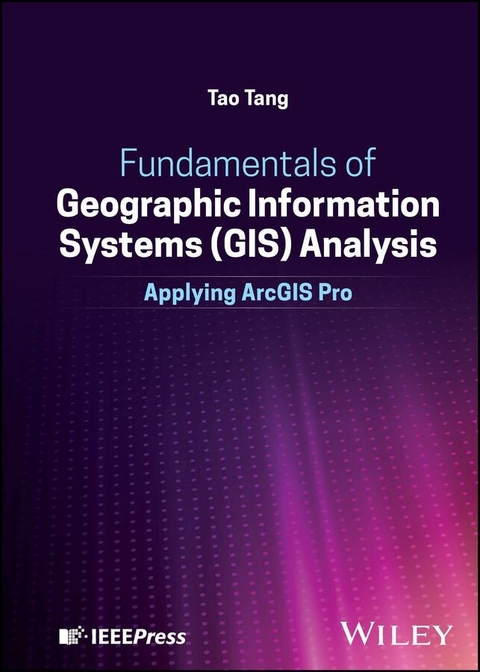
Fundamentals of Geographic Information Systems (GIS) Analysis (eBook)
563 Seiten
Wiley-IEEE Press (Verlag)
978-1-394-25218-3 (ISBN)
Unique and authoritative reference combining concepts, theories, and hands-on analysis in the ArcGIS Pro software environment
Fundamentals of Geographic Information Systems (GIS) Analysis bridges the gap between academic discussions and research with public and private professional practices in the field. The book discusses and illustrates essential concepts and theories, with tutorials showing students how to conduct hands-on analysis in the ArcGIS Pro software environment.
Supplementary material for this text includes data files for the tutorials and student exercises. All datasets are sourced from public domains, including the US Census Bureau data, the New York State ITS Geospatial Services, the New York State Department of Environmental Conservation (NYSDEC), the GIS Services of Erie County New York, and others.
Written by a highly qualified academic, the book covers topics such as:
- Digital data models representing geographic information, including vector, raster, and 3D models
- Methods of spatial data input in vector and raster data formats to incorporate geographic features and events with their attribute data
- Geographic data collections in natural sciences, engineering, and social sciences, and relational, spatial, and structural querying of a database
- Coordinate systems, map projection, geo-referencing, geographic analyses, and internet-enabled geographic information sharing
- Spatial interpolation and spatial statistical analysis, network analysis, digital mapping, and map presentations
Fundamentals of Geographic Information Systems (GIS) Analysis is an essential reference for GIS analysts and technicians, urban planners, civil engineers, and computer scientists, along with students in related programs of study.
Tao Tang is a Professor of Geographic Information Systems (GIS) and Remote Sensing in the Department of Geosciences at Buffalo State University and The State University of New York (SUNY). Along with GIS and remote sensing, he also teaches map interpretation, physical geography, and the geography of Asia. Some of his research interests include slope form and processes, environmental modeling, and watershed management.
Unique and authoritative reference combining concepts, theories, and hands-on analysis in the ArcGIS Pro software environment Fundamentals of Geographic Information Systems (GIS) Analysis bridges the gap between academic discussions and research with public and private professional practices in the field. The book discusses and illustrates essential concepts and theories, with tutorials showing students how to conduct hands-on analysis in the ArcGIS Pro software environment. Supplementary material for this text includes data files for the tutorials and student exercises. All datasets are sourced from public domains, including the US Census Bureau data, the New York State ITS Geospatial Services, the New York State Department of Environmental Conservation (NYSDEC), the GIS Services of Erie County New York, and others. Written by a highly qualified academic, the book covers topics such as: Digital data models representing geographic information, including vector, raster, and 3D modelsMethods of spatial data input in vector and raster data formats to incorporate geographic features and events with their attribute dataGeographic data collections in natural sciences, engineering, and social sciences, and relational, spatial, and structural querying of a databaseCoordinate systems, map projection, geo-referencing, geographic analyses, and internet-enabled geographic information sharingSpatial interpolation and spatial statistical analysis, network analysis, digital mapping, and map presentations Fundamentals of Geographic Information Systems (GIS) Analysis is an essential reference for GIS analysts and technicians, urban planners, civil engineers, and computer scientists, along with students in related programs of study.
| Erscheint lt. Verlag | 14.8.2025 |
|---|---|
| Sprache | englisch |
| Themenwelt | Naturwissenschaften ► Geowissenschaften ► Geologie |
| Technik | |
| Schlagworte | 3D Analysis • 3d models • Coordinate Systems • Digital Mapping • geographic analyses • Geographic data collections • geo-referencing • Map Projection • network analysis • raster models • spatial data input • Spatial interpolation spatial statistical analysis • vector models |
| ISBN-10 | 1-394-25218-8 / 1394252188 |
| ISBN-13 | 978-1-394-25218-3 / 9781394252183 |
| Informationen gemäß Produktsicherheitsverordnung (GPSR) | |
| Haben Sie eine Frage zum Produkt? |
 PDF (Adobe DRM)
Kopierschutz: Adobe-DRM
Adobe-DRM ist ein Kopierschutz, der das eBook vor Mißbrauch schützen soll. Dabei wird das eBook bereits beim Download auf Ihre persönliche Adobe-ID autorisiert. Lesen können Sie das eBook dann nur auf den Geräten, welche ebenfalls auf Ihre Adobe-ID registriert sind.
Details zum Adobe-DRM
Dateiformat: PDF (Portable Document Format)
Mit einem festen Seitenlayout eignet sich die PDF besonders für Fachbücher mit Spalten, Tabellen und Abbildungen. Eine PDF kann auf fast allen Geräten angezeigt werden, ist aber für kleine Displays (Smartphone, eReader) nur eingeschränkt geeignet.
Systemvoraussetzungen:
PC/Mac: Mit einem PC oder Mac können Sie dieses eBook lesen. Sie benötigen eine
eReader: Dieses eBook kann mit (fast) allen eBook-Readern gelesen werden. Mit dem amazon-Kindle ist es aber nicht kompatibel.
Smartphone/Tablet: Egal ob Apple oder Android, dieses eBook können Sie lesen. Sie benötigen eine
Geräteliste und zusätzliche Hinweise
Buying eBooks from abroad
For tax law reasons we can sell eBooks just within Germany and Switzerland. Regrettably we cannot fulfill eBook-orders from other countries.
aus dem Bereich