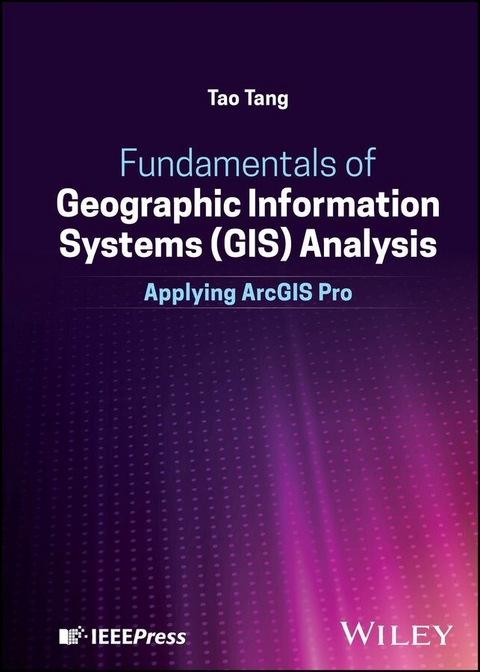
Fundamentals of Geographic Information Systems (GIS) Analysis (eBook)
1032 Seiten
Wiley-IEEE Press (Verlag)
978-1-394-25217-6 (ISBN)
Unique and authoritative reference combining concepts, theories, and hands-on analysis in the ArcGIS Pro software environment
Fundamentals of Geographic Information Systems (GIS) Analysis bridges the gap between academic discussions and research with public and private professional practices in the field. The book discusses and illustrates essential concepts and theories, with tutorials showing students how to conduct hands-on analysis in the ArcGIS Pro software environment.
Supplementary material for this text includes data files for the tutorials and student exercises. All datasets are sourced from public domains, including the US Census Bureau data, the New York State ITS Geospatial Services, the New York State Department of Environmental Conservation (NYSDEC), the GIS Services of Erie County New York, and others.
Written by a highly qualified academic, the book covers topics such as:
- Digital data models representing geographic information, including vector, raster, and 3D models
- Methods of spatial data input in vector and raster data formats to incorporate geographic features and events with their attribute data
- Geographic data collections in natural sciences, engineering, and social sciences, and relational, spatial, and structural querying of a database
- Coordinate systems, map projection, geo-referencing, geographic analyses, and internet-enabled geographic information sharing
- Spatial interpolation and spatial statistical analysis, network analysis, digital mapping, and map presentations
Fundamentals of Geographic Information Systems (GIS) Analysis is an essential reference for GIS analysts and technicians, urban planners, civil engineers, and computer scientists, along with students in related programs of study.
Tao Tang is a Professor of Geographic Information Systems (GIS) and Remote Sensing in the Department of Geosciences at Buffalo State University and The State University of New York (SUNY). Along with GIS and remote sensing, he also teaches map interpretation, physical geography, and the geography of Asia. Some of his research interests include slope form and processes, environmental modeling, and watershed management.
Chapter 1
Introduction to Analyses in Geographic Information Systems (GIS)
Concepts and Theories
Why do geographic information systems (GIS) matter? As its name suggests, GIS contains the concepts and theories of Geography and Locational Science. The historical development of geography and geographical ideas can be traced back to the early stages of human civilizations. Locational or geospatial science is and has been essential for almost all human activities because it is the foundation of both science and social science studies that involve locations on the Earth’s surface. In other words, GIS is the science of studying where objects or phenomena on the Earth’s surface are and attempts to answer the essential question “Why are these objects there?” The issue of geographic location is so important, it is embedded in many problems that our society needs to solve, and in many objectives or goals that our society needs to achieve. Here we can present some examples of GIS analyses:
- Local governments need to manage geographic locations and the ownership of parcels of the land by its residents for various services and property taxation (Figure 1.1). GIS road and street spatial databases help the local or state government maintain and develop infrastructure in the region the government manages. National and state-level governments always need to match people with their locations for the issues of information management and services from time to time.
Figure 1.1 Digital map of parcel polygons for land ownerships and streets that are connected to attribute database in Buffalo, NY.
- Private companies involving deliveries of goods and services, such as Federal Express (FedEx) or United Parcel Services (UPS), need to use GIS to analyze the locations of their customers in order to plan their transportation routes to reach their clients effectively and efficiently (Figure 1.2).
Figure 1.2 Example of delivery route map and route planning in GIS, New York State.
- Civil engineering and construction companies need to utilize GIS to study the natural and human factors at site locations that impact their project. GIS are applied by these companies to study the impacts of construction on the surrounding environment as well.
- Utility supply and transportation companies, such as the National Grid electricity supplier or the Chicago Transportation Authority (CTA), utilize GIS to manage their utility network or transportation network daily in order to provide geographically distributed services to their customers (Figure 1.3).
Figure 1.3 Example of online subway train tracking digital map at CTA website powered by GIS.
Source: Chicago Transit Authority/https://www.transitchicago.com/maps//last accessed on November 20, 2024.
- Retail stores and banks, such as grocery stores or fast-food chains, can utilize GIS to locate their customers and access their store needs relating to customer locations (Figure 1.4).
Figure 1.4 Geocoded business locations with varieties of services in the City of Buffalo, NY.
Source: Dr. Tao Tang.
- Emergency response organizations either public or private in nature, such as firefighters, police, and the US Federal Emergency Management Agency (FEMA), can utilize GIS to access, manage, and mitigate the effects of natural disasters and societal emergencies by their locations and areas.
- Health care systems and health management organizations, such as the Center for Disease Controls (CDC) can use GIS to visualize and analyze the distribution of infectious diseases, such as COVID-19. GIS can also help health providers study the regional distributions of diseases and answer questions about environmental causes of diseases.
- Human living environments are by nature locationally registered or geographically distributed. Therefore, GIS provides an effective utility platform that can be used in a wide range of environmental science and environmental studies, from air pollution to water pollution to other types of environmental management issues.
As Longley et al. (2015) indicated, almost everything that happens, happens somewhere. Knowing where something happens can be critically important. In essence, all the activities or events that occur in either the natural environment or in human-made society can be located in a three-dimensional (3D) geographic space without considering the time issue. If the time scale and time range are considered, we can identify a four-dimensional geographic cube to locate all the various events and activities. The significance of GIS is that we can utilize modern computing power and information system technology to explore the answers to questions such as: where are events happening or where will they happen? How big is the geographic area? Why does it happen there? In addition, GIS can facilitate the simulation of events in a four-dimensional geographic or spatial-temporal cube to answer the question of what will happen under a particular set of conditions.
What Is an Information System?
An information system is an integrated set of components for collecting, storing, and processing data to provide information, knowledge, and digital products. The purpose of processing data and building an information system is to facilitate decision-making for various objectives. Information systems in the modern era are rooted in computer science or the study of computation, automation, and information (The University of York 2020). The study of computer science includes the theoretical and algorithmic foundations of hardware and software, and computer hardware or software used for processing information.
What Does Geography Study?
According to a philosopher in the 1800s, Kant (1755) (Elden 2009), there are three different categories of understanding: (i) the understanding of objects or phenomena, such as in the studies of physics; (ii) the understanding of characteristics of objects through time, such as in the studies of archeology; and (iii) the understanding of the distributions of objects across the space, such as in the studies of geography. Therefore, geography is the study of spatial distributions and patterns of objects that are related to the human living environment on the Earth’s surface (Figure 1.5).
Figure 1.5 Spatial distribution of earthquakes worldwide.
Source: Blue8111/Wikimedia Commons/CC BY SA 4.0.
What Is a GIS?
GIS are special categories or special cases of information systems that combine digital map layers with database to capture (Figure 1.6a), analyze (Figure 1.6b), and model (Figure 1.6c) spatial or geographic features, objects, or Earth’s surface processes (events).
Figure 1.6 (a) Capturing GIS data in the field using LiDAR and drone equipment.
Source: Dr. Tao Tang.
(b) Analyzing and mapping air pollution applying GIS. (c) Modeling water main pipelines for household water supplies applying GIS in the Towns of Amherst and Clarence, NY.
In practice, geographic information analysts need to capture spatial objects and their characteristics first. Hundreds of unique methods have been developed in various disciplines of science or social science to obtain location-stamped data or spatial data on the Earth’s surface. Meanwhile, geographic information analysts cannot practice all these different scientific or social science data collection methods simply because of too many of them. Therefore, utilizing the datasets collected by other scientists or social scientists for geographic information analysis is a common practice in the discipline especially with the exploration of data captures and dataset publications on the internet. Several traditional surveying and remote sensing technologies have been widely used by geographic information analysts to capture GIS data. Some of these are satellite remote sensing, aerial or drone remote sensing, photogrammetrically enabled survey, and Global Positioning System (GPS) survey.
Analysis of the spatial data involves many different levels of data processing, from overlaying map layers to geocoding tabular data, to mathematical or statistical interpolations of grid cell surfaces, to conducting geographical regressions to test the relations of two or more spatial variables in a region. Modeling geographic objects, features, or Earth’s surface events is considered more advanced data processing than that of analysis. The goal of modeling is mainly to answer the question “What if?.” For instance, if we can simulate a certain amount of rainfall in a short period of time, what kind of flooding would result? How many human-made buildings, houses, and infrastructures would be destroyed? The significance of modeling and simulating in GIS is to provide possible measures to avoid such kinds of events happening in the real world in the first place. If such disastrous events do happen, GIS-based modeling and simulation will help to mitigate the losses.
What does computational science or information technology have to do with geography? Equally speaking, why is geography a discipline that needs to use computational science or information technology intensively and extensively?
The answer is very fundamental and straightforward. The nature of geography is to study the relations of human and their living environment, the Earth’s surface. Taking a specific issue that...
| Erscheint lt. Verlag | 15.8.2025 |
|---|---|
| Sprache | englisch |
| Themenwelt | Naturwissenschaften ► Geowissenschaften |
| Technik | |
| Schlagworte | 3D Analysis • 3d models • Coordinate Systems • Digital Mapping • geographic analyses • Geographic data collections • geo-referencing • Map Projection • network analysis • raster models • spatial data input • Spatial interpolation spatial statistical analysis • vector models |
| ISBN-10 | 1-394-25217-X / 139425217X |
| ISBN-13 | 978-1-394-25217-6 / 9781394252176 |
| Informationen gemäß Produktsicherheitsverordnung (GPSR) | |
| Haben Sie eine Frage zum Produkt? |
 EPUB (Adobe DRM)
Kopierschutz: Adobe-DRM
Adobe-DRM ist ein Kopierschutz, der das eBook vor Mißbrauch schützen soll. Dabei wird das eBook bereits beim Download auf Ihre persönliche Adobe-ID autorisiert. Lesen können Sie das eBook dann nur auf den Geräten, welche ebenfalls auf Ihre Adobe-ID registriert sind.
Details zum Adobe-DRM
Dateiformat: EPUB (Electronic Publication)
EPUB ist ein offener Standard für eBooks und eignet sich besonders zur Darstellung von Belletristik und Sachbüchern. Der Fließtext wird dynamisch an die Display- und Schriftgröße angepasst. Auch für mobile Lesegeräte ist EPUB daher gut geeignet.
Systemvoraussetzungen:
PC/Mac: Mit einem PC oder Mac können Sie dieses eBook lesen. Sie benötigen eine
eReader: Dieses eBook kann mit (fast) allen eBook-Readern gelesen werden. Mit dem amazon-Kindle ist es aber nicht kompatibel.
Smartphone/Tablet: Egal ob Apple oder Android, dieses eBook können Sie lesen. Sie benötigen eine
Geräteliste und zusätzliche Hinweise
Buying eBooks from abroad
For tax law reasons we can sell eBooks just within Germany and Switzerland. Regrettably we cannot fulfill eBook-orders from other countries.
aus dem Bereich