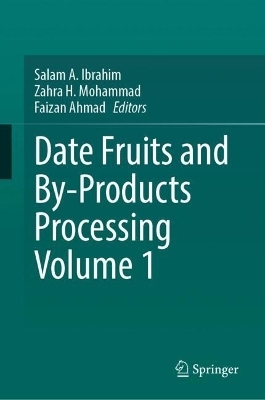
Date Fruits and By-Products Processing Volume 1
Springer International Publishing (Verlag)
978-3-032-05283-4 (ISBN)
The use of dates in non-traditional food products and their by-products for nutritional supplements has been practiced for centuries in many regions across the globe. Unlike many traditional foods, there has been an influx of new technology and processes in the applications of date fruits, many of which have received sparse coverage in the literature. Date Fruits and By-Products Processing covers off of the latest advances in date-fruits and their byproducts and also opens the door for future research in this field, including the use of non-thermal processing and shelf life extension. This research is especially important due to increasing volumes in date production and increasing consumer and industry awareness of the health benefits of date fruits.
In Date Fruits and By-Products Processing Volume 1 researchers will find extensive coverage of the nutritional and chemical composition of dates, non-conventional and innovative date processing technology, including all the latest advances that are revolutionizing these age-old processes, value-added date fruit products, and non-traditional processing and applications. The colorful and interesting worldwide history of dates is outlined, including consumption trends and the evolution of health benefit awareness. Innovative new technologies, including non-thermal and high-pressure processing, pulsed electric field, ultraviolet, X-ray, and cold plasma processing, are examined. All of the major value-added products produced from dates are covered, including ice cream, nutrition bars, functional foods, dietary supplements, and dairy and bakery products. Of major value to researchers are chapters on sugar and polysaccharides extraction, phenolic compounds, and the conversion of dates into fermentation medium.
With the long history of date fruit use in traditional foods, plus recent advances in processing technology and health benefits awareness, date fruits are long overdue for extensive research work. With this book, researchers have everything they need to fully understand the history and future of date fruit products and their processing.
Dr. Salam A. Ibrahim is a Professor of Food Science in the Food and Nutritional Science Program at North Carolina Agricultural and Technical State University, U.S.A. He has established a research program around dairy technology, yogurt starter cultures, probiotics, bioconversion processes, food safety, and the use of natural compounds to inhibit the growth of foodborne illnesses. His program is well-funded by the National Institute of Food and Agriculture-United States Department of Agriculture (NIFA-USDA), the Department of Homeland Security (D.H.S.), and other funding agencies. In addition, the food microbiology laboratory has strong connections with the food industry and often receives funds to support students around fermentation and the production of stable and functional probiotics products. Dr. Ibrahim is specifically interested in Lactobacillus bulgaricus, recognized in the early 1900s as a health-promoting starter culture in yogurt. Currently, Dr. Ibrahim is working on novel methods to produce stable and functional lactic acid cultures for the dairy industry.
Dr. Zahra H. Mohammad, Ph.D., is currently working at Advanced Health and Education Services Organization as C.E.O./president of the organization, managing various training and research programs. She previously worked as a Food Microbiology and Extension Specialist at the University of Houston for many years. She has completed a BSc degree in Chemical Engineering. She was awarded a master s and Ph.D. in Food Science and Technology /Food Microbiology from Texas A&M University. Her research interests focus on detecting pathogens in food, water, and food-related environments, as well as on how to counteract, prevent, and control their potential threats. She took a leading role in a wide variety of research projects addressing food safety, the environment, and the quality and shelf life of foods using conventional and modern intervention technologies, including thermal, non-thermal, molecular, and nanotechnology approaches. She has more than 10 years of teaching, extension, and industry experience and has published more than 30 publications in peer-reviewed journals.
Dr. Faizan Ahmad, MTech, Ph.D., is a Senior Assistant Professor at the Department of Post-Harvest Engineering and Technology, Faculty of Agricultural Sciences, Aligarh Muslim University
Part 1 Nutritional and Chemical Composition of Dates.- Chapter 1. Global History of Dates.- Chapter 2. Chemical and Nutritional Composition of Dates.- Chapter 3. Health and Functional Benefits of Dates.- Part II. Non-Conventional and Innovative Date Processing Technology. Chapter 4. High Pressure Processing of Dates.- Chapter 5. Date Processing by Pulse Electric Field.- Chapter 6. Ultraviolet Processing of Date.- Chapter 7. Date Processing Using X-ray Technology.- Chapte
| Erscheinungsdatum | 25.11.2025 |
|---|---|
| Zusatzinfo | XV, 323 p. 50 illus., 34 illus. in color. |
| Verlagsort | Cham |
| Sprache | englisch |
| Maße | 155 x 235 mm |
| Themenwelt | Technik ► Lebensmitteltechnologie |
| Schlagworte | Date fruit • Date fruit health benefits • Date fruit utilization • Functional ingredients • post-harvest technology |
| ISBN-10 | 3-032-05283-1 / 3032052831 |
| ISBN-13 | 978-3-032-05283-4 / 9783032052834 |
| Zustand | Neuware |
| Informationen gemäß Produktsicherheitsverordnung (GPSR) | |
| Haben Sie eine Frage zum Produkt? |
aus dem Bereich