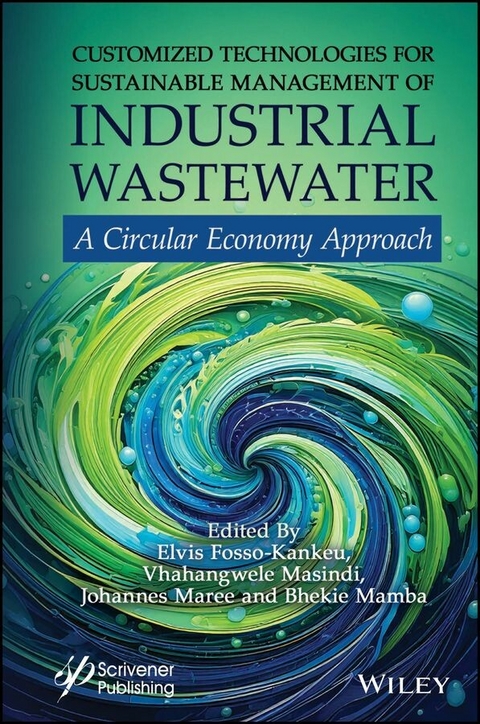
Customized Technologies for Sustainable Management of Industrial Wastewater (eBook)
857 Seiten
Wiley-Scrivener (Verlag)
978-1-394-21454-9 (ISBN)
The book is essential for understanding innovative solutions to the critical challenges posed by increasing wastewater pollution and the urgent need for sustainable practices in light of climate change and resource scarcity.
Increased population growth and climate change put continuous pressure on freshwater resources across the globe. The volume and diversity of pollutants in wastewater discharged from industry have significantly increased over the years, making conventional wastewater treatment systems unfit for managing industrial wastewater released into the environment. The limitations of existing treatments appear not only in the suitability of the technologies to abate emerging pollutants, but also in the approach used to mitigate the situation and ensure sustainability of the process. For wastewater treatment, the circular economy, which is based on the principles reduce, reuse, recycle, restore, and recover, will ensure that waste is minimized and the life-cycle value of natural resources and products is maximized. Considerable progress has been made in developing new technologies that can adequately address the issue. However, with larger volumes of wastewater to treat every day, the cost of treatment is overwhelming, necessitating the right combination of technologies that will promote the reuse of pollutants recovered during the treatment process to offset the treatment cost. Customized Technologies for Sustainable Management of Industrial Wastewater: A Circular Economy Approach presents fifteen comprehensive chapters that cover the sustainability of industrial wastewater treatment technologies with consideration to the circular economy.
Readers will find the volume:
- Emphasizes the mechanisms and strategic combination of technologies that maximize the recovery of valuables during industrial wastewater treatment and deliver effluents treated to the acceptable standard;
- Discusses the characteristics, purity, and potential uses and applications of the recovered products;
- Focuses on the strategic development of technologies for the sustainable treatment of industrial wastewater at large.
Audience
Researchers, mining and industrial professionals, environmental managers, and policymakers involved in environmental, chemical, engineering, and mineral processing fields in the industries; water treatment plants managers and operators, water authorities, government regulatory bodies officers, and environmentalists.
Elvis Fosso-Kankeu, PhD is a professor in the Department of Mining Engineering at the University of South Africa. He has over 220 publications, including journal articles, books, book chapters, and conference proceeding papers. His research focuses on the hydrometallurgical extraction of metal from solid phases, the prediction of pollutant dispersion from industrial areas, and the development of effective and sustainable methods for the removal of organic and inorganic pollutants from polluted water.
Vhahangwele Masindi, PhD is the Research and Development Manager at Magalies Water, a research associate at the University of South Africa, and a visiting research scientist at the Council for Scientific and Industrial Research. He has over 117 publications, including journal articles, books, book chapters, patents, and conference proceeding papers. His research focuses on environmental quality modeling, water resource management, water and wastewater treatment, sustainability, circular economy in water treatment, and waste beneficiation and valorization.
Johannes Maree, PhD is the founder of ROC Water Technologies, a company focused on processing mining waste to recover drinking water and other products. His current projects include a Water Research Center project where the ROC process needs to be demonstrated to treat iron-rich acid mine water, a THRIP focusing on the thermal processing of sodium sulphate, and brine treatment with freeze crystallization for the selective recovery of ice, sodium sulphate, and sodium chloride.
Bhekie Mamba is the executive dean of the College of Science, Engineering and Technology at the University of South Africa. He has published seven book chapters, over 250 journal papers, 12 technical reports, and over 50 conference proceedings. His research interests include nanotechnology, polymer chemistry, and water treatment technologies.
The book is essential for understanding innovative solutions to the critical challenges posed by increasing wastewater pollution and the urgent need for sustainable practices in light of climate change and resource scarcity. Increased population growth and climate change put continuous pressure on freshwater resources across the globe. The volume and diversity of pollutants in wastewater discharged from industry have significantly increased over the years, making conventional wastewater treatment systems unfit for managing industrial wastewater released into the environment. The limitations of existing treatments appear not only in the suitability of the technologies to abate emerging pollutants, but also in the approach used to mitigate the situation and ensure sustainability of the process. For wastewater treatment, the circular economy, which is based on the principles reduce, reuse, recycle, restore, and recover, will ensure that waste is minimized and the life-cycle value of natural resources and products is maximized. Considerable progress has been made in developing new technologies that can adequately address the issue. However, with larger volumes of wastewater to treat every day, the cost of treatment is overwhelming, necessitating the right combination of technologies that will promote the reuse of pollutants recovered during the treatment process to offset the treatment cost. Customized Technologies for Sustainable Management of Industrial Wastewater: A Circular Economy Approach presents fifteen comprehensive chapters that cover the sustainability of industrial wastewater treatment technologies with consideration to the circular economy. Readers will find the volume: Emphasizes the mechanisms and strategic combination of technologies that maximize the recovery of valuables during industrial wastewater treatment and deliver effluents treated to the acceptable standard; Discusses the characteristics, purity, and potential uses and applications of the recovered products; Focuses on the strategic development of technologies for the sustainable treatment of industrial wastewater at large. Audience Researchers, mining and industrial professionals, environmental managers, and policymakers involved in environmental, chemical, engineering, and mineral processing fields in the industries; water treatment plants managers and operators, water authorities, government regulatory bodies officers, and environmentalists.
1
A Review of the Reducing and Alkalinity-Producing System (RAPS) for Acid Mine Drainage Neutralization
Mafeto Malatji1,2*, Elvis Fosso-Kankeu3 and Bhekie B. Mamba4
1Department of Mining Engineering, School of Engineering at the College of Science, Engineering and Technology, University of South Africa, Pretoria, South Africa
2Water and Environment Unit, Council for Geoscience, Silverton, Pretoria, South Africa
3Department of Metallurgy, Faculty of Engineering and Built Environment, University of Johannesburg, Doornfontein, Johannesburg, South Africa
4Institute for Nanotechnology and Water Sustainability (iNanoWS), College of Science Engineering and Technology (CSET), Florida Science Campus, University of South Africa, Pretoria, South Africa
Abstract
A review of the reducing and alkalinity-producing system (RAPS) for treating acid mine drainage (AMD) is presented in this paper. AMD is formed because of the oxidation of sulfide-bearing minerals in the presence of water to form an acidic solution. Characteristics of the resultant solution include a low pH (<4.5), high salinity, as well as sulfates, metals, and metalloids in elevated concentrations. AMD can create long-term environmental damage and changes that can be difficult to manage, and it is imperative that it is treated. Treatment options include active or passive treatment systems, and passive systems are cost-effective; hence, they are preferred over active systems. The RAPS that is an example of passive treatment system combines the concepts of the anaerobic wetland and anoxic limestone drain systems to treat net acidic mine water through combined biogeochemical and physical processes such as bacterial sulfate reduction and limestone dissolution. Bacterial sulfate reduction is responsible for reducing conditions in the system, and this induces metal precipitates as metal sulfides, whereas the limestone dissolution is responsible for the addition of alkalinity in the system, therefore raising the pH of the system. Various authors have reported the effectiveness of RAPS in treating AMD using varying approaches but maintaining the basic principles of RAPS. RAPS is advantageous in treating AMD as they encourage downward vertical flow, therefore significantly raising the interaction of water with treatment material. Other added advantages include higher available head pressures and larger cross-sectional area, and these enable them to resist Al plugging. Moreover, the reducing conditions enable the conversion of ferric ions to ferrous ions. The disadvantage of this system is that they have a limited lifespan, which is difficult to determine because of a variety of limiting factors. Moreover, RAPS is generally limited to treating AMD with low flow rates and low acidity loads. The versatility and adaptability of the RAPS present opportunities for innovation; this is because of site-specific conditions such as topography, AMD chemistry, and flow rate, which vary from region to region. The design, scale, and applicability of the RAPS can be adapted to accommodate such conditions, therefore presenting opportunities for innovation during implementation. In South Africa, there is limited information or application of the RAPS on a large scale because most of the research was conducted in a laboratory or bench scale. The successes achieved in the implementation of such systems in other parts of the world make it compelling for the piloting and upscaling of such systems in South Africa. The implementation of such systems would be advantageous to the country due to their cost-effectiveness and self-sustaining abilities. To simulate conditions or parameters that are, otherwise, difficult to achieve with field monitoring or lab experiments, geochemical modeling is used. This tool can be used to evalute geochemical processes and predict the evolution of geochemical systems over time.
Keywords: Reducing and alkalinity-producing system (RAPS), acid mine drainage (AMD), bacterial sulfate reduction, limestone dissolution, geochemical modeling
1.1 Background
The mining of coal is generally environmentally sensitive as it usually involves the removal of overburden materials and the generation of coal discard dumps that are susceptible to spontaneous combustion and are responsible for the generation and release of acid mine drainage (AMD) [1–4]. Naturally, the generation of AMD is readily neutralized by buffering rocks such as clays and carbonates [5]. However, extensive coal mining activities overwhelms the buffering capacity of such rocks, and this accelerates the production and release of AMD [4, 6].
In South Africa, AMD contamination has been reported in active and abandoned mines of the Witwatersrand Gold Fields, Mpumalanga, and KwaZulu-Natal Coal Fields along with the O’Kiep Copper District [7]. One such contamination event occurred in the town of Carolina, Mpumalanga Province; according to [8], one fateful day in 2012, the residents of Carolina experienced drinking water with an unfamiliar taste and color flowing from taps. An investigation into the incident confirmed that the water had become contaminated with sulfates and metals and the pH had dropped to 3.7, thus rendering the water unfit for human consumption [9–11]. According to the authors in [12] and [80], the investigations into the contamination incident revealed that the water quality of the Boesmanspruit Dam (Carolina’s main water supply) had deteriorated, which was not equipped to treat acidic water. Further investigations revealed that the contamination was due to excessive acid mine water from surface and subsurface workings from active and abandoned mines discharging into the Boesmanspruit catchment. The cause of the contamination was flooding due to a freak storm that had occurred the previous night. This resulted in polluted water that had accumulated for decades in a nearby wetland (Boesmanspruit wetland) being released into the Boesmanspruit dam, therefore contaminating it. Water supply to the town was interrupted for 7 months, which led to civil unrest and a court case against the local authorities, as they were struggling to restore the water supply [10–12].
This review aims to document the reducing and alkalinity-producing passive treatment system by exploring its principles, processes, performance, and applicability for the remediation of polluted mine water in South Africa. The ultimate objective is to contribute toward sustainable mine water management solutions in South Africa.
1.1.1 AMD Generation
AMD is formed because of the oxidation of sulfide-bearing minerals in the presence of water to produce an acidic solution. The characteristics of the resultant solution include a low pH (<4.5), high salinity, as well as sulfates, metals, and metalloids in elevated concentrations [1, 3, 4, 13, 14]. To form AMD, a common sulfate mineral such as pyrite undergoes a process known as pyrite oxidation, Thiobacilus bacteria acts as a catalyst to this process. Equations 1.1 to 1.3 illustrate how pyrite oxidation unfolds [15–18].
- Firstly, an acidic solution of ferrous iron and sulfate is formed by pyrite oxidation. (1.1)
- Then, the oxidation of ferrous iron to ferric iron follows. (1.2)
- Ultimately, the formation of ferric hydroxide and acid. (1.3)
Once started, the reactions are difficult to stop because earlier reactions give rise to later reactions, therefore resulting in a series of reactions. Typically, ferric hydroxide [Fe(OH)3] gives rise to an orange color in affected water, which is referred to as “yellow-boy,” therefore resulting in reduced dissolved oxygen (DO) in the affected water [1, 19].
1.1.2 Effects of AMD on the Environment
AMD can create long-term environmental damage and changes that can be difficult to manage and that can be inherited from one generation to another [19, 20]. Aquatic organisms in receiving environments can become asphyxiated because of the lack of oxygen; this is due to the precipitation of ferric hydroxide, which results in reduced dissolved oxygen in such environments [1, 19]. Furthermore, elevated concentrations of metals become bioavailable and can bioaccumulate in organisms in affected environments. Moreover, AMD leads to the pollution of surface and groundwater, poor soil quality, poor health of aquatic flora and fauna, and the distribution of potentially toxic metals and metalloids into receiving environments [4]. This is because the low pH and the elevated sulfates, metals, and metalloids exacerbate the toxicity of AMD in receiving environments, therefore enhancing their solubility, mobility, and bioavailability [14, 21–23]. The generation and quality of AMD are site-specific and are dependent on several factors including the sulfide mineral type, water and oxygen availability, pH of the medium, mine type, surface area of the exposed sulfide mineral, and microbial activity [4, 6]. The ecological and health impacts of selected metals are tabulated in Table 1.1.
Table 1.1 Ecological and health impacts of selected metals on living organisms [24].
| Metal | DWA limit (mg/L) | Ecological impacts and health of acid mine... |
|---|
| Erscheint lt. Verlag | 29.7.2025 |
|---|---|
| Sprache | englisch |
| Themenwelt | Naturwissenschaften ► Chemie |
| Technik | |
| ISBN-10 | 1-394-21454-5 / 1394214545 |
| ISBN-13 | 978-1-394-21454-9 / 9781394214549 |
| Informationen gemäß Produktsicherheitsverordnung (GPSR) | |
| Haben Sie eine Frage zum Produkt? |
 EPUB (Adobe DRM)
Kopierschutz: Adobe-DRM
Adobe-DRM ist ein Kopierschutz, der das eBook vor Mißbrauch schützen soll. Dabei wird das eBook bereits beim Download auf Ihre persönliche Adobe-ID autorisiert. Lesen können Sie das eBook dann nur auf den Geräten, welche ebenfalls auf Ihre Adobe-ID registriert sind.
Details zum Adobe-DRM
Dateiformat: EPUB (Electronic Publication)
EPUB ist ein offener Standard für eBooks und eignet sich besonders zur Darstellung von Belletristik und Sachbüchern. Der Fließtext wird dynamisch an die Display- und Schriftgröße angepasst. Auch für mobile Lesegeräte ist EPUB daher gut geeignet.
Systemvoraussetzungen:
PC/Mac: Mit einem PC oder Mac können Sie dieses eBook lesen. Sie benötigen eine
eReader: Dieses eBook kann mit (fast) allen eBook-Readern gelesen werden. Mit dem amazon-Kindle ist es aber nicht kompatibel.
Smartphone/Tablet: Egal ob Apple oder Android, dieses eBook können Sie lesen. Sie benötigen eine
Geräteliste und zusätzliche Hinweise
Buying eBooks from abroad
For tax law reasons we can sell eBooks just within Germany and Switzerland. Regrettably we cannot fulfill eBook-orders from other countries.
aus dem Bereich