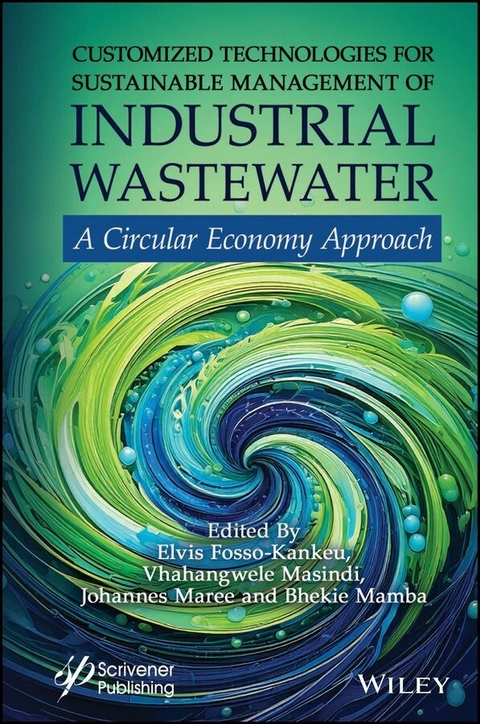
Customized Technologies for Sustainable Management of Industrial Wastewater (eBook)
636 Seiten
Wiley-Scrivener (Verlag)
978-1-394-21455-6 (ISBN)
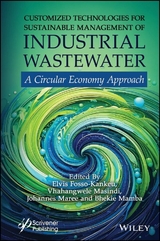
The book is essential for understanding innovative solutions to the critical challenges posed by increasing wastewater pollution and the urgent need for sustainable practices in light of climate change and resource scarcity.
Increased population growth and climate change put continuous pressure on freshwater resources across the globe. The volume and diversity of pollutants in wastewater discharged from industry have significantly increased over the years, making conventional wastewater treatment systems unfit for managing industrial wastewater released into the environment. The limitations of existing treatments appear not only in the suitability of the technologies to abate emerging pollutants, but also in the approach used to mitigate the situation and ensure sustainability of the process. For wastewater treatment, the circular economy, which is based on the principles reduce, reuse, recycle, restore, and recover, will ensure that waste is minimized and the life-cycle value of natural resources and products is maximized. Considerable progress has been made in developing new technologies that can adequately address the issue. However, with larger volumes of wastewater to treat every day, the cost of treatment is overwhelming, necessitating the right combination of technologies that will promote the reuse of pollutants recovered during the treatment process to offset the treatment cost. Customized Technologies for Sustainable Management of Industrial Wastewater: A Circular Economy Approach presents fifteen comprehensive chapters that cover the sustainability of industrial wastewater treatment technologies with consideration to the circular economy.
Readers will find the volume:
- Emphasizes the mechanisms and strategic combination of technologies that maximize the recovery of valuables during industrial wastewater treatment and deliver effluents treated to the acceptable standard;
- Discusses the characteristics, purity, and potential uses and applications of the recovered products;
- Focuses on the strategic development of technologies for the sustainable treatment of industrial wastewater at large.
Audience
Researchers, mining and industrial professionals, environmental managers, and policymakers involved in environmental, chemical, engineering, and mineral processing fields in the industries; water treatment plants managers and operators, water authorities, government regulatory bodies officers, and environmentalists.
Elvis Fosso-Kankeu, PhD is a professor in the Department of Mining Engineering at the University of South Africa. He has over 220 publications, including journal articles, books, book chapters, and conference proceeding papers. His research focuses on the hydrometallurgical extraction of metal from solid phases, the prediction of pollutant dispersion from industrial areas, and the development of effective and sustainable methods for the removal of organic and inorganic pollutants from polluted water.
Vhahangwele Masindi, PhD is the Research and Development Manager at Magalies Water, a research associate at the University of South Africa, and a visiting research scientist at the Council for Scientific and Industrial Research. He has over 117 publications, including journal articles, books, book chapters, patents, and conference proceeding papers. His research focuses on environmental quality modeling, water resource management, water and wastewater treatment, sustainability, circular economy in water treatment, and waste beneficiation and valorization.
Johannes Maree, PhD is the founder of ROC Water Technologies, a company focused on processing mining waste to recover drinking water and other products. His current projects include a Water Research Center project where the ROC process needs to be demonstrated to treat iron-rich acid mine water, a THRIP focusing on the thermal processing of sodium sulphate, and brine treatment with freeze crystallization for the selective recovery of ice, sodium sulphate, and sodium chloride.
Bhekie Mamba is the executive dean of the College of Science, Engineering and Technology at the University of South Africa. He has published seven book chapters, over 250 journal papers, 12 technical reports, and over 50 conference proceedings. His research interests include nanotechnology, polymer chemistry, and water treatment technologies.
The book is essential for understanding innovative solutions to the critical challenges posed by increasing wastewater pollution and the urgent need for sustainable practices in light of climate change and resource scarcity. Increased population growth and climate change put continuous pressure on freshwater resources across the globe. The volume and diversity of pollutants in wastewater discharged from industry have significantly increased over the years, making conventional wastewater treatment systems unfit for managing industrial wastewater released into the environment. The limitations of existing treatments appear not only in the suitability of the technologies to abate emerging pollutants, but also in the approach used to mitigate the situation and ensure sustainability of the process. For wastewater treatment, the circular economy, which is based on the principles reduce, reuse, recycle, restore, and recover, will ensure that waste is minimized and the life-cycle value of natural resources and products is maximized. Considerable progress has been made in developing new technologies that can adequately address the issue. However, with larger volumes of wastewater to treat every day, the cost of treatment is overwhelming, necessitating the right combination of technologies that will promote the reuse of pollutants recovered during the treatment process to offset the treatment cost. Customized Technologies for Sustainable Management of Industrial Wastewater: A Circular Economy Approach presents fifteen comprehensive chapters that cover the sustainability of industrial wastewater treatment technologies with consideration to the circular economy. Readers will find the volume: Emphasizes the mechanisms and strategic combination of technologies that maximize the recovery of valuables during industrial wastewater treatment and deliver effluents treated to the acceptable standard; Discusses the characteristics, purity, and potential uses and applications of the recovered products; Focuses on the strategic development of technologies for the sustainable treatment of industrial wastewater at large. Audience Researchers, mining and industrial professionals, environmental managers, and policymakers involved in environmental, chemical, engineering, and mineral processing fields in the industries; water treatment plants managers and operators, water authorities, government regulatory bodies officers, and environmentalists.
| Erscheint lt. Verlag | 23.7.2025 |
|---|---|
| Sprache | englisch |
| Themenwelt | Naturwissenschaften ► Chemie |
| Technik | |
| ISBN-10 | 1-394-21455-3 / 1394214553 |
| ISBN-13 | 978-1-394-21455-6 / 9781394214556 |
| Informationen gemäß Produktsicherheitsverordnung (GPSR) | |
| Haben Sie eine Frage zum Produkt? |
 PDF (Adobe DRM)
Kopierschutz: Adobe-DRM
Adobe-DRM ist ein Kopierschutz, der das eBook vor Mißbrauch schützen soll. Dabei wird das eBook bereits beim Download auf Ihre persönliche Adobe-ID autorisiert. Lesen können Sie das eBook dann nur auf den Geräten, welche ebenfalls auf Ihre Adobe-ID registriert sind.
Details zum Adobe-DRM
Dateiformat: PDF (Portable Document Format)
Mit einem festen Seitenlayout eignet sich die PDF besonders für Fachbücher mit Spalten, Tabellen und Abbildungen. Eine PDF kann auf fast allen Geräten angezeigt werden, ist aber für kleine Displays (Smartphone, eReader) nur eingeschränkt geeignet.
Systemvoraussetzungen:
PC/Mac: Mit einem PC oder Mac können Sie dieses eBook lesen. Sie benötigen eine
eReader: Dieses eBook kann mit (fast) allen eBook-Readern gelesen werden. Mit dem amazon-Kindle ist es aber nicht kompatibel.
Smartphone/Tablet: Egal ob Apple oder Android, dieses eBook können Sie lesen. Sie benötigen eine
Geräteliste und zusätzliche Hinweise
Buying eBooks from abroad
For tax law reasons we can sell eBooks just within Germany and Switzerland. Regrettably we cannot fulfill eBook-orders from other countries.
aus dem Bereich