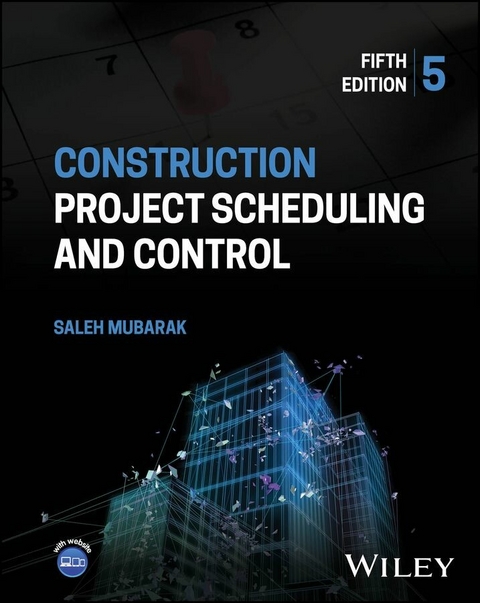
Construction Project Scheduling and Control (eBook)
1136 Seiten
Wiley (Verlag)
978-1-394-21573-7 (ISBN)
Comprehensive guide examining analytical methods used to devise an efficient and successful schedule for construction projects of all sizes
The newly revised and updated Fifth Edition of Construction Project Scheduling and Control describes the tools and methods that make projects run smoothly, with invaluable information from a noted career construction professional, along with updated information on Building Information Modeling (BIM) and new technologies impacting project scheduling. The first chapter is now replaced by two chapters on planning and scheduling, separately. A new chapter on optimizing the schedule that applies all scheduling concepts has been added. The book also includes worked problems and exercises with scheduling software hints to enable students and practicing professionals to apply critical thinking to issues in construction scheduling.
This Fifth Edition includes a revised chapter on the definition of the critical path, which follows a discussion of resource management, schedule updating and project control, schedule acceleration, risk, and other topics. This edition also includes numerous notes on all aspects of the project that may impact the schedule. In addition, it features a chapter on project scheduling and control as viewed through the owner's perspective, as well as an expanded glossary, a list of acronyms, and more. Instructors who adopt this book will be provided with valuable materials including PowerPoint lecture slides, an instructor's manual with complete solutions to the book's exercises, and additional questions for exams.
Sample topics covered in Construction Project Scheduling and Control include:
- Planning and scheduling as two different but related concepts
- Bar (Gantt) charts
- Basic networks, covering arrow networks, node networks, a comparison between the two, networks versus bar charts, and time-scaled logic diagrams
- Precedence networks, covering CPM calculations for precedence diagrams for contiguous and interruptible activities and types of lags
- Resource allocation and leveling, covering labor, equipment, and materials, and assigning budgets in computer scheduling programs
- Schedule updating and project control, covering steps for updating a schedule, measuring work progress, and earned value managament (EVM)
- Schedule acceleration concepts and techniques, and the impact of schedule acceleration on cost
- Reports and documentation, especially as related to the project schedule
- Schedule risk management
- Delay and other claims management
- Other scheduling methods, such as PERT and LSM
- Dynamic Minimum Lag (DML) relationship (a new concept)
- BIM and other technologies in modern construction scheduling
- Construction scheduling from the owner's perspective
Written for undergraduate and graduate students in construction management, civil engineering, and architecture, as well as practicing construction management professionals, the Fifth Edition of Construction Project Scheduling and Control is an essential resource for gaining a foundational understanding of the field, along with the latest and most effective practices.
Dr. Saleh Mubarak (Tampa, FL) is a professor and an independent consultant in construction project management, focused on training, writing, public speaking, and consulting. He is an adjunct professor at the University of South Florida (USF) and a former professor at several universities. He is also an active member of AACE International and a former member of PMI. He served on the PMI committee that created the professional scheduler certification exam. He has more than 35 years of diversified and international experience in academia and industry in private and public sectors.
Comprehensive guide examining analytical methods used to devise an efficient and successful schedule for construction projects of all sizes The newly revised and updated Fifth Edition of Construction Project Scheduling and Control describes the tools and methods that make projects run smoothly, with invaluable information from a noted career construction professional, along with updated information on Building Information Modeling (BIM) and new technologies impacting project scheduling. The first chapter is now replaced by two chapters on planning and scheduling, separately. A new chapter on optimizing the schedule that applies all scheduling concepts has been added. The book also includes worked problems and exercises with scheduling software hints to enable students and practicing professionals to apply critical thinking to issues in construction scheduling. This Fifth Edition includes a revised chapter on the definition of the critical path, which follows a discussion of resource management, schedule updating and project control, schedule acceleration, risk, and other topics. This edition also includes numerous notes on all aspects of the project that may impact the schedule. In addition, it features a chapter on project scheduling and control as viewed through the owner s perspective, as well as an expanded glossary, a list of acronyms, and more. Instructors who adopt this book will be provided with valuable materials including PowerPoint lecture slides, an instructor s manual with complete solutions to the book s exercises, and additional questions for exams. Sample topics covered in Construction Project Scheduling and Control include: Planning and scheduling as two different but related conceptsBar (Gantt) chartsBasic networks, covering arrow networks, node networks, a comparison between the two, networks versus bar charts, and time-scaled logic diagramsPrecedence networks, covering CPM calculations for precedence diagrams for contiguous and interruptible activities and types of lagsResource allocation and leveling, covering labor, equipment, and materials, and assigning budgets in computer scheduling programsSchedule updating and project control, covering steps for updating a schedule, measuring work progress, and earned value managament (EVM) Schedule acceleration concepts and techniques, and the impact of schedule acceleration on costReports and documentation, especially as related to the project scheduleSchedule risk managementDelay and other claims managementOther scheduling methods, such as PERT and LSMDynamic Minimum Lag (DML) relationship (a new concept)BIM and other technologies in modern construction scheduling Construction scheduling from the owner s perspective Written for undergraduate and graduate students in construction management, civil engineering, and architecture, as well as practicing construction management professionals, the Fifth Edition of Construction Project Scheduling and Control is an essential resource for gaining a foundational understanding of the field, along with the latest and most effective practices.
Chapter 1
Introduction to Project Planning
INTRODUCTION
Planning is a comprehensive and generic term that is used frequently by individuals, groups, organizations, and governments. People make planning, formal or informal, for almost everything from a small task like a dinner party or going on a picnic to a large matter such as building a spaceship to land on another planet. Planning has been defined in different phrases with the same core meaning. The Project Management Institute (PMI) defines a plan as “a proposed means of accomplishing something,” thus, planning is the “process of preparing the plan to accomplish the objective.”
Project planning is no different, but it is focused within the context of the project: its scope and constraints. Project planning was defined as “the process of choosing the one method and order of work to be adopted for a project from all the various ways and sequences in which it could be done” (Antill and Woodhead, 1990, p. 8; Callahan, Quackenbush, and Rowings, 1992, p. 2). The author defines project planning as “the comprehensive process of thinking of and preparing for all activities and actions needed to successfully complete a project.” The key terms in this definition are thinking of and preparing for which are the basic two legs of planning: thinking of all the requirements and preparing all the needed resources to achieve the objective as efficiently as possible. The term successfully in the definition implies completion of the project within the set constraints, such as budget and schedule.
The AACE International defines planning as the determination of a project's objectives with identification of the activities to be performed, methods and resources (cost, hours, time, materials, etc.) to be used for accomplishing the tasks, assessment of both value and risks, assignment of responsibility and accountability, and establishment of an integrated plan to achieve completion as required.1
Tip Box 1.1
Often, there is an inverse relationship between planning cost and effort, and the execution cost and effort. Proper planning saves cost, time, and headaches.
Project planning serves as a foundation for several related functions such as cost estimating, scheduling, procurement, cash flow predictions, quality management, safety management, risk management, project control, logistics, and more.
WHO MUST PLAN?
The purpose of project planning is to proactively develop an approach to achieve project objectives (deliverables) in the most efficient manner. Planning is required from all project participants, but the type and nature of this planning depend on the specific party's role, responsibility, and timing (when the assignment is anticipated and known):
- The owner is the first party to be involved in the project even before its inception. Project planning helps the owner:
- Make the decision whether or not to carry out the project unless this project is mandatory. This includes but is not limited to defining scope and constraints, performing feasibility studies (financial, legal, and other), and comparing alternative designs and execution methods, and
- In better and more efficient execution of the project, including choosing the most appropriate type of contract and delivery method.
- Project planning helps the designer (architect/engineer) in aligning the project design with the owner's objectives and constraints as well as legal and professional requirements.
- Project planning helps the general contractor in better and more efficient management of the project: fulfilling the contract requirements and maximizing its profitability.
- Project planning helps subcontractors in starting their involvement in the project with the right foot, with full understanding of their roles and responsibilities, fulfilling their contract requirements and maximizing their profitability.
In general, the earlier the planning is performed, the better the expected results will be, as shown in Figure 1.1.
Figure 1.1 Importance of early planning.
Tip Box 1.2
Failing to plan is planning to fail!
Tip Box 1.3
Those who say “I don't have time for planning” are likely to need planning badly!
WHAT IS A PROJECT?
We have already defined project planning, but we need to define a project. The PMI defines a project as “A temporary endeavor undertaken to create a unique product, service, or result. The temporary nature of projects indicates a beginning and an end to the project work or a phase of the project work. Projects can stand alone or be part of a program or portfolio” (PMBOK, 7th ed., 2021). The key words in this definition are temporary and unique: any project must have a starting point and a finishing point. It also must have a deliverable product, service, or result that is unique. Here are examples on each type of project's deliverables:
- A building or a road is a project with a product as a deliverable.
- Transporting goods between two cities is a project with a service as a deliverable.
- An improvement of the average students' SAT scores in a school or district is a project with a result as a deliverable.
However, in all three preceding examples, the scope and major constraints, such as the budget and timeframe, must be defined in order to qualify as a project. For example:
- The building project has a design and specifications, a budget of $16 million, and a timeframe of 14 months.
- The goods transportation has a clear scope, a budget, and a timeframe.
- The improvement of the average students' SAT scores must be defined, for example, from the current level of 950–1,050, within a certain budget and timeframe.
The budget and timeframe for the preceding and other projects may be approximate, subject to several factors, and based on available information, but having such constraints is a must for the work to be defined as a project. There could be more constraints: environmental, safety, and others.
Tip Box 1.4
Every project must have a starting point, a finishing point, and a deliverable.
Are Projects Unique?
Some people think of two or more projects as being identical just because they have the same design, and they look similar after completion. However, when we consider the construction process as the project, that is, how these projects were built, then every project is unique and there are no identical projects. Differences may occur because of location (soil type, weather conditions, labor market, building codes, unforeseen conditions, etc.), contract type, labor skill level, management type and experience, or for other circumstances (risks, safety issues, etc.).
For this reason, we deal with every project as a new and unique experience, although we utilize “lessons learned” from previous and similar projects. Note that similarity does not imply identicality. We may see identical items in different projects, but when we put all elements together, each project is unique.
Tip Box 1.5
There are no two identical construction projects. Some projects may look identical after completion, but the construction process they had was not identical.
Whose Project Is It?
Although we may be talking about the same physical project, such as a house, office building, or a school, the definition of a project differs among project participants, based on the role and responsibilities of each. For example, as shown in Figure 1.2, the owner's project starts from the moment the project is approved, although the project's proposal starts earlier. For the designer, the project starts when the contract with the owner is signed and ends with the delivery of the completed design. The general contractor's project starts when the contract with the owner is signed and ends at the final completion of the project and the handover to the owner.
Tip Box 1.6
Even though the final product: building, road, or other may be the same for all project participants, the definition of the project, in term or roles and responsibilities differs among project participants.
Figure 1.2 The project lifecycle.
THE PROJECT MANAGEMENT PLAN
The Project Management Plan is the document that describes how the project will be executed, monitored and controlled, and closed.2 The plan:
- Is the outcome of the planning process.
- Represents the roadmap that shows how the contractor (or the party preparing the plan) intends to execute the project.
- Documents approved scope, schedule, and cost baselines, along with project planning assumptions, constraints, and alternatives.
- Is the point of reference for measuring progress.
- Guides project execution and control.
The plan has to be specific and dynamic at the same time. “Specific” so project parties know exactly what to do and where to go,...
| Erscheint lt. Verlag | 16.7.2025 |
|---|---|
| Sprache | englisch |
| Themenwelt | Technik ► Bauwesen |
| Schlagworte | electrode reaction kinetics • electrolysis research • electrolysis thermodynamics • electrolyzer technology • electrosynthesis • electrosynthesis applications • electrosynthesis research • fuel cell applications • fuel cell research • Fuel Cell Technology • fuel cell textbook • fuel cell thermodynamics |
| ISBN-10 | 1-394-21573-8 / 1394215738 |
| ISBN-13 | 978-1-394-21573-7 / 9781394215737 |
| Informationen gemäß Produktsicherheitsverordnung (GPSR) | |
| Haben Sie eine Frage zum Produkt? |
 EPUB (Adobe DRM)
Kopierschutz: Adobe-DRM
Adobe-DRM ist ein Kopierschutz, der das eBook vor Mißbrauch schützen soll. Dabei wird das eBook bereits beim Download auf Ihre persönliche Adobe-ID autorisiert. Lesen können Sie das eBook dann nur auf den Geräten, welche ebenfalls auf Ihre Adobe-ID registriert sind.
Details zum Adobe-DRM
Dateiformat: EPUB (Electronic Publication)
EPUB ist ein offener Standard für eBooks und eignet sich besonders zur Darstellung von Belletristik und Sachbüchern. Der Fließtext wird dynamisch an die Display- und Schriftgröße angepasst. Auch für mobile Lesegeräte ist EPUB daher gut geeignet.
Systemvoraussetzungen:
PC/Mac: Mit einem PC oder Mac können Sie dieses eBook lesen. Sie benötigen eine
eReader: Dieses eBook kann mit (fast) allen eBook-Readern gelesen werden. Mit dem amazon-Kindle ist es aber nicht kompatibel.
Smartphone/Tablet: Egal ob Apple oder Android, dieses eBook können Sie lesen. Sie benötigen eine
Geräteliste und zusätzliche Hinweise
Buying eBooks from abroad
For tax law reasons we can sell eBooks just within Germany and Switzerland. Regrettably we cannot fulfill eBook-orders from other countries.
aus dem Bereich