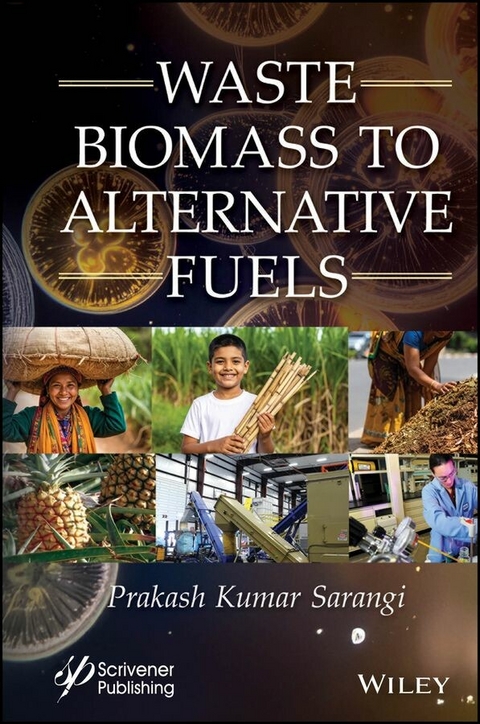
Waste Biomass to Alternative Fuels (eBook)
183 Seiten
Wiley-Scrivener (Verlag)
978-1-119-60217-0 (ISBN)
Waste Biomass to Alternative Fuels explores innovative microbial conversion technologies that offer sustainable solutions for energy production from waste biomass, addressing the urgent need for environmentally friendly alternatives to fossil fuels.
The world's increasing population and dependency on available fossil fuels has created a need for environmental sustainability. This need calls for innovative products that offer alternative sustainable solutions with less environmental impact. Waste biomass is a cheap renewable resource for biofuels and can be produced sustainably utilizing various biotechnological and biochemical tools.
Waste Biomass to Alternative Fuels introduces microbial conversion technologies to recover energy and fuel from plant-based non-edible biomass and other organic wastes. This book serves as a platform to recognize breakthrough research for understanding the physicochemical properties of biomass, available conversion technologies, and advanced engineering for large-scale biomass processing using microbial biomass. New developments and approaches in biomass processing and characterization, conversion technologies, biofuel upgrading, and utilization are discussed. Waste Biomass to Alternative Fuels seeks to provide information on recent advances in the field of biotechnology, catalysis, bioprocess engineering, microbial fuel cells for environmentally friendly production of clean energy, and fine chemicals.
Prakash Kumar Sarangi, PhD is a scientist with a specialization in Microbiology at Central Agricultural University in Imphal, India with over 12 years of research and teaching experience. He has published over 45 research articles in international journals, over 15 book chapters, and over 70 conference proceedings. He has held a leading role as a principal investigator for different research and development projects and served as a reviewer for many international journals. His research is focused on bioprocess engineering, renewable energy, biochemicals, biomaterials, sustainability, and livelihood development.
Waste Biomass to Alternative Fuels explores innovative microbial conversion technologies that offer sustainable solutions for energy production from waste biomass, addressing the urgent need for environmentally friendly alternatives to fossil fuels. The world s increasing population and dependency on available fossil fuels has created a need for environmental sustainability. This need calls for innovative products that offer alternative sustainable solutions with less environmental impact. Waste biomass is a cheap renewable resource for biofuels and can be produced sustainably utilizing various biotechnological and biochemical tools. Waste Biomass to Alternative Fuels introduces microbial conversion technologies to recover energy and fuel from plant-based non-edible biomass and other organic wastes. This book serves as a platform to recognize breakthrough research for understanding the physicochemical properties of biomass, available conversion technologies, and advanced engineering for large-scale biomass processing using microbial biomass. New developments and approaches in biomass processing and characterization, conversion technologies, biofuel upgrading, and utilization are discussed. Waste Biomass to Alternative Fuels seeks to provide information on recent advances in the field of biotechnology, catalysis, bioprocess engineering, microbial fuel cells for environmentally friendly production of clean energy, and fine chemicals.
2
Pretreatment Methods of Waste Biomass: A Broad Overview
Prakash Kumar Sarangi
College of Agriculture, Central Agricultural University, Imphal, Manipur, India
Abstract
The production of bioethanol is a multistep process wherein steps to the pretreatment of lignocellulosic biomass is pivotal. Several strategies are now available for pretreating biomass. The pretreatment process can either be physical, chemical, physicochemical, or biological. Merits and demerits are associated with each pretreatment approach. Enzymatic saccharification becomes easier and efficient once the biomass is pretreated. Alteration in structure of pretreated biomass allows easier accession towards their enzymatic hydrolysis, thereby enhancing the yield of bioethanol. This chapter discusses various novel approaches of pretreatment like supercritical fluid pretreatment and hydrodynamic cavitation, along with conventional approaches like acid, alkali, wet oxidation, ionic liquid, ammonia recycle percolation, and steam explosion.
Keywords: Steam explosion, crystallinity, supercritical fluid pretreatment, hydrodynamic cavitation, enzymatic hydrolysis, biological pretreatments, supercritical CO2 (scCO2)
2.1 Introduction
The world heavily relies upon fossil fuels as a primary source of energy. Rapid civilization, unprecedented industrialization, continued population growth, and an ever-expanding economy are the factors behind the hike in energy demand and depletion of natural energy sources globally (Pathak and Chandel, 2017). The consumption of fossil fuel is predicted to hike from 15 TW in 2012, to two times or three times the bulk in 2050 and 2100, mutually on a global level (Cheah et al., 2018). This planet may face extreme challenges, such as a shortage of fossil fuels along with the rise in global warming and pollution. To circumvent these challenges, it is high time to explore the potential of renewable sources of energy like solar, wind, hydro, tidal, and biomass globally (Pathak and Chandel, 2017). These novel alternative sources will not be only sustainable but also cost effective. There are other substantial reasons to undergo into a massive-scale substitution of petroleum-based fuels, such as energy security, concomitant hikes in prices of crude oil, and unavoidable changes in climate (Goel and Wati, 2016).
Many countries are taking the initiative to address various issues of hikes in global energy demand and consumption (Cortes–Tolalpa et al., 2016). The European Union is all set to use renewable sources of energy to reduce the need on imports of energy and enhance inventory guarantee (Cucchiella et al., 2014). Recent research has diverted their attention towards generating energy resources that are not only alternative but also eco-friendly (Waghmare et al., 2018). The exploration of sustainable fuel sources and essential chemicals from bio-resources is becoming more popular (Elmore et al., 2017). Fossil fuel is presumed to be substituted by biomass-based renewable energy by 10%–50% in 2030 (Cucchiella et al., 2014).
There are various forms of bioenergy. Biofuel is one of them. It is a product of microbial activity on agricultural waste products, making it one of the potential sources of alternate energy (Wang et al., 2014). Precious biochemicals are the outcome of various efforts made to alter microorganisms, by plugging-in and -out genes required for their production. Profit generated as an outcome of these artificial biological tools and efforts is synthesis of biofuel (Bhatia and Johri, 2017). Priorities have been diverted towards enhancing biofuel production from renewable lignocellulosic biomaterial, to address the pivotal issues of hike in global demand for energy and environmental threats in the form of global warming synergized with fossil fuels combustion (Liu et al., 2015).
Biofuels are a form of bioenergy that are biologically produced from bio-organic matter. Biofuels can be solid, liquid, or gaseous. Based on the sources from where they are derived, biofuels can be classified into three categories: (1) Biofuels of natural origin; (2) Primary biofuels; and (3) Secondary biofuels. Landfill gas, animal waste, and vegetables are the organic sources of natural biofuels. Heating, cooking, electricity production, or brick furnace employs fuelwoods that are primary biofuels. Bioethanol, biobutanol, biodiesel, and biohydrogen are examples of secondary biofuels that are the outcome of biomass processing. Secondary biofuels can be of first generation or second generation. Food crops and oil seeds are the source of first-generation biofuels. Several factors restrict the production of first-generation biofuels; the biggest among them are food security issues, climate change mitigation, and the usage of fertile lands for fuel production. Therefore, the focus has shifted towards utilizing non-food feedstocks like agro-waste (rice husk, groundnut shell, etc.), forest waste, wood processing residues, non-edible parts of sugar beet, sugarcane, and corn for the production of second generation biofuels, which gives no competition to human food chain (Pathak and Chandel, 2017). Ethanol has gathered peak attention among all biofuels, and its consumption comprises more than 90% of the complete bioalcohols in the US (Reginatto and Antonio, 2015).
2.2 Broad Overview of Pretreatment
Chapter 2 thoroughly discusses various steps involved in ethanol production. Varieties of lignocellulosic biomass (LB) explored for ethanol production have been mentioned. These biomasses are largely available globally in nature, acting as a potent alternative to energy sources. The concept of biorefinery exists because of a broad spectrum of biofuels, biochemicals, and biomaterials produced in a sustainable manner from these biomasses. Complex LB cannot be directly fermented to ethanol by microorganisms, and hence demands a suitable pretreatment strategy, which aids in the hydrolysis of lignocelluloses into fermentable sugars.
There is significant involvement of microbes and/or their enzyme systems in ethanol production. The natural recalcitrance of LB creates hurdles for microbes and/or their enzyme systems to convert cellulosic and/or hemicellulosic sugars to ethanol via fermentation. This problem can be substantially solved by pretreating the LB that not only accelerated the hydrolysis but also enhanced the product yield. Physical and chemical barriers are removed once the pretreatment is done. These barriers were initially responsible for recalcitrance and inaccessibility towards enzymatic hydrolysis. During pretreatment, hemicelluloses and/or lignin gets solubilized, thereby making cellulose accessible for enzymatic hydrolysis (Jönsson and Martin, 2016). Accessibility of cellulolytic enzymes enhances after pretreatment as an outcome of the alteration in pore size of biomass and the reduction of cellulose crystallinity. As the accessibility of enzymes gets quicker and easier, less quantity of enzymes and therefore less cost input to manifest hydrolysis of pretreated biomass are seen as compared to unpretreated biomass (Dawson and Boopathy, 2007). Pretreatment also supports the upgradation of biodegradable materials (Yang and Wyman, 2008). As depicted in Figure 2.1, pretreatment is mostly the first step in producing second-generation sugars, which will later produce second-generation ethanol from LB and starch-based feedstock.
Figure 2.1 Basic technology and the main steps for bioethanol production from LB and starch-based feedstock.
Several factors have been explored that play a pivotal role in the development of ideal cost-efficient and energy-efficient pretreatment procedures (Maurya et al., 2015). There are many pretreatment strategies established to elevate the reactivity of cellulose and to improve the production of fermentable sugars. Important aims of pretreatment embrace:
- Enhancing sugar production during enzyme hydrolysis of highly digestible solids produced post pretreatment;
- Prevention of degradation of sugars like pentoses and other sugars obtained from hemicelluloses;
- Curtailing the formation of inhibitors for the smooth conduction of subsequent fermentation steps;
- Lignin recovery so that it can get converted into valuable coproducts; and
- Involving reactors of moderate size so that during operation minimized heat and power is required, thereby making the process cost effective (Yang and Wyman, 2008).
Pretreatment must face major challenges to accomplish above aims. These challenges include:
- Establishing an accomplished technology that serves the purpose of achieving a significant volume of pretreated biomass material irrespective of the raw material employed;
- Achieving cost effective and eco-friendly methods that are able to perform best under ambient conditions;
- Reducing the initial investments, by employing cost effective construction material like steel alloys that can tolerate acid or base; and
- Involving fewer corrosive chemicals (Valdivia et al., 2016).
Many forms of technological processes are now available that support the pretreatment of LB. Chief among these technological processes include chemical, physical, and biological processes. Some of these technologies have been successfully employed commercially, whereas a few are still being experimented on a lab scale.
Different pretreatment approaches lead to alterations in morphology and composition of biomass, leading to a reduction in its recalcitrance. For instance, biomass that has...
| Erscheint lt. Verlag | 15.7.2025 |
|---|---|
| Sprache | englisch |
| Themenwelt | Naturwissenschaften ► Physik / Astronomie |
| Technik ► Elektrotechnik / Energietechnik | |
| Schlagworte | Agrowaste • Bioconversion Technologies • bioenergy • Biofuels • biomass valorization • circular economy • Fuel cells • Microbial Enzymes • Microbiology • Sustainable energy • waste biomass |
| ISBN-10 | 1-119-60217-3 / 1119602173 |
| ISBN-13 | 978-1-119-60217-0 / 9781119602170 |
| Informationen gemäß Produktsicherheitsverordnung (GPSR) | |
| Haben Sie eine Frage zum Produkt? |
 EPUB (Adobe DRM)
Kopierschutz: Adobe-DRM
Adobe-DRM ist ein Kopierschutz, der das eBook vor Mißbrauch schützen soll. Dabei wird das eBook bereits beim Download auf Ihre persönliche Adobe-ID autorisiert. Lesen können Sie das eBook dann nur auf den Geräten, welche ebenfalls auf Ihre Adobe-ID registriert sind.
Details zum Adobe-DRM
Dateiformat: EPUB (Electronic Publication)
EPUB ist ein offener Standard für eBooks und eignet sich besonders zur Darstellung von Belletristik und Sachbüchern. Der Fließtext wird dynamisch an die Display- und Schriftgröße angepasst. Auch für mobile Lesegeräte ist EPUB daher gut geeignet.
Systemvoraussetzungen:
PC/Mac: Mit einem PC oder Mac können Sie dieses eBook lesen. Sie benötigen eine
eReader: Dieses eBook kann mit (fast) allen eBook-Readern gelesen werden. Mit dem amazon-Kindle ist es aber nicht kompatibel.
Smartphone/Tablet: Egal ob Apple oder Android, dieses eBook können Sie lesen. Sie benötigen eine
Geräteliste und zusätzliche Hinweise
Buying eBooks from abroad
For tax law reasons we can sell eBooks just within Germany and Switzerland. Regrettably we cannot fulfill eBook-orders from other countries.
aus dem Bereich