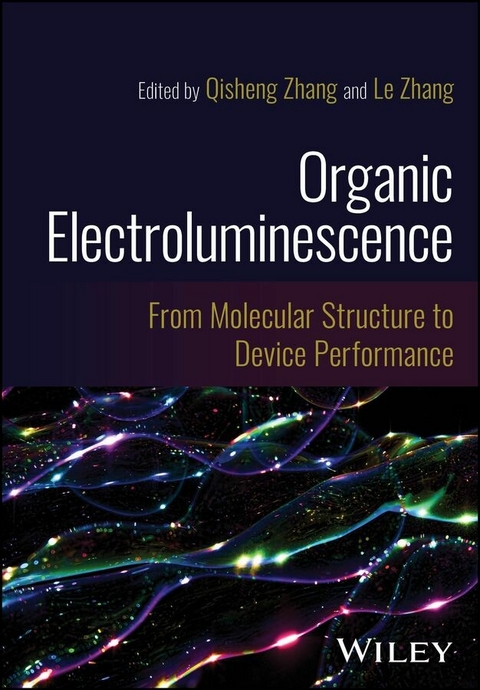
Organic Electroluminescence (eBook)
960 Seiten
Wiley (Verlag)
978-1-119-69413-7 (ISBN)
Unique reference on the fundamentals, applications, and latest research in electroluminescence of organic molecules
Organic Electroluminescence provides a comprehensive overview of organic electroluminescent materials from their structure-property relationships to the outlook of improved device performance. Divided into three parts, the first section of the book covers fundamental aspects of OLEDs such as history, structures, properties, and operating and aging mechanisms. The second section provides quantum chemical and experimental insights into correlations between device performance, material characteristics, molecular physical parameters, and molecular structure. The last section is devoted to improving device performance in real world applications using molecular and device simulations.
Featuring contributions from experts from around the world, Organic Electroluminescence discusses sample topics including:
- Fundamental concepts in the fields of display, organic electronics, molecular photochemistry, and quantum chemistry
- Device fabrication, characterization and simulation techniques
- Physical and chemical processes in OLEDs including charge injection and transport, exciton generation and decay, reversible dipole reorientation, and chemical reactions
- Physical and chemical properties of organic semiconductors in solutions and thin-films including photoluminescence quantum yield, excited-state lifetime, and redox potential
- Single-molecule and condensed-matter simulations including vertical transition, nonradiative decay, spin-orbital and spin-phonon coupling, bond dissociation and charge transfer
Organic Electroluminescence delivers advanced information for professionals seeking a thorough reference on the subject and for students learning about OLEDs.
Qisheng Zhang is a Professor in the Department of Polymer Science and Engineering at Zhejiang University in Hangzhou, China. He pursued his PhD at Changchun Institute of Applied Chemistry, China during 2001-2005, and began his research on high efficiency and low cost organic electroluminescent materials since then.
Le Zhang graduated from the department of physical electronics of Tokyo Institute of Technology, Japan with a PhD degree in 2013. Since then, his main research interests are organic semiconducting materials, device physics, charge/exciton dynamics, and advanced characterization methods. He is now the CTO of Zhejiang Hongwu Technology.
Unique reference on the fundamentals, applications, and latest research in electroluminescence of organic molecules Organic Electroluminescence provides a comprehensive overview of organic electroluminescent materials from their structure-property relationships to the outlook of improved device performance. Divided into three parts, the first section of the book covers fundamental aspects of OLEDs such as history, structures, properties, and operating and aging mechanisms. The second section provides quantum chemical and experimental insights into correlations between device performance, material characteristics, molecular physical parameters, and molecular structure. The last section is devoted to improving device performance in real world applications using molecular and device simulations. Featuring contributions from experts from around the world, Organic Electroluminescence discusses sample topics including: Fundamental concepts in the fields of display, organic electronics, molecular photochemistry, and quantum chemistryDevice fabrication, characterization and simulation techniquesPhysical and chemical processes in OLEDs including charge injection and transport, exciton generation and decay, reversible dipole reorientation, and chemical reactionsPhysical and chemical properties of organic semiconductors in solutions and thin-films including photoluminescence quantum yield, excited-state lifetime, and redox potentialSingle-molecule and condensed-matter simulations including vertical transition, nonradiative decay, spin-orbital and spin-phonon coupling, bond dissociation and charge transfer Organic Electroluminescence delivers advanced information for professionals seeking a thorough reference on the subject and for students learning about OLEDs.
Chapter 1
Fundamentals of Organic Light-Emitting Diode
1Shine Materials Technology Co., Ltd., Kaohsiung, Taiwan, Republic of China
2Shanghai Taoe Chemical Technology Co., Ltd., Shanghai, P.R. China
1.1 Brief History
Organic electroluminescence (EL) is the electrically driven light-emitting phenomenon of organic materials first reported by Pope in 1963 [1, 2], who had discovered that by applying a high DC voltage (>100 V) across a thick layer of anthracene crystals sandwiched between two electrodes of Ag (epoxy paste), a faint blue EL could be detected. But, the high voltage required for charge injection prohibited any consideration for practical application. In order to reduce the driving voltage and to improve the luminance efficiency, much effort has been spent ever since [3, 4].
It was not until 1987, a small research team led by Tang at Kodak [5] realized the first practical organic light-emitting diode (OLED) with a heterojunction, which consisted of a double thin-layer structure of a -type electron donor molecule of TAPC and an -type electron acceptor molecule of Alq3. The thin-film structure of these organic materials, which were prepared by vacuum evaporation, produced a high brightness of green emission (from Alq3) with a DC drive voltage of <10 V and an external quantum efficiency (EQE) of about 1% (Figure 1.1a). The injected hole and electron were shown to accumulate near the heterojunction where the probability of charge recombination was greatly enhanced to produce light. It was soon discovered that the bilayer structure was not sufficient to produce all colors at will and was later evolved to a trilayer device structure with an additional thin emission layer (EML) inserted into the junction. Thenceforth, RGB emissions were enabled by the invention of the guest–host doped emitter [6], which would later to become the foundation for full-color OLED displays of today.
Figure 1.1 Schematic of (a) a typical bilayer structure. (b) Refined multilayer OLED.
Source: Reproduced from [7] / permission of John Wiley & Sons.
A typical multilayered small molecule OLED architecture is depicted in Figure 1.1b, in which an electron (EIL) and a hole injection layers (HIL) are inserted in-between the cathode/electron (ETL) and anode/hole transport (HTL) layers, respectively, to reduce charge–injection barrier and enhance carrier–charge balance for recombination in the doped EML. Subsequently, in 1990, a new kind of polymer light-emitting diode (PLED) having about 100 nm luminescent and conducting PPV thin film prepared by solution coating was discovered by Friends and coworkers at Cambridge [8]. Its substantial charge injection took place just below 14 V (corresponding to an electric field of about 2 × 10⁶ Vcm−1), and the device was able to achieve an EQE up to about 0.05%.
In the ensuing three decades, tremendous R&D progress has been achieved for the improvement of OLED’s charge injection, transport properties, luminance and power efficiencies, RGB color gamut, and device stability, including the understanding of its luminescence photophysics and the design/synthesis of new materials as well as optimization of device structure. Motivated by the huge potential of practical application of this new organic EL technology, the commercialization of OLED display and lighting products is well underway.
Much credit has to be given to Pioneer of Japan, which was the first Co. to recognize the potential of OLED for display applications in 1998 by introducing the first passive matrix (PM) area color display audio product for use in automobile. Thereafter, many Co’s in Japan, Taiwan, and Korea followed suit in attempts to develop better materials (then mostly fluorescence), fabrication process, manufacturing equipment, encapsulation, driver electronics, array design, and module assembly for full-color PMOLEDs. But commercial success unfortunately was limited due to its line-by-line scanning pulse addressing and inefficient materials development that could only accommodate small panel size (<2″) with low resolution and brightness like those used in MP-3. Then it became obvious that for OLED to be competitive in the mainstream display market, it has to adopt active matrix (AM) addressing in order to satisfy the ever-increasing demand of consumers for higher resolution and larger displays. The answer was quickly found in the development of low-temperature polycrystalline silicon (LTPS) thin-film transistor (TFT) backplane technology, with which, by appropriate circuit design and compensation scheme, a precise amount of micro-current can be channeled to each individual RGB sub-pixel to produce a vivid full-color display without jeopardizing its brightness, efficiency, material stability, and device lifetime. Highlights of these pioneering AMOLED CE products included the introduction of the BenQ-Siemans S88 cell phone in 2006 by AUO and the first Sony’s 11″OLED TV. The timely discovery of green [9] and red phosphorescent [10] materials also aided to enhance significantly the efficiency as well as the lifetime of AMOLED, which proved to be well-suited for portable device applications. Other milestone achievements (just to name a few) at the same period of time were top-emission OLED structure to enhance RGB color gamut by micro-cavity [11]; structure [12] to reduce power consumption; tandem OLED [13] to increase luminance efficiency; bipolar host [14] to reduce exciton quenching; molecular engineering to enhance blue fluorescence [15]; thermally activated delayed fluorescence (TADF) [16]; and thin-film encapsulation (TFE) [17] to protect OLED from moisture and oxygen erosion, etc., all contributed tremendously to the ultimate success of AMOLED.
Samsung of Korea is to be specially commended for developing the manufacturing-worthy side-by-side (SBS) fine metal mask (FMM) fabrication process for small-to-medium-size panels for smartphone and tablet usages, while LGD ventured into large-sized OLED TV production, adopting the maskless [WOLED + Color Filter] RGBW pixelation scheme and the Oxide TFT backplane technology. By the time, when Apple introduced the iPhone X in 2017 adopting for the first time the 5.8″AMOLED (made by Samsung with a specification of 458 ppi retinal resolution, 1 000 000:1 contrast ratio, and 625 cd m−2 max brightness), the establishment of OLED in the mainstream display marketplace was all but assured. Furthermore, since TOLED can be fabricated on a single crystal Si wafer with high electron mobility, OLED micro-displays with an extremely high resolution of 1920 × 1200 and >7000 cd m−2 brightness (championed by eMagin) for use as AR/VR wearable displays have also been realized in 2019. As power efficiency, out-coupling, and lifetime continue to be improved over time, white OLED will soon penetrate into the space of SSL application of indoor lighting as a unique area/surface, thin/light weight luminaire capable of delivering homogeneous, warm (most sun-like) illumination devoid of glare and blue emission hazard. It is believed that flexible display will be the “killer application” for OLED in the twenty-first century as its flexibility and freedom of form factor are unrivaled by others. Transparent OLED may also be another area of great potential to be exploited. Highlights of OLED product development in the last two decades are shown in Figure 1.2.
Figure 1.2 Highlights of historical development of OLED products.
Source: Reproduced and arranged chronologically from various websites of public domain.
1.2 Characterization and Measurements
EL is the photophysical phenomenon produced by driving electrical current. A typical OLED of today comprises a multilayer structure of at least five extremely thin films ( in total thickness) of organic materials sandwiched in-between two electrodes on a substrate, one of which serves as the anode and the other as the cathode (Figure 1.1b). Either or both of them can be made transparent to allow electro-generated light to escape.
For introduction, its EL process can be explained by a simple working model [18] that roughly involves five steps, namely: (i) charge injection. As electrical bias is applied across the device, the anode is at a more positive potential than that of the cathode, and a huge electric field (>1 × 10⁶ Vcm−1) is generated within the entire organic layers. Injection of holes occurs from the anode into the highest occupied molecular orbital (HOMO) of the HIL overcoming the energy barrier across the interface, while electrons are injected from the cathode into the lowest unoccupied molecular orbital (LUMO) of the EIL; (ii) charge transport. Injected carriers ( and ) are transported through their respective HTL and ETL toward each other (the opposite electrodes) driven by the forward-biased potential and are confined in the EML; (iii) exciton formation. In the ideal case of an optimized device, the ratio of hole/electron should be one that would allow the best possibility for holes and electrons to recombine to form excitons. According to spin physics statistics (Pauli exclusion principle), for each singlet exciton (spin antisymmetrical) generated, there will be formed three triplet excitons (spin symmetrical) as well. Following spin–orbital conservation theory, only the singlet exciton can...
| Erscheint lt. Verlag | 10.7.2025 |
|---|---|
| Sprache | englisch |
| Themenwelt | Naturwissenschaften ► Chemie |
| Technik ► Maschinenbau | |
| Schlagworte | oled ai • oled applications • oled development • oled films • oled molecular electronics • oled parameters • oled performance • oled processes • oled simulations • oled structure • oled structure-activity relationships • oled testing methods |
| ISBN-10 | 1-119-69413-2 / 1119694132 |
| ISBN-13 | 978-1-119-69413-7 / 9781119694137 |
| Informationen gemäß Produktsicherheitsverordnung (GPSR) | |
| Haben Sie eine Frage zum Produkt? |
 EPUB (Adobe DRM)
Kopierschutz: Adobe-DRM
Adobe-DRM ist ein Kopierschutz, der das eBook vor Mißbrauch schützen soll. Dabei wird das eBook bereits beim Download auf Ihre persönliche Adobe-ID autorisiert. Lesen können Sie das eBook dann nur auf den Geräten, welche ebenfalls auf Ihre Adobe-ID registriert sind.
Details zum Adobe-DRM
Dateiformat: EPUB (Electronic Publication)
EPUB ist ein offener Standard für eBooks und eignet sich besonders zur Darstellung von Belletristik und Sachbüchern. Der Fließtext wird dynamisch an die Display- und Schriftgröße angepasst. Auch für mobile Lesegeräte ist EPUB daher gut geeignet.
Systemvoraussetzungen:
PC/Mac: Mit einem PC oder Mac können Sie dieses eBook lesen. Sie benötigen eine
eReader: Dieses eBook kann mit (fast) allen eBook-Readern gelesen werden. Mit dem amazon-Kindle ist es aber nicht kompatibel.
Smartphone/Tablet: Egal ob Apple oder Android, dieses eBook können Sie lesen. Sie benötigen eine
Geräteliste und zusätzliche Hinweise
Buying eBooks from abroad
For tax law reasons we can sell eBooks just within Germany and Switzerland. Regrettably we cannot fulfill eBook-orders from other countries.
aus dem Bereich