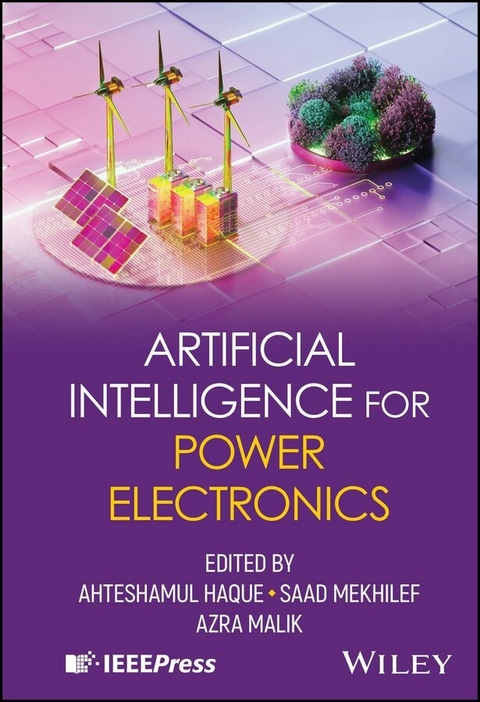
Artificial Intelligence for Power Electronics (eBook)
591 Seiten
Wiley-IEEE Press (Verlag)
978-1-394-27078-1 (ISBN)
Thorough review of how artificial intelligence can enhance the design, control, and optimization of power electronics systems
Artificial Intelligence for Power Electronics provides a comprehensive overview of the intersection between artificial intelligence (AI) and the field of power electronics, exploring how AI can revolutionize and enhance the design, control, and optimization of power electronics systems. The book covers the fundamentals of AI, the fundamentals of power electronics and the challenges the field faces in design to production, and the solutions of these challenges through AI methods. Example solutions, along with Q&A review sections, are included throughout the text, with coverage of both Python and MATLAB.
Topics discussed in Artificial Intelligence for Power Electronics include:
- Supervised, unsupervised, and reinforcement machine learning and the role of data in training machine learning models
- Techniques for AI data collection in power electronics and how to clean, normalize, and handle missing values of data
- Optimization techniques such as Particle Swarm Optimization and Ant Colony Optimization
- Detection techniques for identifying faults and anomalies and clustering algorithms to group similar operational behavior
- Essential Python libraries for machine learning and how to perform machine learning on a Raspberry Pi
Delivering an industry-specific approach to AI applications, Artificial Intelligence for Power Electronics is a helpful reference for undergraduate, postgraduate, and PhD students in electrical, electronic, and computer engineering. Mechanical engineers and other industry professionals may also find it valuable.
Dr. Ahteshamul Haque is Professor with the Department of Electrical Engineering, Jamia Millia Islamia, New Delhi, India.
Dr. Saad Mekhilef is an IEEE Fellow and a Distinguished Professor at the School of Engineering, Swinburne University of Technology, Melbourne, Australia.
Dr. Azra Malik is a Post Doctoral Fellow with the Department of Electrical Engineering, IIT Roorkee, Uttarakhand, India.
Thorough review of how artificial intelligence can enhance the design, control, and optimization of power electronics systems Artificial Intelligence for Power Electronics provides a comprehensive overview of the intersection between artificial intelligence (AI) and the field of power electronics, exploring how AI can revolutionize and enhance the design, control, and optimization of power electronics systems. The book covers the fundamentals of AI, the fundamentals of power electronics and the challenges the field faces in design to production, and the solutions of these challenges through AI methods. Example solutions, along with Q&A review sections, are included throughout the text, with coverage of both Python and MATLAB. Topics discussed in Artificial Intelligence for Power Electronics include: Supervised, unsupervised, and reinforcement machine learning and the role of data in training machine learning modelsTechniques for AI data collection in power electronics and how to clean, normalize, and handle missing values of dataOptimization techniques such as Particle Swarm Optimization and Ant Colony OptimizationDetection techniques for identifying faults and anomalies and clustering algorithms to group similar operational behaviorEssential Python libraries for machine learning and how to perform machine learning on a Raspberry Pi Delivering an industry-specific approach to AI applications, Artificial Intelligence for Power Electronics is a helpful reference for undergraduate, postgraduate, and PhD students in electrical, electronic, and computer engineering. Mechanical engineers and other industry professionals may also find it valuable.
1
Fundamentals of Power Electronics and Key Challenges
Azra Malik and Ahteshamul Haque
Advance Power Electronics and Research Laboratory, Jamia Millia Islamia (A Central University), New Delhi, India
1.1 Introduction
Power electronics is a cornerstone of modern electrical engineering, allowing for efficient control and conversion of electrical power in a wide range of applications. This area combines electronics and power engineering ideas to develop devices and systems capable of handling large amounts of electricity effectively [1]. Power electronics encompasses a wide range of devices, including power converters, inverters, and motor drives, which are all necessary for modern industrial operations, consumer electronics, and renewable energy systems. The history of power electronics began with the introduction of the first semiconductor devices. The silicon-controlled rectifier (SCR) was invented in the late 1950s, and it marked an important milestone in electrical power regulation [2]. Since then, advances in semiconductor technology have resulted in the creation of a variety of power electronic devices, including Insulated Gate Bipolar Transistors (IGBTs) and Metal–Oxide–Semiconductor Field-Effect Transistors (MOSFETs), which provide higher efficiency and switching capabilities. These developments were crucial in improving the performance and lowering the costs of power electronic systems. Despite these advances, the area of power electronics encounters significant challenges that should be addressed in order to fulfil the rising demands of present-day technology. One of the pressing challenges is the requirement for increased efficiency and power density. As applications become increasingly demanding, it is critical to minimize energy losses and reduce the weight, and size of power electronic systems. This necessitates novel materials, enhanced semiconductor devices, and better heat management approaches. Wide bandgap (WBG) semiconductors like silicon carbide (SiC) and gallium nitride (GaN) have emerged as potential options [3]. These materials provide superior electrical characteristics, including higher breakdown voltage and more rapid switching rates, which may drastically enhance power electronic systems' performance.
Power electronics technology in the 21st century envisions a more distributed energy sector with IoT connectivity, and smart devices. Power electronics is the study of how electrical power is controlled and converted through electronic devices. It covers a wide range of technologies and applications, including small power supply and huge power systems [4]. Understanding basic ideas and terminologies, such as the many types of power electronic devices, converters, modulation techniques, and control methods, is critical for anyone working in this field. These ideas underpin a wide range of applications, including renewable energy systems, electric transportation systems, and diverse range of power suppliers. The swift growth of energy planning technology in smart grids, combining sensors, smart devices, storage devices, and non-conventional energy sources utilizing communication networks, is driving the demand for more sustainable and cleaner energy. It is a well-known fact that burning fossil fuels like coal, oil, and natural gas to create power is harmful to the environment and contributes significantly to climate change. Throughout decades of heavy mining of resources based on fossil fuel, the consumption of energy is enormously increasing and is expected to rise further as the global economy expands. Developing inexpensive and clean electricity is crucial for ensuring global sustainability and combating climate change. Efforts to increase the use of renewable energy (REN) sources are ongoing, with new technologies developing. Among these resources, solar photovoltaic (PV) and wind are now the most favorable, accounting for more than half of the entire worldwide capacity being installed.
Worldwide, the installed PV capacity grew significantly, surpassing 1340 GW in 2023, an increase from around 940 GW at the close of 2022 and 760 GW in 2021. This shows an impressive annual growth rate of nearly 24% and 30% for the respective years, as depicted in Figure 1.1 [5]. It is expected that additional wind and solar PV capacity will be built shortly, as the costs of such technologies continue to fall; hence, large-scale wind and solar PV power generation is just around the corner. However, the key problem is the combination of power electronics with these RENs. Renewable energy sources, such as solar and wind, are inherently variable and intermittent, necessitating complex power electronic systems to assure steady and reliable power conversion and delivery. Advanced control algorithms and grid-tied inverters are critical for regulating fluctuations and ensuring grid stability. Furthermore, power electronics play an important part in energy storage systems, which are critical for balancing supply and demand in renewable energy applications [6]. Power electronics is also having a huge influence on the electrification of transportation. Electric vehicles (EVs) require extremely efficient power converters and inverters that can function in a variety of challenging environments [7]. To fulfil performance and safety regulations, power electronics are widely used in the development of fast-charging infrastructure and advanced battery management systems. Innovations in these areas are vital for the broad adoption of EVs, which is necessary for lowering greenhouse gas emissions and dependency on fossil fuels.
Figure 1.1 Globally installed renewable energy trend.
Furthermore, as modern power systems become increasingly complicated, control and reliability issues arise. The integration of smart grid technologies, which rely on power electronics for real-time monitoring and control, is critical for increasing the efficiency and resilience of electricity distribution networks [8]. These technologies allow for improved regulation of electrical flows, the integration of dispersed energy resources, and the general stability of the grid. To summarize, this chapter details the modern power electronics fundamental concepts and related principles. While power electronics has made significant progress over the last few decades, continued research and development is required to solve present problems. Future developments must focus on increasing efficiency, integrating renewable energy sources, and promoting vehicle electrification. By tackling these problems, power electronics can continue to play an important role in increasing energy efficiency and sustainability across a variety of applications.
1.2 Fundamental Concepts and Definitions
Power electronics is an essential field that deals with the control, conversion and delivery of electrical power utilizing different electronic components. Power semiconductor devices are at the heart of power electronics, providing the switching and rectification operations required for effective power control. These semiconductor devices are the foundation of power electronics systems, allowing for efficient conversion and management of electrical power. They enable precise control of required electrical parameters, as per the operation of a wide range of electronic devices and systems, from small consumer electronics to big industrial machinery [9]. Key components of such systems include semiconductor devices like diodes, transistors, and thyristors as discussed here. The fundamental component or devices in power conversion applications are electronic switches, since they have the capability of dealing with high currents and voltages at high-frequency operations. The concept of ideal switch is highly important in this regard, and it can be represented using a three-terminal device as displayed in Figure 1.2 (a) which consists of input, control terminal often pronounced as gate terminal, and output. An “ideal” switch is one, which, when open, conducts zero current and can tolerate infinite voltage. When this ideal switch is closed, the voltage across it is zero, and it may handle infinite current. Furthermore, an ideal switch has the ability to change its state immediately, which means it takes no time to move from ON to OFF or OFF to ON states. An ideal switch may maintain bidirectional voltage, carry bidirectional current, and consume no power. When we draw the graph of the current through the switch in relation to its voltage, we get four quadrants, which are commonly known by the term vi plane as depicted in Figure 1.2 (b). As per the description, an ideal switch may function in each of the four quadrants. It is important to understand the concept of ideal switches particularly during the evaluation of various circuit topologies. The presumptions of zero leakage current, zero voltage drop, and instant transitions facilitates the simulation and modeling of varied electrical devices. Power switches are classified into three types based on the ideal switch characteristics.
Figure 1.2 (a) Ideal switch and (b) switch vi characteristics (4 quadrant).
1.2.1 Uncontrolled Switches
Uncontrolled switch is a two-terminal device, with the terminals labeled as Cathode (K), and Anode (A), shown in Figure 1.3 (a). Ideally, current flows only from the anode to the cathode, making it unidirectional. The diode voltage is positive when analyzed from the terminal A to terminal K. The ideal diode,...
| Erscheint lt. Verlag | 9.7.2025 |
|---|---|
| Sprache | englisch |
| Themenwelt | Technik ► Elektrotechnik / Energietechnik |
| Schlagworte | ai energy conversion • AI hardware • ai matlab • AI python • Power electronics control • power electronics design • power electronics optimization • power electronics research • Power electronic systems • Reinforcement Learning |
| ISBN-10 | 1-394-27078-X / 139427078X |
| ISBN-13 | 978-1-394-27078-1 / 9781394270781 |
| Informationen gemäß Produktsicherheitsverordnung (GPSR) | |
| Haben Sie eine Frage zum Produkt? |
 EPUB (Adobe DRM)
Kopierschutz: Adobe-DRM
Adobe-DRM ist ein Kopierschutz, der das eBook vor Mißbrauch schützen soll. Dabei wird das eBook bereits beim Download auf Ihre persönliche Adobe-ID autorisiert. Lesen können Sie das eBook dann nur auf den Geräten, welche ebenfalls auf Ihre Adobe-ID registriert sind.
Details zum Adobe-DRM
Dateiformat: EPUB (Electronic Publication)
EPUB ist ein offener Standard für eBooks und eignet sich besonders zur Darstellung von Belletristik und Sachbüchern. Der Fließtext wird dynamisch an die Display- und Schriftgröße angepasst. Auch für mobile Lesegeräte ist EPUB daher gut geeignet.
Systemvoraussetzungen:
PC/Mac: Mit einem PC oder Mac können Sie dieses eBook lesen. Sie benötigen eine
eReader: Dieses eBook kann mit (fast) allen eBook-Readern gelesen werden. Mit dem amazon-Kindle ist es aber nicht kompatibel.
Smartphone/Tablet: Egal ob Apple oder Android, dieses eBook können Sie lesen. Sie benötigen eine
Geräteliste und zusätzliche Hinweise
Buying eBooks from abroad
For tax law reasons we can sell eBooks just within Germany and Switzerland. Regrettably we cannot fulfill eBook-orders from other countries.
aus dem Bereich