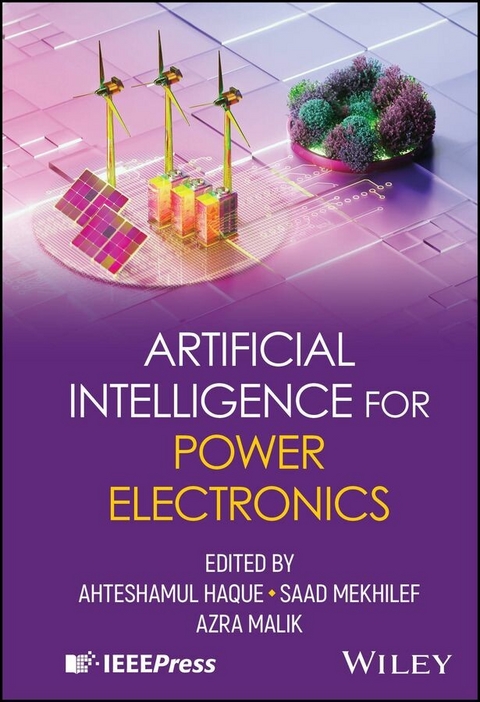
Artificial Intelligence for Power Electronics (eBook)
398 Seiten
Wiley-IEEE Press (Verlag)
978-1-394-27079-8 (ISBN)
Thorough review of how artificial intelligence can enhance the design, control, and optimization of power electronics systems
Artificial Intelligence for Power Electronics provides a comprehensive overview of the intersection between artificial intelligence (AI) and the field of power electronics, exploring how AI can revolutionize and enhance the design, control, and optimization of power electronics systems. The book covers the fundamentals of AI, the fundamentals of power electronics and the challenges the field faces in design to production, and the solutions of these challenges through AI methods. Example solutions, along with Q&A review sections, are included throughout the text, with coverage of both Python and MATLAB.
Topics discussed in Artificial Intelligence for Power Electronics include:
- Supervised, unsupervised, and reinforcement machine learning and the role of data in training machine learning models
- Techniques for AI data collection in power electronics and how to clean, normalize, and handle missing values of data
- Optimization techniques such as Particle Swarm Optimization and Ant Colony Optimization
- Detection techniques for identifying faults and anomalies and clustering algorithms to group similar operational behavior
- Essential Python libraries for machine learning and how to perform machine learning on a Raspberry Pi
Delivering an industry-specific approach to AI applications, Artificial Intelligence for Power Electronics is a helpful reference for undergraduate, postgraduate, and PhD students in electrical, electronic, and computer engineering. Mechanical engineers and other industry professionals may also find it valuable.
Dr. Ahteshamul Haque is an Associate Professor in the Department of Electrical Engineering, Jamia Millia Islamia, New Delhi.
Dr. Saad Mekhilef is an IEEE and IET Fellow, a Distinguished Professor at the School of Science, Swinburne University of Technology, Australia, and an Honorary Professor in the Department of Electrical Engineering, University of Malaya.
Azra Malik is a Doctoral Research Scholar in the Department of Electrical Engineering, Jamia Millia Islamia, New Delhi.
Thorough review of how artificial intelligence can enhance the design, control, and optimization of power electronics systems Artificial Intelligence for Power Electronics provides a comprehensive overview of the intersection between artificial intelligence (AI) and the field of power electronics, exploring how AI can revolutionize and enhance the design, control, and optimization of power electronics systems. The book covers the fundamentals of AI and power electronics, and the challenges the field faces in design to production, with the solutions of these challenges through AI methods. Example solutions, along with Q&A review sections, are included throughout the text, with coverage of both Python and MATLAB. Some of the topics discussed in this book include: Supervised, unsupervised, and reinforcement machine learning and the role of data in training machine learning models Techniques for AI data collection in power electronics and how to clean, normalize, and handle missing values of data Optimization techniques such as Particle Swarm Optimization and Ant Colony Optimization Detection techniques for identifying faults and anomalies and clustering algorithms to group similar operational behavior Essential Python libraries for machine learning and how to perform machine learning on a Raspberry Pi Delivering an industry-specific approach to AI applications, Artificial Intelligence for Power Electronics is a helpful reference for undergraduate, postgraduate, and PhD students in electrical, electronic, and computer engineering. Mechanical engineers and other industry professionals may also find it valuable.
| Erscheint lt. Verlag | 4.7.2025 |
|---|---|
| Sprache | englisch |
| Themenwelt | Technik ► Elektrotechnik / Energietechnik |
| Schlagworte | ai energy conversion • AI hardware • ai matlab • AI python • Power electronics control • power electronics design • power electronics optimization • power electronics research • Power electronic systems • Reinforcement Learning |
| ISBN-10 | 1-394-27079-8 / 1394270798 |
| ISBN-13 | 978-1-394-27079-8 / 9781394270798 |
| Informationen gemäß Produktsicherheitsverordnung (GPSR) | |
| Haben Sie eine Frage zum Produkt? |
 PDF (Adobe DRM)
Kopierschutz: Adobe-DRM
Adobe-DRM ist ein Kopierschutz, der das eBook vor Mißbrauch schützen soll. Dabei wird das eBook bereits beim Download auf Ihre persönliche Adobe-ID autorisiert. Lesen können Sie das eBook dann nur auf den Geräten, welche ebenfalls auf Ihre Adobe-ID registriert sind.
Details zum Adobe-DRM
Dateiformat: PDF (Portable Document Format)
Mit einem festen Seitenlayout eignet sich die PDF besonders für Fachbücher mit Spalten, Tabellen und Abbildungen. Eine PDF kann auf fast allen Geräten angezeigt werden, ist aber für kleine Displays (Smartphone, eReader) nur eingeschränkt geeignet.
Systemvoraussetzungen:
PC/Mac: Mit einem PC oder Mac können Sie dieses eBook lesen. Sie benötigen eine
eReader: Dieses eBook kann mit (fast) allen eBook-Readern gelesen werden. Mit dem amazon-Kindle ist es aber nicht kompatibel.
Smartphone/Tablet: Egal ob Apple oder Android, dieses eBook können Sie lesen. Sie benötigen eine
Geräteliste und zusätzliche Hinweise
Buying eBooks from abroad
For tax law reasons we can sell eBooks just within Germany and Switzerland. Regrettably we cannot fulfill eBook-orders from other countries.
aus dem Bereich