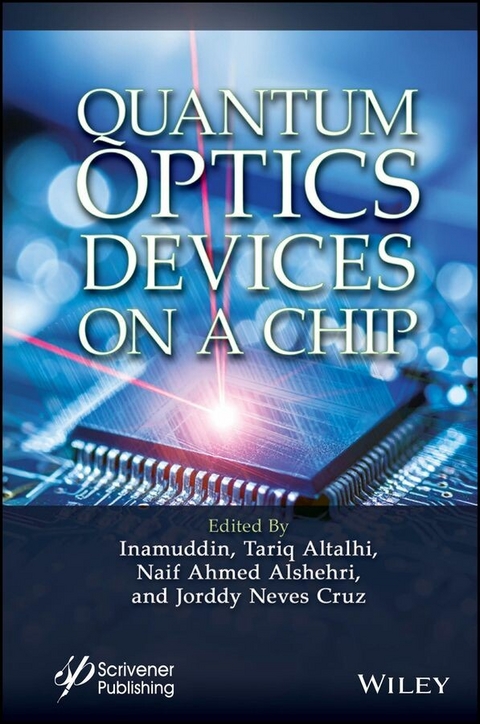
Quantum Optics Devices on a Chip (eBook)
601 Seiten
Wiley-Scrivener (Verlag)
978-1-394-24858-2 (ISBN)
Quantum Optics Devices on a Chip provides a comprehensive understanding of how the integration of advanced quantum technologies and photonics is revolutionizing multiple industries, making it essential for anyone interested in the future of quantum innovation.
Quantum Optics Devices on a Chip is situated at the intersection of several disciplines and industries, driving advancements in quantum technology and integrated photonics. The development of quantum optics devices on a chip represents a significant breakthrough. Chip-scale integration involves designing and fabricating optical devices, such as waveguides, modulators, detectors, and light sources, on a micro- or nanoscale chip. This miniaturization enables the integration of multiple components on a single chip, leading to compact, efficient, and scalable quantum optical systems. Quantum sensing applications, such as magnetometry, gyroscopy, and biosensing, can benefit from miniaturized, high-performance devices integrated on a chip, allowing for the seamless integration of quantum optical functionalities with existing photonic circuits. This integration holds promise for applications in telecommunications, data communication, and optical signal processing.
Overall, the development of quantum optics devices on a chip represents a significant step forward in the advancement of quantum technology. It brings together principles from physics, materials science, engineering, and computer science to enable the practical implementation of quantum phenomena for a wide range of applications across industries. Quantum Optics Devices on a Chip serves as a comprehensive guide to this rapidly evolving field, providing insights and knowledge, exploring the contributions it has made to the disciplinary and industrial development of quantum optics devices on a chip.
Inamuddin, PhD, is an assistant professor at the Department of Applied Chemistry, Zakir Husain College of Engineering and Technology, Faculty of Engineering and Technology, Aligarh Muslim University, Aligarh, India. He has extensive research experience in multidisciplinary fields of analytical chemistry, materials chemistry, electrochemistry, renewable energy, and environmental science. He has worked on different research projects funded by various government agencies and universities and is the recipient of awards, including the Department of Science and Technology, India, Fast-Track Young Scientist Award and Young Researcher of the Year Award 2020 from Aligarh Muslim University. He has published about 210 research articles in various international scientific journals, many book chapters, and dozens of edited books, many with Wiley-Scrivener.
Tariq Altalhi, PhD, is an associate professor in the Department of Chemistry at Taif University, Saudi Arabia. He received his doctorate degree from University of Adelaide, Australia in the year 2014 with Dean's Commendation for Doctoral Thesis Excellence. He has worked as head of the Chemistry Department at Taif university and Vice Dean of Science College. In 2015, one of his works was nominated for Green Tech awards from Germany, Europe's largest environmental
Naif Ahmed Alshehri, PhD, is an assistant professor of Nanotechnology at the Department of Physics, Faculty of Sciences at Al-Baha University. He is currently the vice-dean of postgraduate studies, research, innovation and quality. Prior to this position, he was the head of the Physics Department. His research interests include fabrication, characterization, and applications of nanomaterials and thin films.
Jorddy Neves Cruz is a researcher at the Federal University of Pará and the Emilio Goeldi Museum. He has experience in multidisciplinary research in the areas of medicinal chemistry, drug design, extraction of bioactive compounds, extraction of essential oils, food chemistry and biological testing. He has published several research articles in scientific journals and is an associate editor of the Journal of Medicine.
Quantum Optics Devices on a Chip provides a comprehensive understanding of how the integration of advanced quantum technologies and photonics is revolutionizing multiple industries, making it essential for anyone interested in the future of quantum innovation. Quantum Optics Devices on a Chip is situated at the intersection of several disciplines and industries, driving advancements in quantum technology and integrated photonics. The development of quantum optics devices on a chip represents a significant breakthrough. Chip-scale integration involves designing and fabricating optical devices, such as waveguides, modulators, detectors, and light sources, on a micro- or nanoscale chip. This miniaturization enables the integration of multiple components on a single chip, leading to compact, efficient, and scalable quantum optical systems. Quantum sensing applications, such as magnetometry, gyroscopy, and biosensing, can benefit from miniaturized, high-performance devices integrated on a chip, allowing for the seamless integration of quantum optical functionalities with existing photonic circuits. This integration holds promise for applications in telecommunications, data communication, and optical signal processing. Overall, the development of quantum optics devices on a chip represents a significant step forward in the advancement of quantum technology. It brings together principles from physics, materials science, engineering, and computer science to enable the practical implementation of quantum phenomena for a wide range of applications across industries. Quantum Optics Devices on a Chip serves as a comprehensive guide to this rapidly evolving field, providing insights and knowledge, exploring the contributions it has made to the disciplinary and industrial development of quantum optics devices on a chip.
Preface
The topic of the book, “Quantum Optics Devices on a Chip,” is situated at the intersection of several disciplines and industries, driving advancements in quantum technology and integrated photonics. In the realm of disciplinary development, quantum optics is a branch of physics that focuses on the behavior and properties of light at the quantum level. It explores the fundamental principles of quantum mechanics applied to optics, including the wave–particle duality of light and the quantized nature of energy. Quantum optics plays a crucial role in understanding and harnessing phenomena such as entanglement, superposition, and quantum interference, which are essential for quantum information processing, communication, and sensing.
The development of quantum optics devices on a chip represents a significant breakthrough in the field. Chip-scale integration involves designing and fabricating optical devices, such as waveguides, modulators, detectors, and light sources, on a micro- or nanoscale chip. This miniaturization enables the integration of multiple components on a single chip, leading to compact, efficient, and scalable quantum optical systems. The impact of quantum optics devices on a chip extends beyond the realm of physics and has far-reaching implications across various industries. In quantum computing, the ability to manipulate and control quantum states of light on a chip paves the way for the development of quantum processors capable of solving complex problems at unprecedented speeds. Quantum communication benefits from chip-scale devices by enabling secure transmission of information through quantum key distribution protocols. Quantum sensing applications, such as magnetometry, gyroscopy, and biosensing, can benefit from miniaturized, high-performance devices integrated on a chip. Moreover, the integration of quantum optics on a chip has implications for the field of integrated photonics. It allows for the seamless integration of quantum optical functionalities with existing photonic circuits, enabling the development of hybrid systems that leverage the advantages of both classical and quantum technologies. This integration holds promise for applications in telecommunications, data communication, and optical signal processing.
Overall, the development of quantum optics devices on a chip represents a significant step forward in the advancement of quantum technology. It brings together principles from physics, materials science, engineering, and computer science to enable the practical implementation of quantum phenomena for a wide range of applications across industries. The book serves as a comprehensive guide to this rapidly evolving field, providing insights and knowledge to researchers, scientists, and industry professionals seeking to explore and contribute to the disciplinary and industrial development of quantum optics devices on a chip. The book’s content is carefully structured to appeal to a wide audience, from graduate students and researchers entering the field of quantum optics to experienced scientists and engineers who want to expand their knowledge. The comprehensive and accessible approach will enable readers from diverse scientific backgrounds to understand fundamental concepts, explore cutting-edge research, and visualize the future prospects of on-chip quantum optics devices. The chapters included in the book are summarized below:
Chapter 1 reviews different quantum-limited microwave amplifiers for various quantum technological applications. The chapter details current progress related to quantum-limited microwave amplifiers, types of amplifiers, their design and structure, advantages and limitations, and future development. The outlook discusses controlling operating parameters, materials geometry, and fabrication techniques.
Chapter 2 provides a brief introduction to the field of quantum optics. It includes an overview of key scientific developments that led to the field of quantum optics and a discussion of the physical phenomena covered within the field.
Chapter 3 covers the significance of carbon nanotubes in molecular electronics. It emphasizes several intriguing ways to alter the fundamental properties of the carbon network by adding defects and examines their creation in depth.
Chapter 4 introduces quantum dots (QDs) and their medical applications, detailing synthesis methods, properties, and biocompatibility. It highlights their superior fluorescence for imaging, roles in drug delivery, and diagnostic uses. Ethical, safety, regulatory, and environmental issues are discussed, emphasizing QDs’ potential in diagnostics and therapy while addressing associated challenges.
Chapter 5 describes fascinating areas in quantum optics and quantum information, revealing unique quantum properties with essential characteristics and principles governing the quantum state of light. The study discusses superposition, entanglement, and quantum coherence, techniques for generating and manipulating light quantum states, and applications in communication, computing, and metrology.
Chapter 6 details the historical development of quantum technology, the fundamentals of quantum chip-scale devices, and the revolution that these technologies bring to the fabrication of next-generation devices. Various quantum chip-scale architectures and circuits are discussed in detail to elaborate on their effectiveness in device fabrication. The benefits, challenges, and financial aspects of investing in quantum chip-scale devices have opened the market for innovation and research. With the latest technologies like artificial intelligence and machine learning, this industry is poised to deliver better and more customer-friendly products.
Chapter 7 delves into the cutting-edge realm of quantum-enhanced THz spectroscopy and the integration of on-chip devices. It explores the generation and detection of THz radiation, emphasizing the pivotal role of femtosecond lasers, photoconductive antennas, and quantum cascade lasers. Advanced THz spectroscopy techniques, including terahertz time-domain and time-resolved spectroscopy, are discussed in detail, showcasing their potential to unravel dynamic material properties. The chapter also highlights innovative THz imaging methodologies, particularly near-field imaging, and groundbreaking biomedical applications such as early-stage cancer detection. Concluding with a forward-looking perspective, the chapter provides insights into future breakthroughs and opportunities, inviting interdisciplinary collaboration to push the boundaries of this dynamic field.
Chapter 8 delves into the fascinating world of optical devices found on microchips incorporating plasmonics for sensor applications. The literature primarily focuses on plasmonic-based sensors, including SPR, LSPR, and SERS sensors. It explores their scope, advantages, and limitations.
Chapter 9 traces the evolution of quantum computing, highlighting silicon photonics’ pivotal role in scalability and efficiency. Focusing on practical implementation, it explores scalable methods for silicon photonic chips and their advancements. In chip-based quantum communication, particularly quantum key distribution (QKD), integrated photonics enables real-world applications. The chapter discusses diverse QKD approaches, including entanglement-based and superposition-based methods, and introduces continuous-variable QKD for secure metropolitan communication. Addressing challenges, it covers quantum multiplexing techniques, emphasizing solutions to issues like spontaneous Raman scattering noise. Examining the intersection of silicon photonics and quantum computing, the narrative highlights applications in communication, imaging, and error correction. Persistent challenges like quantum noise and decoherence underscore the need for innovative solutions, showcasing silicon photonics’ pivotal role in advancing secure communication and unlocking unprecedented computational power.
Chapter 10 navigates through the intricate landscape of quantum nanophotonics, with a spotlight on the indispensable role of rare earth ions. Key themes include the growth techniques and material topologies associated with rare earth-doped materials, the fundamental aspects of rare earth ions in solid-state materials, and their pivotal role in quantum optics. The chapter unveils applications spanning quantum devices, low-dimensional materials, insulators, and spectral hole burning. The convergence of ultrasound and optics in ultrasonic-optical tissue imaging and the transformative impact of solid-state optical devices in diverse industries further enrich the narrative.
Chapter 11 delves into the evolution of chip-scale quantum memories, highlighting their scalability, rapid communication, and low power consumption. It explores theoretical and experimental approaches, development challenges, and the significant roles of quantum dots and photonic methods in advancing chip-scale memories.
Chapter 12 discusses the integrated light sources that revolutionize applications with high efficiency. Several III-V-based inorganic semiconductor lasers, quantum dots, and germanium-on-silicon lasers are discussed, along with a tunable quantum light source, enabling on-demand tuning of spatial photon-pair correlations and entanglement in a nonlinear directional coupler for practical quantum information applications.
Chapter 13 delves into the progressive advancements of integrated optical systems, focusing on their significant influence on telecommunications,...
| Erscheint lt. Verlag | 18.6.2025 |
|---|---|
| Sprache | englisch |
| Themenwelt | Technik ► Elektrotechnik / Energietechnik |
| Schlagworte | Chip-Scale Integration • Information Processing • Integrated Light Sources • Integrated optical devices • Integrated Waveguides • Modulators on a Chip • Photodetectors on a Chip • Photonic Circuits • Photonics on a Chip • quantum • Quantum Communication • Quantum Computing • quantum metrology • Quantum Optics Devices • quantum sensing • Switches on a Chip |
| ISBN-10 | 1-394-24858-X / 139424858X |
| ISBN-13 | 978-1-394-24858-2 / 9781394248582 |
| Informationen gemäß Produktsicherheitsverordnung (GPSR) | |
| Haben Sie eine Frage zum Produkt? |
 EPUB (Adobe DRM)
Kopierschutz: Adobe-DRM
Adobe-DRM ist ein Kopierschutz, der das eBook vor Mißbrauch schützen soll. Dabei wird das eBook bereits beim Download auf Ihre persönliche Adobe-ID autorisiert. Lesen können Sie das eBook dann nur auf den Geräten, welche ebenfalls auf Ihre Adobe-ID registriert sind.
Details zum Adobe-DRM
Dateiformat: EPUB (Electronic Publication)
EPUB ist ein offener Standard für eBooks und eignet sich besonders zur Darstellung von Belletristik und Sachbüchern. Der Fließtext wird dynamisch an die Display- und Schriftgröße angepasst. Auch für mobile Lesegeräte ist EPUB daher gut geeignet.
Systemvoraussetzungen:
PC/Mac: Mit einem PC oder Mac können Sie dieses eBook lesen. Sie benötigen eine
eReader: Dieses eBook kann mit (fast) allen eBook-Readern gelesen werden. Mit dem amazon-Kindle ist es aber nicht kompatibel.
Smartphone/Tablet: Egal ob Apple oder Android, dieses eBook können Sie lesen. Sie benötigen eine
Geräteliste und zusätzliche Hinweise
Buying eBooks from abroad
For tax law reasons we can sell eBooks just within Germany and Switzerland. Regrettably we cannot fulfill eBook-orders from other countries.
aus dem Bereich