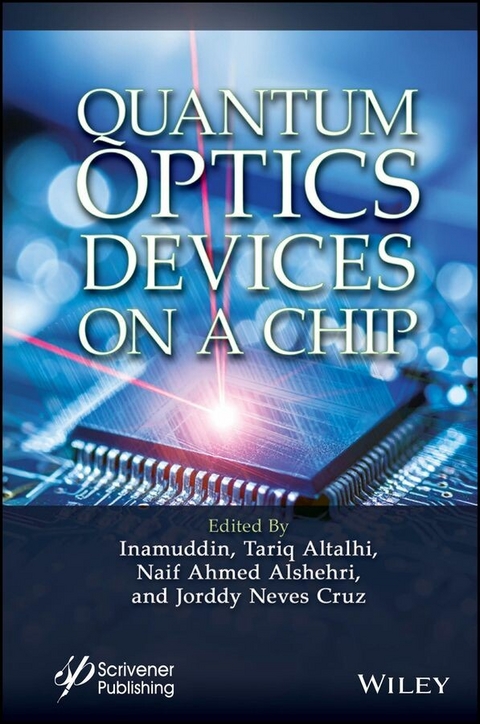
Quantum Optics Devices on a Chip (eBook)
411 Seiten
Wiley-Scrivener (Verlag)
978-1-394-24859-9 (ISBN)
Quantum Optics Devices on a Chip provides a comprehensive understanding of how the integration of advanced quantum technologies and photonics is revolutionizing multiple industries, making it essential for anyone interested in the future of quantum innovation.
Quantum Optics Devices on a Chip is situated at the intersection of several disciplines and industries, driving advancements in quantum technology and integrated photonics. The development of quantum optics devices on a chip represents a significant breakthrough. Chip-scale integration involves designing and fabricating optical devices, such as waveguides, modulators, detectors, and light sources, on a micro- or nanoscale chip. This miniaturization enables the integration of multiple components on a single chip, leading to compact, efficient, and scalable quantum optical systems. Quantum sensing applications, such as magnetometry, gyroscopy, and biosensing, can benefit from miniaturized, high-performance devices integrated on a chip, allowing for the seamless integration of quantum optical functionalities with existing photonic circuits. This integration holds promise for applications in telecommunications, data communication, and optical signal processing.
Overall, the development of quantum optics devices on a chip represents a significant step forward in the advancement of quantum technology. It brings together principles from physics, materials science, engineering, and computer science to enable the practical implementation of quantum phenomena for a wide range of applications across industries. Quantum Optics Devices on a Chip serves as a comprehensive guide to this rapidly evolving field, providing insights and knowledge, exploring the contributions it has made to the disciplinary and industrial development of quantum optics devices on a chip.
Inamuddin, PhD, is an assistant professor at the Department of Applied Chemistry, Zakir Husain College of Engineering and Technology, Faculty of Engineering and Technology, Aligarh Muslim University, Aligarh, India. He has extensive research experience in multidisciplinary fields of analytical chemistry, materials chemistry, electrochemistry, renewable energy, and environmental science. He has worked on different research projects funded by various government agencies and universities and is the recipient of awards, including the Department of Science and Technology, India, Fast-Track Young Scientist Award and Young Researcher of the Year Award 2020 from Aligarh Muslim University. He has published about 210 research articles in various international scientific journals, many book chapters, and dozens of edited books, many with Wiley-Scrivener.
Tariq Altalhi, PhD, is an associate professor in the Department of Chemistry at Taif University, Saudi Arabia. He received his doctorate degree from University of Adelaide, Australia in the year 2014 with Dean's Commendation for Doctoral Thesis Excellence. He has worked as head of the Chemistry Department at Taif university and Vice Dean of Science College. In 2015, one of his works was nominated for Green Tech awards from Germany, Europe's largest environmental
Naif Ahmed Alshehri, PhD, is an assistant professor of Nanotechnology at the Department of Physics, Faculty of Sciences at Al-Baha University. He is currently the vice-dean of postgraduate studies, research, innovation and quality. Prior to this position, he was the head of the Physics Department. His research interests include fabrication, characterization, and applications of nanomaterials and thin films.
Jorddy Neves Cruz is a researcher at the Federal University of Pará and the Emilio Goeldi Museum. He has experience in multidisciplinary research in the areas of medicinal chemistry, drug design, extraction of bioactive compounds, extraction of essential oils, food chemistry and biological testing. He has published several research articles in scientific journals and is an associate editor of the Journal of Medicine.
Quantum Optics Devices on a Chip provides a comprehensive understanding of how the integration of advanced quantum technologies and photonics is revolutionizing multiple industries, making it essential for anyone interested in the future of quantum innovation. Quantum Optics Devices on a Chip is situated at the intersection of several disciplines and industries, driving advancements in quantum technology and integrated photonics. The development of quantum optics devices on a chip represents a significant breakthrough. Chip-scale integration involves designing and fabricating optical devices, such as waveguides, modulators, detectors, and light sources, on a micro- or nanoscale chip. This miniaturization enables the integration of multiple components on a single chip, leading to compact, efficient, and scalable quantum optical systems. Quantum sensing applications, such as magnetometry, gyroscopy, and biosensing, can benefit from miniaturized, high-performance devices integrated on a chip, allowing for the seamless integration of quantum optical functionalities with existing photonic circuits. This integration holds promise for applications in telecommunications, data communication, and optical signal processing. Overall, the development of quantum optics devices on a chip represents a significant step forward in the advancement of quantum technology. It brings together principles from physics, materials science, engineering, and computer science to enable the practical implementation of quantum phenomena for a wide range of applications across industries. Quantum Optics Devices on a Chip serves as a comprehensive guide to this rapidly evolving field, providing insights and knowledge, exploring the contributions it has made to the disciplinary and industrial development of quantum optics devices on a chip.
| Erscheint lt. Verlag | 6.6.2025 |
|---|---|
| Sprache | englisch |
| Themenwelt | Technik ► Elektrotechnik / Energietechnik |
| Schlagworte | Chip-Scale Integration • Information Processing • Integrated Light Sources • Integrated optical devices • Integrated Waveguides • Modulators on a Chip • Photodetectors on a Chip • Photonic Circuits • Photonics on a Chip • quantum • Quantum Communication • Quantum Computing • quantum metrology • Quantum Optics Devices • quantum sensing • Switches on a Chip |
| ISBN-10 | 1-394-24859-8 / 1394248598 |
| ISBN-13 | 978-1-394-24859-9 / 9781394248599 |
| Informationen gemäß Produktsicherheitsverordnung (GPSR) | |
| Haben Sie eine Frage zum Produkt? |
 PDF (Adobe DRM)
Kopierschutz: Adobe-DRM
Adobe-DRM ist ein Kopierschutz, der das eBook vor Mißbrauch schützen soll. Dabei wird das eBook bereits beim Download auf Ihre persönliche Adobe-ID autorisiert. Lesen können Sie das eBook dann nur auf den Geräten, welche ebenfalls auf Ihre Adobe-ID registriert sind.
Details zum Adobe-DRM
Dateiformat: PDF (Portable Document Format)
Mit einem festen Seitenlayout eignet sich die PDF besonders für Fachbücher mit Spalten, Tabellen und Abbildungen. Eine PDF kann auf fast allen Geräten angezeigt werden, ist aber für kleine Displays (Smartphone, eReader) nur eingeschränkt geeignet.
Systemvoraussetzungen:
PC/Mac: Mit einem PC oder Mac können Sie dieses eBook lesen. Sie benötigen eine
eReader: Dieses eBook kann mit (fast) allen eBook-Readern gelesen werden. Mit dem amazon-Kindle ist es aber nicht kompatibel.
Smartphone/Tablet: Egal ob Apple oder Android, dieses eBook können Sie lesen. Sie benötigen eine
Geräteliste und zusätzliche Hinweise
Buying eBooks from abroad
For tax law reasons we can sell eBooks just within Germany and Switzerland. Regrettably we cannot fulfill eBook-orders from other countries.
aus dem Bereich