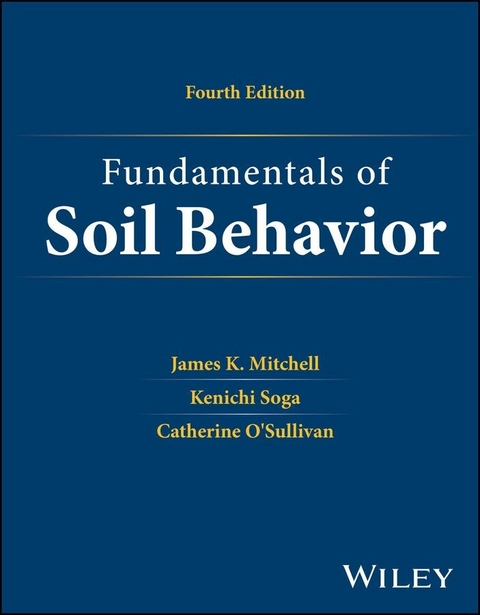
Fundamentals of Soil Behavior (eBook)
690 Seiten
Wiley (Verlag)
978-1-119-83233-1 (ISBN)
Authoritative and generously illustrated resource covering the many properties of soil and its behavior needed for addressing geotechnical and geoenvironmental engineering projects and problems.
The Fourth Edition of Fundamentals of Soil Behavior has been thoroughly updated to provide the latest information on the physical properties of soil and the fundamentals of its behavior, with hundreds of tables and graphs illustrating correlations among composition, classification, state, and static and dynamic properties. Overall, each topic is addressed in a micro-to-macro sequence, considering behaviors at the atomic and/or particle scales to develop understanding of soil properties and behaviors at the macro-scale, which is relevant to engineering practice.
This Fourth Edition includes two new chapters on special features of soil behavior and temperature-dependent soil behavior. Other chapters have been substantially updated to include the latest developments in imaging technology, and analysis numerical simulations that have advanced research on the complexities of soil behavior, and recent experimental data. The content has been reviewed, consolidated, and reorganized to more effectively comunicate key information. The text features end-of-chapter questions and problems to aid in seamless reader comprehension and information retention.
Updated by true thought leaders in the field, the Fourth Edition of Fundamentals of Soil Behavior includes detailed information on:
- Soil formation, covering the earth's crust, the geologic cycle, rock and mineral stability, weathering, and origin of clay minerals and genesis.
- Soil mineralogy, covering atomic structure, interatomic bonding, secondary bonds, crystal notation, and clay mineral characteristics.
- Fundamental engineering characterization of soil, covering granular soils and clay minerals.
- Observing and quantifying soil fabric, covering qualitative and quantitative assessment of soil fabric.
- Transport of heat, fluid, and electrical current.
- The fundamentals of volume change, deformation, and strength properties of soils.
- The impact of time and temperature changes on soil behavior.
Providing an understanding of soil behavior, a fundamental requisite to a wide variety of engineering applications including foundation design and construction, earthwork construction, and geotechnical engineering, Fundamentals of Soil Behavior is an essential learning resource for geotechnical and geoenvironmental engineers, geologists, geophysicists, and students studying geotechnical engineering and granular materials.
James K. Mitchell, ScD, Dist.M.ASCE, NAE, NAS (1930-2023) was Emeritus Cahill Professor of Civil Engineering at the University of California, Berkeley, and Emeritus University Distinguished Professor at Virginia Polytechnic Institute.
Kenichi Soga, PHD, NAE, FREng, FASCE, FICE is Donald H. McLaughlin Chair in Mineral Engineering and Distinguished Professor at the University of California, Berkeley.
Catherine O'Sullivan, PHD, FIEI, FICE is Professor of Particulate Soil Mechanics in the Department of Civil and Environmental Engineering at Imperial College London.
Authoritative and generously illustrated resource covering the many properties of soil and its behavior needed for addressing geotechnical and geoenvironmental engineering projects and problems. The Fourth Edition of Fundamentals of Soil Behavior has been thoroughly updated to provide the latest information on the physical properties of soil and the fundamentals of its behavior, with hundreds of tables and graphs illustrating correlations among composition, classification, state, and static and dynamic properties. Overall, each topic is addressed in a micro-to-macro sequence, considering behaviors at the atomic and/or particle scales to develop understanding of soil properties and behaviors at the macro-scale, which is relevant to engineering practice. This Fourth Edition includes two new chapters on special features of soil behavior and temperature-dependent soil behavior. Other chapters have been substantially updated to include the latest developments in imaging technology, and analysis numerical simulations that have advanced research on the complexities of soil behavior, and recent experimental data. The content has been reviewed, consolidated, and reorganized to more effectively comunicate key information. The text features end-of-chapter questions and problems to aid in seamless reader comprehension and information retention. Updated by true thought leaders in the field, the Fourth Edition of Fundamentals of Soil Behavior includes detailed information on: Soil formation, covering the earth s crust, the geologic cycle, rock and mineral stability, weathering, and origin of clay minerals and genesis. Soil mineralogy, covering atomic structure, interatomic bonding, secondary bonds, crystal notation, and clay mineral characteristics. Fundamental engineering characterization of soil, covering granular soils and clay minerals. Observing and quantifying soil fabric, covering qualitative and quantitative assessment of soil fabric. Transport of heat, fluid, and electrical current. The fundamentals of volume change, deformation, and strength properties of soils. The impact of time and temperature changes on soil behavior. Providing an understanding of soil behavior, a fundamental requisite to a wide variety of engineering applications including foundation design and construction, earthwork construction, and geotechnical engineering, Fundamentals of Soil Behavior is an essential learning resource for geotechnical and geoenvironmental engineers, geologists, geophysicists, and students studying geotechnical engineering and granular materials.
| Erscheint lt. Verlag | 17.6.2025 |
|---|---|
| Sprache | englisch |
| Themenwelt | Technik ► Bauwesen |
| Schlagworte | Clay minerals • cohesionless soils • cohesive soils • geologic cycle • geologic time • Geotechnical Engineering • Seepage • Soil Analysis • soil behavior • soil characteristics • soil fabric • soil imaging • Soil Mechanics • Soil Mineralogy • soil structure • soil temperature • soil volume change, strength, and deformation |
| ISBN-10 | 1-119-83233-0 / 1119832330 |
| ISBN-13 | 978-1-119-83233-1 / 9781119832331 |
| Informationen gemäß Produktsicherheitsverordnung (GPSR) | |
| Haben Sie eine Frage zum Produkt? |
 PDF (Adobe DRM)
Kopierschutz: Adobe-DRM
Adobe-DRM ist ein Kopierschutz, der das eBook vor Mißbrauch schützen soll. Dabei wird das eBook bereits beim Download auf Ihre persönliche Adobe-ID autorisiert. Lesen können Sie das eBook dann nur auf den Geräten, welche ebenfalls auf Ihre Adobe-ID registriert sind.
Details zum Adobe-DRM
Dateiformat: PDF (Portable Document Format)
Mit einem festen Seitenlayout eignet sich die PDF besonders für Fachbücher mit Spalten, Tabellen und Abbildungen. Eine PDF kann auf fast allen Geräten angezeigt werden, ist aber für kleine Displays (Smartphone, eReader) nur eingeschränkt geeignet.
Systemvoraussetzungen:
PC/Mac: Mit einem PC oder Mac können Sie dieses eBook lesen. Sie benötigen eine
eReader: Dieses eBook kann mit (fast) allen eBook-Readern gelesen werden. Mit dem amazon-Kindle ist es aber nicht kompatibel.
Smartphone/Tablet: Egal ob Apple oder Android, dieses eBook können Sie lesen. Sie benötigen eine
Geräteliste und zusätzliche Hinweise
Buying eBooks from abroad
For tax law reasons we can sell eBooks just within Germany and Switzerland. Regrettably we cannot fulfill eBook-orders from other countries.
aus dem Bereich