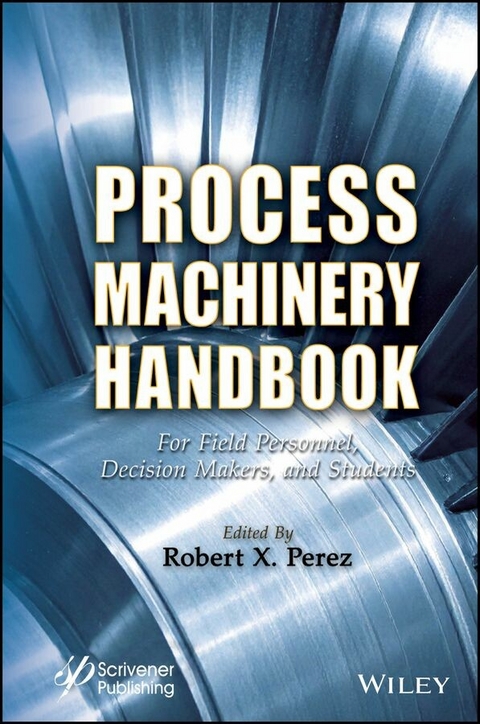
Process Machinery Handbook (eBook)
1387 Seiten
Wiley-Scrivener (Verlag)
978-1-394-21446-4 (ISBN)
Process Machinery Handbook: For Field Personnel, Decision Makers, and Students equips newcomers and seasoned professionals with essential insights into the diverse world of process machinery, empowering them to understand unique performance characteristics, common failure modes, and effective strategies for enhancing reliability in their operations.
Any professional working at a production site for any length of time knows that process machinery comes in a wide range of designs and sizes, but not all process machines are considered equal. Some machines are more critical to the process than others, some are small, some are very large, some spin fast, and some turn relatively slowly. The great diversity in their construction and application can be daunting to those new to the industry and sometimes even challenge machinery veterans. There are many common concepts that apply to all equipment types, but each equipment category has its own unique application and performance characteristics, including cavitation in liquid handling pumps, surging in centrifugal gas compressors, rotor instability in high-speed centrifugal compressors, and the effect of the compression ratio on a reciprocating compressor's the discharge temperature. It is also essential for users to understand how and why different types of machinery fail, keeping in mind that the common failure modes differ greatly between rotating machinery types. We know that by addressing the common types of failure modes associated with each machine type, we can achieve significant improvements in their reliability.
The first step in organizing an effective machinery reliability program is committing to performing failure analyses and gathering failure statistics. These activities will help users learn how and why their machines are failing. The next step is to continuously modify machines, processes, and methods to avoid common failures. Process Machinery Handbook: For Field Personnel, Decision Makers, and Students gives students and professionals alike the tools they need to understand the fundamentals of working with rotating machinery.
Robert X. Perez is a mechanical engineer with more than 40 years of rotating equipment experience in the petrochemical industry. He has worked in petroleum refineries, chemical facilities, and gas processing plants. He earned a BSME degree from Texas A&M University at College Station, an MSME degree from the University of Texas at Austin and holds a Texas PE license. Mr. Perez has written numerous technical articles for magazines and conferences proceedings and has authored and coauthored 11 books covering machinery reliability, including several books also available from Wiley-Scrivener.
Process Machinery Handbook: For Field Personnel, Decision Makers, and Students equips newcomers and seasoned professionals with essential insights into the diverse world of process machinery, empowering them to understand unique performance characteristics, common failure modes, and effective strategies for enhancing reliability in their operations. Any professional working at a production site for any length of time knows that process machinery comes in a wide range of designs and sizes, but not all process machines are considered equal. Some machines are more critical to the process than others, some are small, some are very large, some spin fast, and some turn relatively slowly. The great diversity in their construction and application can be daunting to those new to the industry and sometimes even challenge machinery veterans. There are many common concepts that apply to all equipment types, but each equipment category has its own unique application and performance characteristics, including cavitation in liquid handling pumps, surging in centrifugal gas compressors, rotor instability in high-speed centrifugal compressors, and the effect of the compression ratio on a reciprocating compressor s the discharge temperature. It is also essential for users to understand how and why different types of machinery fail, keeping in mind that the common failure modes differ greatly between rotating machinery types. We know that by addressing the common types of failure modes associated with each machine type, we can achieve significant improvements in their reliability. The first step in organizing an effective machinery reliability program is committing to performing failure analyses and gathering failure statistics. These activities will help users learn how and why their machines are failing. The next step is to continuously modify machines, processes, and methods to avoid common failures. Process Machinery Handbook: For Field Personnel, Decision Makers, and Students gives students and professionals alike the tools they need to understand the fundamentals of working with rotating machinery.
1
Overview of Rotating Machinery
By Robert X. Perez
Rotating machines power our production facilities by safely transporting a wide variety of liquids, gases, and solids from one point in the process to another. Those of you who have worked in a production site for any length of time know that process machines come in a wide range of designs and sizes. It soon becomes apparent that not all process machines are created equal; some are more critical than others; some are small and some are very large; some spin fast and some turn relatively slow. The great diversity in their construction and application can be daunting to those new to the industry and a challenge to the veteran.
Drivers, Speed Modifiers, and Driven Machines:
Process machinery refers to mechanical assemblies, or trains, designed to transport fluids within chemical processing facilities. These trains are typically composed of a group of sub-elements that convert one type of energy into another until it is finally transferred into a useable form of fluid power within a process. Here is a simple flow chart showing how power flows through a machine train.
Figure 1.1 An electric motor coupled directly to a six-throw, reciprocating compressor.
Energy (in) → Driver → Speed Modifier → Driven Machine → Process Fluid Power (out)
Machine train sub-elements are normally interconnected using flexible components called couplings (Figures 1.3 and 1.4). Coupling designs range from elastomeric to metallic disc pack designs. Figure 1.2 illustrates a simple machine train comprised of an electric motor directly coupled to a centrifugal pump.
Available energy, usually in the form of electrical power, steam power, or fuel gas, is first converted into rotational output power. Sometimes, the speed of the driver output shaft must be increased or decreased by a speed modifier, i.e., gearbox or pulleys, depending on the requirement of process machine being driven. Finally, the output power from the speed modifier drives the driven machine that delivers fluid power to the process.
Figure 1.2 An electric motor coupled to a centrifugal pump.
Figure 1.3 Elastomeric couplings.
Figure 1.4 Disc pack type couplings.
Table 1.1 contains common design options for driven machines, drivers, speed modifiers, and combination machines. There are numerous combinations of driven machines, drivers, and speed modifiers. In some cases, process machines can be made up of a combination of a driver and a process driver (Figure 1.2). For example, a turbo expander can have an expansion wheel and a compressor impeller on the same shaft, enabling both components to be contained in a single housing.
Here are a few real examples of machinery trains you can find operating in process settings:
In Figure 1.1, electricity is used to power an electric motor coupled to a reciprocating compressor. The energy flows as follows:
Table 1.1 Common types of process machinery elements.
| Driven machines | Drivers | Speed modifiers | Combination machines |
|---|
| Centrifugal compressors | Electric motors | Gearboxes | Turbo expanders (Figure 1.5) |
| Reciprocating compressors | Steam turbines | Hydraulic speed modifiers | Turbochargers |
| Rotary compressors | Gas turbines | Sheaves and belts |
| Centrifugal pumps | Reciprocating engines |
| Reciprocating pumps |
| Rotary pumps |
| Fans |
Figure 1.5 A turbo-expander consists of a compressor and expander on the same shaft.
Electrical Power (in) → rotating magnetic fields drive electric motor → electric motor powers reciprocating compressor → compressor cylinders generate high pressure gas (out)
Figure 1.6 A natural gas fired engine (on the right) drives a reciprocating compressor (on the left).
Figure 1.7 An electric motor driving a forces draft (FD) fan.
Figure 1.8 An electric motor drives a gearbox, which in turn drives an axial compressor.
In Figure 1.6, natural gas is used to run a reciprocating engine, which in turn powers a reciprocating compressor.
Fuel Gas (in) → Engine power is produced by internal combustion of the fuel gas → engine drives reciprocating compressor → compressor cylinders generate high pressure gas (out)
In Figure 1.7, electricity is used to run an electric motor that is directly coupled to a fan.
Electrical Power (in) → rotating magnetic fields drive electric motor → electric motor powers fan → fan forces air through the system (out)
In Figure 1.8, an electric motor drives an axial compressor. To drive the compressor at the proper speed, a speed increaser is required. Here the input shaft, driven by the motor, turns the low-speed bull gear. The bull gear drives a high-speed pinion gear, which is coupled directly to the axial compressor.
Unspared versus Spared Machine Trains
Machine trains are considered either spared or unspared, i.e., critical. If a process train has an installed “twin” machine train that’s fully functional, but idle, for process redundancy, it is considered spared. However, if a process train does not have an installed “twin” machine train for redundancy, it is said to be a critical machinery train. A machine train can be considered critical if a single mechanical failure will result in a process slowdown or outage. For this reason, unspared process machines tend to receive more scrutiny with regards to condition monitoring and surveillance.
Most processing facilities categorize machinery into several criticality classes. For example, a site may use levels A, B, C, and D criticality classifications and define them as follows:
- Level A train outrages result in:
- complete unit or plant outages or
- could result in significant safety or environmental events.
- Level B train outages result in:
- reduced processing capacity or
- major repair costs.
- Level C train outages have no or minor process consequences but may result in moderate repair costs.
- Level D train outage have no process consequences and minor repair costs
Level A (Critical) machine trains should be the most reliable machines in the plant by design. They need to be able to run continuously and safely between process outages. Predictive and preventative maintenance programs should be thoughtfully designed and meticulously maintained to ensure reliable performance.
Driven-Process Machines
The ultimate purpose of a driven-process machine is to deliver a given process fluid, at a given flow and pressure, to specific points in a process. Driven machines receive the power input from a driver or speed modifier and convert it into fluid power at the process machine’s discharge flange. Most driven-process machines are composed of an input shaft, a casing to contain the process fluid, a suction nozzle for input flow, a discharge nozzle for output flow, bearings to support the rotor (or rotors) and one or two end seals to prevent process leakage into the atmosphere (see Figure 1.8).
Critical Machine Components
The most important machine components are rotor support bearings and end seals. Bearings support all forces acting on the rotor, while allowing it to rotate freely with minimal friction. Most bearings are either rolling element bearings (Figure 1.10) or fluid film bearings (Figure 1.11). Bearing reliability is closely tied to making the proper bearing selection, selecting the right lubricate supply system, and maintaining lubrication cleanliness. End seals are highly engineered components that limit process leakage rates to acceptable levels. There are wet seals (Figure 1.12), which require a liquid to lubricate the seal faces and dry mechanical seals, which use the process gas or an external buffer gas to lubricate the seal faces. Figure 1.13 shows a dry gas seal used in process compressors.
Figure 1.9 This is a cross section of a centrifugal gas compressor. Notice that the rotor is supported by bearings and that gas containment seals are located at the two ends of the compressor casing.
Figure 1.10 Rolling element bearings is a bearing that carries a load by placing rolling elements (such as balls or rollers) between two concentric, grooved rings called races. The relative motion of the races causes the rolling elements to roll with very little rolling resistance and with little sliding.
Figure 1.11 A journal bearing consists of a smooth shaft rotating inside a cylindrical bearing. A thin layer of lubricant separates the journal from the bearing. Journal bearings are used to reduce friction in continuously rotating shafts.
Those...
| Erscheint lt. Verlag | 10.6.2025 |
|---|---|
| Sprache | englisch |
| Themenwelt | Technik ► Maschinenbau |
| Schlagworte | Centrifugal Compressor • Centrifugal Pump • Condition Monitoring • Fluid Power • Liquid Handling Pumps • Machinery Construction • Process Machinery • Rotary Power • rotating machinery |
| ISBN-10 | 1-394-21446-4 / 1394214464 |
| ISBN-13 | 978-1-394-21446-4 / 9781394214464 |
| Informationen gemäß Produktsicherheitsverordnung (GPSR) | |
| Haben Sie eine Frage zum Produkt? |
 EPUB (Adobe DRM)
Kopierschutz: Adobe-DRM
Adobe-DRM ist ein Kopierschutz, der das eBook vor Mißbrauch schützen soll. Dabei wird das eBook bereits beim Download auf Ihre persönliche Adobe-ID autorisiert. Lesen können Sie das eBook dann nur auf den Geräten, welche ebenfalls auf Ihre Adobe-ID registriert sind.
Details zum Adobe-DRM
Dateiformat: EPUB (Electronic Publication)
EPUB ist ein offener Standard für eBooks und eignet sich besonders zur Darstellung von Belletristik und Sachbüchern. Der Fließtext wird dynamisch an die Display- und Schriftgröße angepasst. Auch für mobile Lesegeräte ist EPUB daher gut geeignet.
Systemvoraussetzungen:
PC/Mac: Mit einem PC oder Mac können Sie dieses eBook lesen. Sie benötigen eine
eReader: Dieses eBook kann mit (fast) allen eBook-Readern gelesen werden. Mit dem amazon-Kindle ist es aber nicht kompatibel.
Smartphone/Tablet: Egal ob Apple oder Android, dieses eBook können Sie lesen. Sie benötigen eine
Geräteliste und zusätzliche Hinweise
Buying eBooks from abroad
For tax law reasons we can sell eBooks just within Germany and Switzerland. Regrettably we cannot fulfill eBook-orders from other countries.
aus dem Bereich