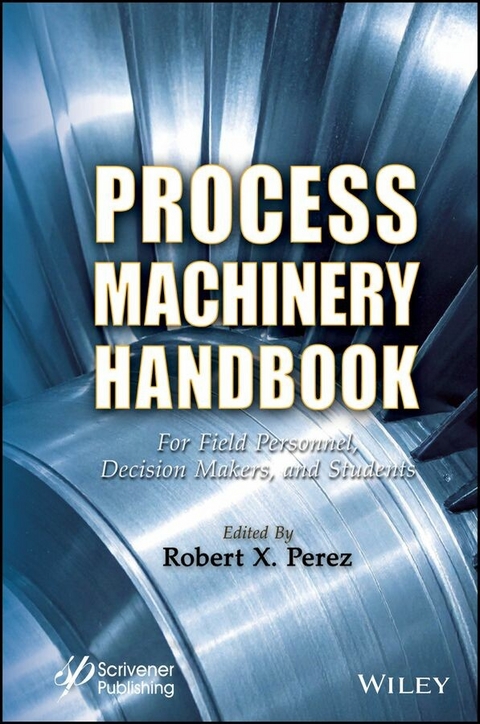
Process Machinery Handbook (eBook)
749 Seiten
Wiley-Scrivener (Verlag)
978-1-394-21447-1 (ISBN)
Process Machinery Handbook: For Field Personnel, Decision Makers, and Students equips newcomers and seasoned professionals with essential insights into the diverse world of process machinery, empowering them to understand unique performance characteristics, common failure modes, and effective strategies for enhancing reliability in their operations.
Any professional working at a production site for any length of time knows that process machinery comes in a wide range of designs and sizes, but not all process machines are considered equal. Some machines are more critical to the process than others, some are small, some are very large, some spin fast, and some turn relatively slowly. The great diversity in their construction and application can be daunting to those new to the industry and sometimes even challenge machinery veterans. There are many common concepts that apply to all equipment types, but each equipment category has its own unique application and performance characteristics, including cavitation in liquid handling pumps, surging in centrifugal gas compressors, rotor instability in high-speed centrifugal compressors, and the effect of the compression ratio on a reciprocating compressor's the discharge temperature. It is also essential for users to understand how and why different types of machinery fail, keeping in mind that the common failure modes differ greatly between rotating machinery types. We know that by addressing the common types of failure modes associated with each machine type, we can achieve significant improvements in their reliability.
The first step in organizing an effective machinery reliability program is committing to performing failure analyses and gathering failure statistics. These activities will help users learn how and why their machines are failing. The next step is to continuously modify machines, processes, and methods to avoid common failures. Process Machinery Handbook: For Field Personnel, Decision Makers, and Students gives students and professionals alike the tools they need to understand the fundamentals of working with rotating machinery.
Robert X. Perez is a mechanical engineer with more than 40 years of rotating equipment experience in the petrochemical industry. He has worked in petroleum refineries, chemical facilities, and gas processing plants. He earned a BSME degree from Texas A&M University at College Station, an MSME degree from the University of Texas at Austin and holds a Texas PE license. Mr. Perez has written numerous technical articles for magazines and conferences proceedings and has authored and coauthored 11 books covering machinery reliability, including several books also available from Wiley-Scrivener.
Process Machinery Handbook: For Field Personnel, Decision Makers, and Students equips newcomers and seasoned professionals with essential insights into the diverse world of process machinery, empowering them to understand unique performance characteristics, common failure modes, and effective strategies for enhancing reliability in their operations. Any professional working at a production site for any length of time knows that process machinery comes in a wide range of designs and sizes, but not all process machines are considered equal. Some machines are more critical to the process than others, some are small, some are very large, some spin fast, and some turn relatively slowly. The great diversity in their construction and application can be daunting to those new to the industry and sometimes even challenge machinery veterans. There are many common concepts that apply to all equipment types, but each equipment category has its own unique application and performance characteristics, including cavitation in liquid handling pumps, surging in centrifugal gas compressors, rotor instability in high-speed centrifugal compressors, and the effect of the compression ratio on a reciprocating compressor s the discharge temperature. It is also essential for users to understand how and why different types of machinery fail, keeping in mind that the common failure modes differ greatly between rotating machinery types. We know that by addressing the common types of failure modes associated with each machine type, we can achieve significant improvements in their reliability. The first step in organizing an effective machinery reliability program is committing to performing failure analyses and gathering failure statistics. These activities will help users learn how and why their machines are failing. The next step is to continuously modify machines, processes, and methods to avoid common failures. Process Machinery Handbook: For Field Personnel, Decision Makers, and Students gives students and professionals alike the tools they need to understand the fundamentals of working with rotating machinery.
| Erscheint lt. Verlag | 3.6.2025 |
|---|---|
| Sprache | englisch |
| Themenwelt | Technik ► Maschinenbau |
| Schlagworte | Centrifugal Compressor • Centrifugal Pump • Condition Monitoring • Fluid Power • Liquid Handling Pumps • Machinery Construction • Process Machinery • Rotary Power • rotating machinery |
| ISBN-10 | 1-394-21447-2 / 1394214472 |
| ISBN-13 | 978-1-394-21447-1 / 9781394214471 |
| Informationen gemäß Produktsicherheitsverordnung (GPSR) | |
| Haben Sie eine Frage zum Produkt? |
 PDF (Adobe DRM)
Kopierschutz: Adobe-DRM
Adobe-DRM ist ein Kopierschutz, der das eBook vor Mißbrauch schützen soll. Dabei wird das eBook bereits beim Download auf Ihre persönliche Adobe-ID autorisiert. Lesen können Sie das eBook dann nur auf den Geräten, welche ebenfalls auf Ihre Adobe-ID registriert sind.
Details zum Adobe-DRM
Dateiformat: PDF (Portable Document Format)
Mit einem festen Seitenlayout eignet sich die PDF besonders für Fachbücher mit Spalten, Tabellen und Abbildungen. Eine PDF kann auf fast allen Geräten angezeigt werden, ist aber für kleine Displays (Smartphone, eReader) nur eingeschränkt geeignet.
Systemvoraussetzungen:
PC/Mac: Mit einem PC oder Mac können Sie dieses eBook lesen. Sie benötigen eine
eReader: Dieses eBook kann mit (fast) allen eBook-Readern gelesen werden. Mit dem amazon-Kindle ist es aber nicht kompatibel.
Smartphone/Tablet: Egal ob Apple oder Android, dieses eBook können Sie lesen. Sie benötigen eine
Geräteliste und zusätzliche Hinweise
Buying eBooks from abroad
For tax law reasons we can sell eBooks just within Germany and Switzerland. Regrettably we cannot fulfill eBook-orders from other countries.
aus dem Bereich