


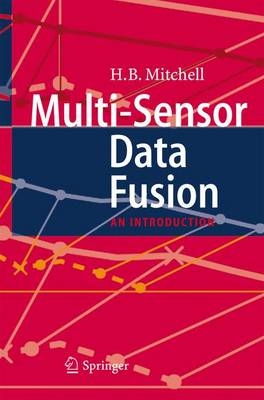
Multi-Sensor Data Fusion
An Introduction
Seiten
2007
Springer Berlin (Verlag)
978-3-540-71463-7 (ISBN)
Springer Berlin (Verlag)
978-3-540-71463-7 (ISBN)
- Titel erscheint in neuer Auflage
- Artikel merken
Zu diesem Artikel existiert eine Nachauflage
This textbook provides a comprehensive introduction to the theories and techniques of multi-sensor data fusion. It is aimed at advanced undergraduate and first-year graduate students in electrical engineering and computer science, as well as researchers and professional engineers. The book is intended to be self-contained. No previous knowledge of multi-sensor data fusion is assumed, although some familiarity with the basic tools of linear algebra, calculus and simple probability theory is recommended.
Although conceptually simple, the study of multi-sensor data fusion presents challenges that are unique within the education of the electrical engineer or computer scientist. To become competent in the field the student must become familiar with tools taken from a wide range of diverse subjects including: neural networks, signal processing, statistical estimation, tracking algorithms, computer vision and control theory. All too often the student views multi-sensor data fusion as a miscellaneous assortment of different processes which bear no relationship to each other. In this book the processes are described using a common statistical framework. As a consequence, the underlying pattern of relationships that exists between the different methodologies is made evident.
Although conceptually simple, the study of multi-sensor data fusion presents challenges that are unique within the education of the electrical engineer or computer scientist. To become competent in the field the student must become familiar with tools taken from a wide range of diverse subjects including: neural networks, signal processing, statistical estimation, tracking algorithms, computer vision and control theory. All too often the student views multi-sensor data fusion as a miscellaneous assortment of different processes which bear no relationship to each other. In this book the processes are described using a common statistical framework. As a consequence, the underlying pattern of relationships that exists between the different methodologies is made evident.
Introduction.- Sensors.- Architecture.- Common Representational Format.- Spatial Alignment.- Temporal Registration.- Sensor Value Normalization.- Bayesian Inference.- Parameter Estimation.- Robust Parameter Estimation.- Sequential Bayesian Inference.- Bayesian Decision Theory.- Multiple Classifier Systems.- Multi-Sensor Management.
| Sprache | englisch |
|---|---|
| Maße | 155 x 235 mm |
| Gewicht | 555 g |
| Einbandart | gebunden |
| Themenwelt | Technik |
| Schlagworte | Bayesion Probabilistic Framework • data fusion • Datenfusion • Multi Sensor Data Fusion • Sensoren • sensors |
| ISBN-10 | 3-540-71463-4 / 3540714634 |
| ISBN-13 | 978-3-540-71463-7 / 9783540714637 |
| Zustand | Neuware |
| Informationen gemäß Produktsicherheitsverordnung (GPSR) | |
| Haben Sie eine Frage zum Produkt? |
Mehr entdecken
aus dem Bereich



aus dem Bereich
mit Berechnungshinweisen und Beispielen
Buch | Hardcover (2024)
Reguvis Fachmedien (Verlag)
CHF 78,40
Praxiswissen zu Schimmelpilzschäden in Gebäuden: Mikrobiologie, …
Buch | Hardcover (2024)
Reguvis Fachmedien (Verlag)
CHF 138,60


