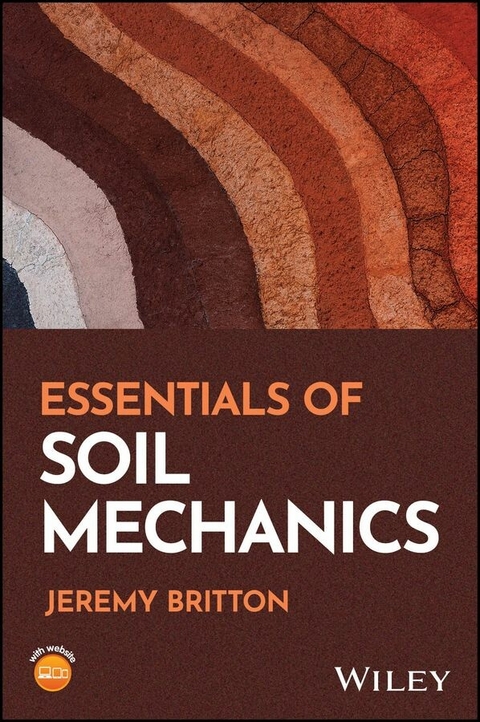
Essentials of Soil Mechanics (eBook)
225 Seiten
Wiley (Verlag)
978-1-394-28988-2 (ISBN)

An overview of the key foundations of soil mechanics
Geotechnical engineering is the subfield of civil engineering which specifically deals with the behavior of earth materials, such as soil and rocks. Soil mechanics is an essential component of geotechnical engineering, and one which incorporates geology, hydrogeology, and other connected subjects in an interdisciplinary engineering approach. Since geotechnical engineering remains a vital component of civil engineering, the need for good introductory materials on soil mechanics continues to be urgent.
Essentials of Soil Mechanics meets this need with a concise, readable introduction to soil behavior and the engineering properties of soil. Written by a practicing engineer with a passion for teaching, it emphasizes content that is used on a regular basis and equips engineers to find additional information they may need. It is an essential reference and supplement for anyone needing additional guidance on this crucial subject.
Essentials of Soil Mechanics readers will also find:
- A friendly, engaging, accessible tone throughout
- Detailed discussion of topics including effective stress, seepage, consolidation, shear strength, and more
- Recaps at the end of each chapter to emphasize key concepts
Essentials of Soil Mechanics is ideal for students studying soil mechanics, geotechnical engineering, civil engineering, and related subjects.
Jeremy Britton, PhD, is a Registered Professional Engineer with decades of practical and teaching experience. He has spent two decades as a geotechnical engineer at the US Army Corps of Engineers, Portland District, Civil Works, where he currently serves as senior geotechnical engineer and project technical lead. He has extensive teaching experience at multiple educational levels and has taught soil mechanics at Portland State University.
An overview of the key foundations of soil mechanics Geotechnical engineering is the subfield of civil engineering which specifically deals with the behavior of earth materials, such as soil and rocks. Soil mechanics is an essential component of geotechnical engineering, and one which incorporates geology, hydrogeology, and other connected subjects in an interdisciplinary engineering approach. Since geotechnical engineering remains a vital component of civil engineering, the need for good introductory materials on soil mechanics continues to be urgent. Essentials of Soil Mechanics meets this need with a concise, readable introduction to soil behavior and the engineering properties of soil. Written by a practicing engineer with a passion for teaching, it emphasizes content that is used on a regular basis and equips engineers to find additional information they may need. It is an essential reference and supplement for anyone needing additional guidance on this crucial subject. Essentials of Soil Mechanics readers will also find: A friendly, engaging, accessible tone throughoutDetailed discussion of topics including effective stress, seepage, consolidation, shear strength, and moreRecaps at the end of each chapter to emphasize key concepts Essentials of Soil Mechanics is ideal for students studying soil mechanics, geotechnical engineering, civil engineering, and related subjects.
1
Soil Composition
Soil is a complex material in both its composition and its behavior. The main objective of this chapter is to introduce the properties we use to characterize the composition of soils. What is in a particular soil and what are the relative amounts? We will introduce the properties by talking about phase diagrams and the division of soils into the broad categories of coarse grained and fine grained. We will also talk about the Unified Soil Classification System (USCS).
Soils are assemblages of solid particles, water, air, and potentially other things such as organic matter. We rarely make soil like we make steel, concrete, and plastics. We get the soil that nature gives us. For this reason, it is important to ask how a soil got to be where it is. What is the geologic origin? If you are not a geologist, that is okay. Find a geologist friend.
It is also important to appreciate how variable the subsurface can be. This applies at all scales, from within a single soil deposit to the overall stratigraphy of a site. We drill some holes, dig some test pits, and otherwise try our best to “see” as much of the subsurface as economically practical. We only ever see a little bit. We are going to apply principles of mechanics to soils. We have become very good at this, but please keep in mind the variability of the soils to which we apply our mechanics.
The solid particles in soils cover a wide range of sizes. Figure 1.1 shows the size boundaries between boulders, cobbles, gravels, sands, and silts and clays based on the USCS. Silt and clay particles are too small to see with the naked eye. A soil can consist of particles that are all within one size range (e.g., all sand) or can be a mixture of particles of various sizes (e.g., clayey sand with gravel).
1.1 Phase Diagrams
Figure 1.2 is a phase diagram for the solids, water, and air in a soil. Volumes are shown on the left side. The volume of the voids, Vv, is the volume of the water plus the volume of the air. The subscript s in Vs stands for solids. Do not mistake Vs for the volume of the soil. Masses are shown on the right side. The total mass is the mass of the solids plus the mass of the water.
Figure 1.1 Soil particle sizes.
Figure 1.2 Soil phase diagram.
Each phase has its own density. The density of air is zero. The density of water, ρw, is 1 Mg/m3. The density of the solids, ρs, typically ranges from about 2.6 to 2.8 Mg/m3. We often express the density of the solids in terms of specific gravity, Gs, which is the density of the solids divided by the density of water. We usually assume a value for the specific gravity of the solids within the range of 2.6–2.8. Specific gravity can be measured in the lab if for some reason it is important to know it more accurately, but usually it is just estimated.
In soil mechanics, we care a lot about the relative volume of the voids in a soil and the relative amount of water in those voids. The voids in soil are also called pores. We call the water in the pores “pore water.” We can use the phase diagram to define the following four properties related to void volume and amount of water:
The void ratio and porosity, which are typically reported as decimals, contain the same information. The void ratio can be converted into porosity and vice versa. The degree of saturation and water content, which are typically reported as percentages, are related by the nice equation below which includes the void ratio and the specific gravity of the solids,
The phase diagram can also be used to derive equations for the density of a soil in terms of the properties above. We use the total density and dry density,
We call the total density a saturated density, ρsat, when a soil is entirely saturated (S = 100%). When a soil is partially saturated (S < 100%), we call the total density a moist density, ρm. The total density is the dry density when a soil is entirely dry (w = 0%). The soil does not have to be dry, however, for us to calculate and use its dry density. We often want to know the dry density of the soil even when there is water in the voids. The dry density is inversely related to the void ratio. When there are a lot of voids in a soil, its void ratio is high and its dry density is low. Conversely, a soil with a low void ratio has a high dry density. We track the dry density when compacting soils as we will see in the next section. A high dry density leads to a stronger and less compressible soil.
In Chapter 5, we will discuss the relationship between the relative density and the shear strength of sands. The relative density, Dr, is an indication of a soil's density compared to its minimum and maximum dry densities (or its maximum and minimum void ratios). There are standardized lab tests for determining a soil's minimum and maximum dry densities. The relative density, which is typically reported as a percentage, is defined as
or
1.2 Application of Phase Diagrams: Compaction
Suppose we have a source of sandy clay soil that we want to compact into an embankment. We take a sample of the soil and bring it into the lab to perform compaction tests.
The standard Proctor compaction test is performed by compacting the soil, which is in a moist condition, in three layers in a cylindrical mold with a total volume of 944 cm3. The compactive effort is applied by dropping a 24.4 N rammer onto the soil from a height of 30.5 cm. Each layer receives 25 rammer blows. The compactive energy applied to the soil is 600 kN‐m/m3.
After the soil is compacted, the total mass of the soil in the mold is measured. The moist density of the soil is the total mass divided by the volume of the mold. A sample of the soil is taken for a water content test, which involves measuring the mass of the soil before and after evaporating the water in an oven. The water content is calculated as the mass of the evaporated water divided by the mass of the dry solids.
Table 1.1 shows how the phase diagram relationships can be used to calculate the various properties of the soil for a compaction water content of 11.5%. We do not always calculate all of these items, but we can if we need to.
Table 1.1 Phase diagram calculations in a compaction test.
| Calculations for compaction test with w = 11.5% |
|---|
| Gs | 2.7, assumed |
| Mt | 1789 g, measured |
| Vt | 944 cm3, measured |
| ρt = ρm | Mt/Vt = 1.90 g/cm3 |
| w | 11.5%, measured |
| ρd | ρt/(1 + w) = 1.70 g/cm3 |
| Ms | ρdVt = 1605 g |
| Vs | Ms/(Gsρw) = 594 cm3 |
| Mw | wMs = 185 g |
| Vw | Mw/ρw = 185 cm3 |
| Vv | Vt − Vs = 350 cm3 |
| Va | Vv − Vw = 165 cm3 |
| e | Vv/Vs = 0.59 | or | ρd = Gsρw/(1 + e) e = (Gsρw/ρd) − 1 |
| n | Vv/Vt = 0.37 | or | n = e/(1 + e) |
| S | Vw/Vv = 53% | or | Se = wGs S = wGs/e |
Note that 1 g/cm3 = 1 Mg/m3
The compaction test is repeated five or so times with the soil mixed at various water contents. We plot the dry density versus the compaction water content, as shown in Figure 1.3. As the water content initially...
| Erscheint lt. Verlag | 13.5.2025 |
|---|---|
| Sprache | englisch |
| Themenwelt | Technik ► Bauwesen |
| Schlagworte | active pressure • Consolidation • drained loading condition • effective stress • flow net • Mohr Circle • Mohr-Coulomb failure line • passive pressure • Seepage • site investigation • Soil Composition • soil compressibility • soil permeability • Soil properties • soil shear strength • undrained loading condition |
| ISBN-10 | 1-394-28988-X / 139428988X |
| ISBN-13 | 978-1-394-28988-2 / 9781394289882 |
| Informationen gemäß Produktsicherheitsverordnung (GPSR) | |
| Haben Sie eine Frage zum Produkt? |
 EPUB (Adobe DRM)
Kopierschutz: Adobe-DRM
Adobe-DRM ist ein Kopierschutz, der das eBook vor Mißbrauch schützen soll. Dabei wird das eBook bereits beim Download auf Ihre persönliche Adobe-ID autorisiert. Lesen können Sie das eBook dann nur auf den Geräten, welche ebenfalls auf Ihre Adobe-ID registriert sind.
Details zum Adobe-DRM
Dateiformat: EPUB (Electronic Publication)
EPUB ist ein offener Standard für eBooks und eignet sich besonders zur Darstellung von Belletristik und Sachbüchern. Der Fließtext wird dynamisch an die Display- und Schriftgröße angepasst. Auch für mobile Lesegeräte ist EPUB daher gut geeignet.
Systemvoraussetzungen:
PC/Mac: Mit einem PC oder Mac können Sie dieses eBook lesen. Sie benötigen eine
eReader: Dieses eBook kann mit (fast) allen eBook-Readern gelesen werden. Mit dem amazon-Kindle ist es aber nicht kompatibel.
Smartphone/Tablet: Egal ob Apple oder Android, dieses eBook können Sie lesen. Sie benötigen eine
Geräteliste und zusätzliche Hinweise
Buying eBooks from abroad
For tax law reasons we can sell eBooks just within Germany and Switzerland. Regrettably we cannot fulfill eBook-orders from other countries.
aus dem Bereich