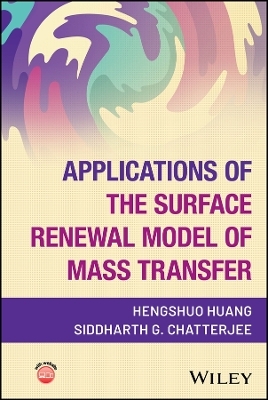
Applications of the Surface Renewal Model of Mass Transfer
John Wiley & Sons Inc (Verlag)
978-1-394-31282-5 (ISBN)
Applications of the Surface Renewal Model of Mass Transfer provides a rigorous application of the surface renewal theory of mass transfer to describe physical and chemical gas absorption and membrane filtration. This book demonstrates that the surface renewal model can predict the experimentally measured liquid-side physical mass-transfer coefficient in gas absorption with a fair degree of accuracy, shows that the surface renewal model can correlate permeate flux and transmembrane pressure drop data in constant pressure and constant flux microfiltration, and contains numerous examples of the application of the model to real-world situations.
This book includes information on:
Applications of the surface renewal model in fields like chemical engineering and oceanography
The complex nature of the surface renewal model as a better description of the turbulent hydrodynamics that prevail at the gas-liquid interface compared to the film model
Measurements of the liquid-side physical mass-transfer coefficient in gas absorption studies and surface-age distributions in wind-wave tanks
Flow instabilities induced by wall roughness or spacers or by their deliberate introduction into the main flow in membrane filtration
Analysis and design of gas-liquid contactors (stirred tanks and packed towers) and membrane filters using a mass-transfer approach
Applications of the Surface Renewal Model of Mass Transfer is an excellent, first-of-its-kind reference for researchers in academia and industry, along with advanced students in chemical engineering, environmental engineering, bioprocess/biological engineering, paper engineering, and related programs of study.
Dr. Hengshuo Huang is a dedicated researcher specializing in chemical engineering and environmental biotechnology. His postdoctoral research at Peking University, where he is Assistant Research Fellow under Professor Shaojun Guo, focuses on gas diffusion electrode modeling via finite element analysis and machine learning for electrochemical applications. Dr. Siddharth G. Chatterjee is Associate Professor Emeritus in the Department of Chemical Engineering at SUNY College of Environmental Science and Forestry in Syracuse, New York, USA.
Preface xiii
About the Companion Website xv
1 The Surface Renewal Model of Mass Transfer 1
1.1 Introduction 1
1.2 Literature Review 2
References 8
2 Age-Distribution Function of the Surface Renewal Model 15
2.1 Introduction 15
2.2 Danckwerts Age Distribution 15
2.2.1 Case 1 16
2.2.2 Case 2 17
2.3 Generalized Danckwerts Age Distribution 19
Notation 23
Greek Letters 24
Homework Exercises 24
References 24
3 Physical Gas Absorption in a Large Volume of Liquid 27
3.1 Introduction 27
3.2 Rates of Absorption and Dissolved-Gas Transfer 27
3.3 Comparison of the Surface Renewal Model with Experimental Data 32
Notation 34
Greek Letters 35
Homework Exercises 35
References 35
4 Physical Gas Absorption in a Stirred Batch Cell 37
4.1 Introduction 37
4.2 Interfacial Mass-Transfer Model 38
4.2.1 Zero Gas-Phase Mass-Transfer Resistance 38
4.2.2 Finite Gas-Phase Mass-Transfer Resistance 42
4.3 Philosophical Interlude 45
4.4 Bulk Mass-Transfer Model 46
4.4.1 Zero Gas-Phase Mass-Transfer Resistance 47
4.4.2 Finite Gas-Phase Mass-Transfer Resistance 47
4.5 Analytical Expressions for the Rates of Absorption and Dissolved-Gas Transfer Using the Laplace Transform Method 48
4.5.1 Gaver–Stehfest Algorithm 48
4.5.2 Zero Gas-Phase Mass-Transfer Resistance 49
4.5.3 Finite Gas-Phase Mass-Transfer Resistance 50
4.6 Conventional Pseudo-Steady-State LDF Model 52
4.7 Absorption of Oxygen and Hydrogen in Water 52
Notation 64
Greek Letters 66
Homework Exercises 66
References 67
5 Gas Absorption with First-Order Reaction in a Stirred Batch Cell 69
5.1 Introduction 69
5.2 Interfacial Mass-Transfer Model 72
5.2.1 Zero Gas-Phase Mass-Transfer Resistance 72
5.2.2 Finite Gas-Phase Mass-Transfer Resistance 78
5.3 Bulk Mass-Transfer Model 83
5.3.1 Zero Gas-Phase Mass-Transfer Resistance 84
5.3.2 Finite Gas-Phase Mass-Transfer Resistance 85
5.4 Analytical Expressions for the Rates of Absorption and Dissolved-Gas Transfer Using the Laplace Transform Method 85
5.4.1 Gaver–Stehfest Algorithm 85
5.4.2 Zero Gas-Phase Mass-Transfer Resistance 86
5.4.3 Finite Gas-Phase Mass-Transfer Resistance 88
5.5 Pseudo-Steady-State (PSS) Model 89
5.5.1 Zero Gas-Phase Mass-Transfer Resistance 89
5.5.2 Finite Gas-Phase Mass-Transfer Resistance 91
5.6 Absorption of Oxygen in Water Containing a Liquid-Phase Reagent (e.g., Na 2 SO 3) 91
Notation 100
Greek Letters 102
Acronyms 102
Homework Exercises 103
References 103
6 Gas Absorption with First-Order Reaction in a Packed Tower 107
6.1 Introduction 107
6.2 Surface Renewal Model 109
6.2.1 Physical Absorption 115
6.2.2 Liquid-Phase Control 116
6.2.3 Gas-Phase Control 117
6.3 Film Model 118
6.3.1 Physical Absorption 120
6.3.2 Liquid-Phase Control 120
6.3.3 Gas-Phase Control 120
6.4 Mass-Transfer and Hydraulic Correlations 121
6.5 Illustrative Calculations 122
6.5.1 System 1 124
6.5.2 System 2 126
6.5.3 System 3 128
6.5.4 Outlet Gas- and Liquid-Phase Concentrations as Functions of Hatta Number 129
6.5.5 Effect of Operational Gas and Liquid Mass Velocities on Gas Concentration Profile 131
6.5.6 Effect of Hatta Number on the Height and Number of Overall Gasand Liquid-Phase Mass-Transfer Units 133
Notation 135
Greek Letters 137
Homework Exercises 137
Acknowledgment 138
References 138
7 Gas Absorption with Instantaneous Reaction in a Packed Tower 141
7.1 Introduction 141
7.2 Theoretical Analysis 144
7.2.1 Film Model 145
7.2.1.1 Zero Gas-Phase Mass-Transfer Resistance 147
7.2.1.2 Finite Gas-Phase Mass-Transfer Resistance 152
7.2.2 Surface Renewal Model 153
7.2.2.1 Zero Gas-Phase Mass-Transfer Resistance 154
7.2.2.2 Finite Gas-Phase Mass-Transfer Resistance 160
7.3 Illustrative Calculations 166
7.3.1 Zero Gas-Phase Mass-Transfer Resistance 166
7.3.1.1 Tower Concentration Profiles 168
7.3.1.2 Movement of Reaction Front 170
7.3.2 Finite Gas-Phase Mass-Transfer Resistance 171
7.3.2.1 Validity of the Solution of the Surface Renewal Model 171
7.3.2.2 Tower Concentration Profiles 173
7.3.2.3 Effect of Concentration of B in the Incoming Liquid on Tower Performance 175
Notation 179
Greek Letters 182
Acronyms 182
Homework Exercises 182
References 183
8 Constant Pressure Crossflow Ultrafiltration (UF) 187
8.1 Introduction 187
8.2 Surface Renewal Model 188
8.2.1 Empirical Equation 190
8.2.2 Diffusion Equation 191
8.3 Film Model 196
8.4 Mass-Transfer Coefficient 196
8.5 Relation Between Limiting Flux and Transmembrane Pressure (tmp) 197
8.6 Application of the Surface Renewal and Film Models 197
8.6.1 UF of Cheese Whey 197
8.6.2 UF of Dextran Solutions 200
8.6.3 UF of Skim Milk 204
Notation 207
Greek Letters 208
Acronyms 209
Homework Exercises 209
Acknowledgment 209
References 210
9 Constant Pressure Crossflow Microfiltration 213
9.1 Introduction 213
9.2 Surface Renewal Model of Crossflow Microfiltration 216
9.2.1 Complete Model 216
9.2.2 Approximate Model 221
9.3 Correlation of the Surface Renewal Model with Experimental Permeate Flux Data 224
9.3.1 Data of Hasan et al. (2013) 224
9.3.1.1 Fermentation 224
9.3.1.2 Membrane Characteristics 224
9.3.1.3 Experimental Runs 225
9.3.1.4 Model Validation 225
9.3.2 Dependence of the Surface Renewal Frequency on Feed Velocity 229
9.3.3 Data of Mallubhotla and Belfort (1997) 231
9.3.3.1 Model Validation 232
Notation 242
Greek Letters 243
Acronyms 244
Homework Exercises 244
References 245
10 Constant Flux Crossflow Microfiltration 249
10.1 Introduction 249
10.2 Surface Renewal Model of Crossflow Microfiltration 252
10.2.1 Complete Model: Compressible Cake (n ≠ 0) 254
10.2.1.1 Variation of TMP with Process Time 255
10.2.1.2 Variation of TMP with Permeate Flux 255
10.2.2 Subsidiary Model: Incompressible Cake (n = 0) 257
10.3 Correlation of the Surface Renewal Model with Experimental TMP Data 258
10.3.1 Data of Ho and Zydney (2002) 258
10.3.2 Data of Kovalsky et al. (2009) 262
10.3.3 Data of Miller et al. (2014) 263
Notation 271
Greek Letters 272
Acronyms 272
Homework Exercises 273
References 274
Index 277
| Erscheinungsdatum | 04.12.2025 |
|---|---|
| Verlagsort | New York |
| Sprache | englisch |
| Themenwelt | Technik |
| ISBN-10 | 1-394-31282-2 / 1394312822 |
| ISBN-13 | 978-1-394-31282-5 / 9781394312825 |
| Zustand | Neuware |
| Informationen gemäß Produktsicherheitsverordnung (GPSR) | |
| Haben Sie eine Frage zum Produkt? |
aus dem Bereich