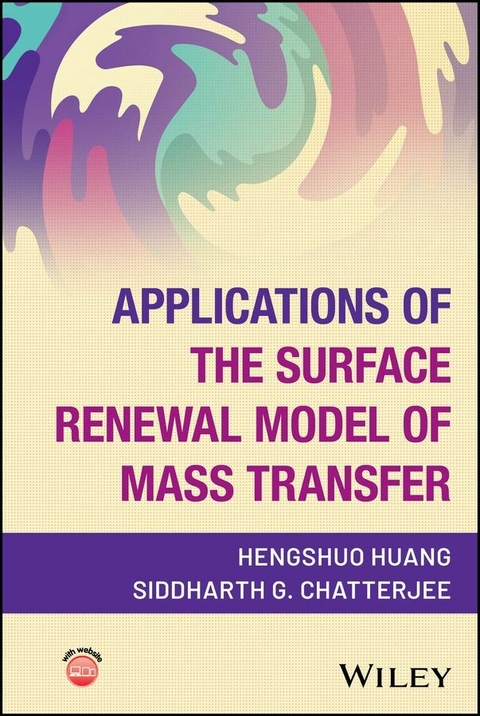
Applications of the Surface Renewal Model of Mass Transfer (eBook)
504 Seiten
Wiley (Verlag)
978-1-394-31283-2 (ISBN)
Introduction to the surface renewal model of mass transfer for the analysis and design of gas-liquid contacting equipment and membrane filters
Applications of the Surface Renewal Model of Mass Transfer provides a rigorous application of the surface renewal theory of mass transfer to describe physical and chemical gas absorption and membrane filtration. This book demonstrates that the surface renewal model can predict the experimentally measured liquid-side physical mass-transfer coefficient in gas absorption with a fair degree of accuracy, shows that the surface renewal model can correlate permeate flux and transmembrane pressure drop data in constant pressure and constant flux microfiltration, and contains numerous examples of the application of the model to real-world situations.
This book includes information on:
- Applications of the surface renewal model in fields like chemical engineering and oceanography
- The complex nature of the surface renewal model as a better description of the turbulent hydrodynamics that prevail at the gas-liquid interface compared to the film model
- Measurements of the liquid-side physical mass-transfer coefficient in gas absorption studies and surface-age distributions in wind-wave tanks
- Flow instabilities induced by wall roughness or spacers or by their deliberate introduction into the main flow in membrane filtration
- Analysis and design of gas-liquid contactors (stirred tanks and packed towers) and membrane filters using a mass-transfer approach
Applications of the Surface Renewal Model of Mass Transfer is an excellent, first-of-its-kind reference for researchers in academia and industry, along with advanced students in chemical engineering, environmental engineering, bioprocess/biological engineering, paper engineering, and related programs of study.
Dr. Hengshuo Huang is a dedicated researcher specializing in chemical engineering and environmental biotechnology. His postdoctoral research at Peking University, where he is Assistant Research Fellow under Professor Shaojun Guo, focuses on gas diffusion electrode modeling via finite element analysis and machine learning for electrochemical applications.
Dr. Siddharth G. Chatterjee is Associate Professor Emeritus in the Department of Chemical Engineering at SUNY College of Environmental Science and Forestry in Syracuse, New York, USA.
1
The Surface Renewal Model of Mass Transfer*
1.1 Introduction
The surface of a turbulent liquid is characterized by bursting and chaotic movements of eddies that emerge from below the surface and by the presence of turbulent sweeps, upwellings, downwellings, and vortices that profoundly affect the interfacial mass‐transfer process (Komori et al., 1989; Banerjee, 2007; Turney and Banerjee, 2008). In 1951, Danckwerts published his classic paper on gas absorption in a turbulent liquid, in which he presented the surface renewal model of mass transfer (Danckwerts, 1951). This model visualizes the gas–liquid interface, where the absorption occurs, to be replenished by fresh liquid elements that emerge continuously from the bulk liquid. During the exposure time of an element at the gas–liquid interface, mass transfer of dissolved gas is assumed to occur in it by the mechanism of unsteady‐state molecular diffusion. In contrast to the penetration model of Higbie (1935), which had assumed that all surface elements had the same residence time at the gas–liquid interface (i.e., uniform age distribution), Danckwerts derived an exponential age distribution by using the postulate that all surface elements, irrespective of their individual ages, had an equal probability of being replaced by fresh elements arriving from the bulk liquid. The only parameter that appears in this distribution is the frequency or rate of surface renewal S, which is the mean rate of production of fresh surface according to Danckwerts (1951) and which depends upon the prevailing hydrodynamic conditions. This well‐known age distribution, whose experimental confirmation has been provided by Lamb et al. (1969) in the case of a stirred liquid and Lesage et al. (2002) in the case of a single liquid phase flowing through a packed‐bed reactor, has been widely used in chemical engineering, and a variety of applications and extensions of the surface renewal model have appeared in the literature over the years.
In mass‐transfer studies, the surface renewal model is believed to be a more realistic representation of interfacial mass transfer than the film model1 since it predicts that the liquid‐side mass‐transfer coefficient kL is proportional to the square root of the diffusion coefficient D of the dissolved gas in the liquid – a result that has often been confirmed experimentally. For example, Kuthan and Broz̆ (1989) obtained experimental values of kL for the absorption of helium, nitrogen, and propane in a liquid film of aqueous ethylene glycol flowing over a smooth wetted wall and an expanded metal sheet. For the case of the wetted wall, they found kL ∝ D0.5, which agrees with the prediction of the surface renewal model. For the expanded metal sheet, kL ∝ D0.64, and the film‐penetration model (Dobbins, 1956; Toor and Marchello, 1958) was found to be more appropriate. According to Astarita (1967), for a flowing liquid in contact with a solid or a more viscous liquid phase, kL ∝ D2/3. Richter and Jähne (2010) measured the transfer velocity (i.e., kL) of five sparingly soluble gas tracers as a function of wind speed (1–10 m s−1) in the Heidelberg Aeolotron and a small circular wind‐wave facility. Their experiments revealed that the exponent of D varied from 2/3 to 1/2 as the water surface transitioned from smooth to rough or wavy with increasing wind speed, a finding later confirmed by the extensive experimental measurements of Krall (2013). Empirical correlations for kL in towers filled with random packings indicate that kL ∝ D1/2 (Onda et al., 1968a; 1968b; Richardson et al., 2003). All of this evidence is in sharp contrast to the prediction of the film model, according to which kL ∝ D.
1.2 Literature Review
Since the publication of the original surface renewal model by Danckwerts (1951), many studies have been conducted on heat‐ and mass‐transfer phenomena near the surface of a turbulent liquid, including measurements of gas absorption rates in wetted‐wall columns, stirred tanks, and packed towers. We present only a brief review of the literature, mostly drawn from chemical engineering, on the surface renewal model, although a considerable body of work has developed on it in fields like oceanography and meteorology – see, for instance, the paper by Zorzetto et al. (2021) and the references cited therein.
Johnson and Huang (1956) measured the dissolution rates of five different organic solids from a stationary surface into a turbulent vessel with and without baffles and proposed a dimensionless correlation for the Sherwood number in which the Schmidt number exponent was set equal to 0.5 in accordance with the Danckwerts model and obtained satisfactory results. Further, they found good consistency between the experimental and theoretical values of the Schmidt number exponent, which indicated that the surface renewal model could also be used to describe mass transport from a plane solid surface into a turbulent liquid. Perlmutter (1961) likened the Higbie and Danckwerts age distributions to residence time distributions in plug‐flow and well‐mixed vessels and derived a variety of surface renewal models based on this analogy. The models included multiple capacitances, dead time, and interfacial nonequilibrium effects; however, no estimates of the model parameters drawn from model comparisons with experimental data were presented.
An extension of the surface renewal model to describe mass transfer from a turbulent fluid to a solid wall was made by Harriott (1962), who assumed randomly arriving eddies at arbitrary intervals to approach random distances from the wall, thereby removing accumulated solute in its vicinity. In the intervals between the arrival of eddies, mass transfer of the solute was assumed to occur by molecular diffusion alone. The gamma distribution was chosen to fit the random sequences of distances and times, and it was found that the random distance model was consistent with available data for mass transfer in pipes. Angelo et al. (1966) extended Higbie's penetration model to account for surface stretch (i.e., the creation of new surface) to describe mass transfer to oscillating and forming drops. In the case of the former, their model was in reasonable agreement with experimental data on the extraction efficiency for some liquid–liquid systems.
Analytical solutions for the hydrodynamic behavior of very small scales of turbulent motion in the vicinity of the surface of a turbulent liquid were obtained by Lamont and Scott (1970), who related the energy dissipation rate to the turbulent energy spectrum and the collective outcome of eddies with diverse sizes. For turbulent bubbly flow in a 5/16‐in. tube, the predicted mass‐transfer coefficient agreed quite well with its measured value at a Reynolds number of 10,000. However, the exponent of the Reynolds number in the theoretical equation for the mass‐transfer coefficient (0.69) was higher than the experimental exponent (0.52). Chung et al. (1971) presented a general transient age distribution from which different age‐distribution functions could be obtained by substituting different steady‐state age distributions into the general equation. Using these, they developed penetration and surface renewal models and derived four different expressions for the instantaneous rate of mass transfer for different boundary conditions (see Table 1 in their paper). These models were expected to more accurately reflect physical reality compared to steady‐state models, especially during the start‐up period of interphase transport processes. Also, the transient models had better agreement with experimental data for large flow rates than for small ones. Babu and Narsimhan (1980) derived a transient form of the generalized gamma age‐distribution function for interfacial transport phenomena in free or fixed configurations. By fitting their model to published experimental measurements of the Nusselt number in the thermal entrance region of a pipe and response measurements from a continuous tubular flow reactor, the shape factor of the distribution was determined to be five, and an empirical linear correlation was established between the fractional surface renewal rate and Reynolds number lying within the range of 20,000−55,000.
Sada et al. (1979) measured the rates of absorption of CO2 into water, NaOH solution (0.2 mol L−1), and glycerol solution (40 weight percent) in a stirred vessel. They found that the experimental data of the enhancement factor agreed well with predicted values obtained from the Danckwerts surface renewal model for the first two solutions. However, the data for the glycerol solution were lower than the calculated values, probably due to a decrease in the average surface renewal rate in a system with high viscosity. Their findings also suggested that both bulk turbulence and interfacial turbulence have a similar impact on the rate of gas absorption...
| Erscheint lt. Verlag | 18.11.2025 |
|---|---|
| Sprache | englisch |
| Themenwelt | Naturwissenschaften ► Chemie |
| Schlagworte | Age distribution function • chemical reaction • Film Model • Gas absorption • gas-liquid reactor • mass transfer • Microfiltration • Packed tower • surface renewal model • Ultrafiltration |
| ISBN-10 | 1-394-31283-0 / 1394312830 |
| ISBN-13 | 978-1-394-31283-2 / 9781394312832 |
| Informationen gemäß Produktsicherheitsverordnung (GPSR) | |
| Haben Sie eine Frage zum Produkt? |
 EPUB (Adobe DRM)
Kopierschutz: Adobe-DRM
Adobe-DRM ist ein Kopierschutz, der das eBook vor Mißbrauch schützen soll. Dabei wird das eBook bereits beim Download auf Ihre persönliche Adobe-ID autorisiert. Lesen können Sie das eBook dann nur auf den Geräten, welche ebenfalls auf Ihre Adobe-ID registriert sind.
Details zum Adobe-DRM
Dateiformat: EPUB (Electronic Publication)
EPUB ist ein offener Standard für eBooks und eignet sich besonders zur Darstellung von Belletristik und Sachbüchern. Der Fließtext wird dynamisch an die Display- und Schriftgröße angepasst. Auch für mobile Lesegeräte ist EPUB daher gut geeignet.
Systemvoraussetzungen:
PC/Mac: Mit einem PC oder Mac können Sie dieses eBook lesen. Sie benötigen eine
eReader: Dieses eBook kann mit (fast) allen eBook-Readern gelesen werden. Mit dem amazon-Kindle ist es aber nicht kompatibel.
Smartphone/Tablet: Egal ob Apple oder Android, dieses eBook können Sie lesen. Sie benötigen eine
Geräteliste und zusätzliche Hinweise
Buying eBooks from abroad
For tax law reasons we can sell eBooks just within Germany and Switzerland. Regrettably we cannot fulfill eBook-orders from other countries.
aus dem Bereich