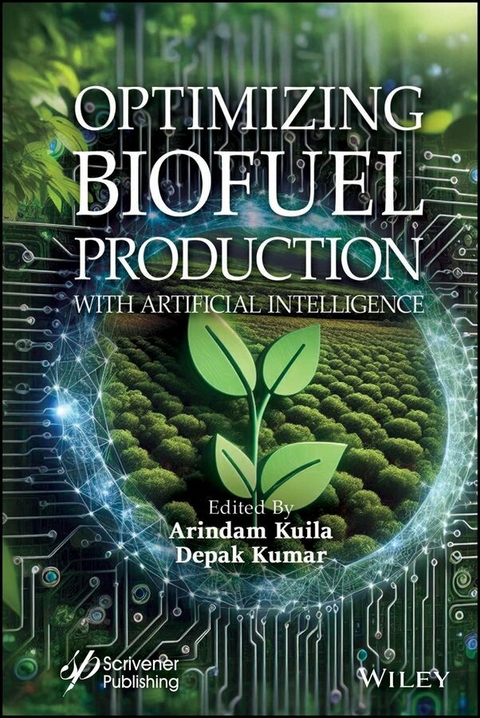
Optimizing Biofuel Production with Artificial Intelligence (eBook)
548 Seiten
Wiley-Scrivener (Verlag)
978-1-394-30126-3 (ISBN)
Optimizing Biofuel Production with Artificial Intelligence will help readers discover how integrating artificial intelligence with biotechnological advancements can revolutionize biofuel production, ensuring a sustainable energy future in response to pressing global challenges like pollution and climate change.
This book presents artificial intelligence as a technique to aid the production of biofuels. Recently, tremendous developments have been made in energy and environmental biotechnologies, spurred by societal issues like pollution control, energy security, and climate change. Energy can be obtained from a variety of sources, including coal, oil, natural gas, solar, wind, and nuclear energy. The need to transition to new energy results from finite resources and economic sustainability. Biotechnological process optimization is crucial for ensuring a quality final product and boosting bioconversion performance efficiency. When combined with traditional simulation and modeling methods, artificial intelligence and computer technology can help define ideal process parameters and save total process costs. The energy sector can benefit from artificial intelligence in several ways, including increased asset efficiency, early detection and assessment of wildfire risks, assistance with vegetation management and storm recovery, and optimized energy use. The new frontier for energy is biomass.
Arindam Kuila, PhD, is an assistant professor in the Department of Bioscience and Biotechnology, Banasthali Vidyapith, Rajasthan, India. He has co-authored 35 peer-reviewed articles and 18 book chapters, edited 12 books, and filed six patents. In addition to his written work, he has completed an Indo-Brazil collaborative project funded by India's Department of Biotechnology. His research interests include environmental biotechnology, lignocellulosic biofuel, and bioremediation.
Depak Kumar, PhD, is an assistant professor in the Department of Chemical Engineering, Banasthali Vidyapith, Rajasthan, India. He has published several articles in international journals of repute, as well as three book chapters and three books. His research interests include solar cell degradation, stability of solar cells, and energy conversion devices.
Optimizing Biofuel Production with Artificial Intelligence will help readers discover how integrating artificial intelligence with biotechnological advancements can revolutionize biofuel production, ensuring a sustainable energy future in response to pressing global challenges like pollution and climate change. This book presents artificial intelligence as a technique to aid the production of biofuels. Recently, tremendous developments have been made in energy and environmental biotechnologies, spurred by societal issues like pollution control, energy security, and climate change. Energy can be obtained from a variety of sources, including coal, oil, natural gas, solar, wind, and nuclear energy. The need to transition to new energy results from finite resources and economic sustainability. Biotechnological process optimization is crucial for ensuring a quality final product and boosting bioconversion performance efficiency. When combined with traditional simulation and modeling methods, artificial intelligence and computer technology can help define ideal process parameters and save total process costs. The energy sector can benefit from artificial intelligence in several ways, including increased asset efficiency, early detection and assessment of wildfire risks, assistance with vegetation management and storm recovery, and optimized energy use. The new frontier for energy is biomass.
1
Artificial Intelligence in Biofuel Applications
Neha Jain1, Anuj Rohatgi2, Jain Suransh2 and Depak Kumar3*
1Department of Chemical Engineering, Indian Institute of Technology, Roorkee, India
2Department of Biotechnology and Bioengineering, Institute of Advanced Research, Gandhinagar, Gujarat, India
3Department of Chemical Engineering, Banasthali Vidyapith, Newai, Tonk, Rajasthan, India
Abstract
As the world grapples with the challenges of climate change, energy security, and the need for sustainable solutions, biofuels are emerging as a promising alternative to fossil fuels. This chapter delves into how artificial intelligence (AI) is playing a key role in transforming the biofuel industry. From selecting the best crops for fuel production to fine-tuning the processes that turn biomass into energy, AI is making biofuel production more efficient, cost-effective, and sustainable. AI-driven systems can optimize every stage—helping farmers grow better feedstocks, improving production methods, ensuring fuel quality, and even reducing environmental impacts through smart assessments. Real-world examples show how AI is already increasing biofuel yields and reducing waste while tackling challenges like limited data and the complexity of scaling these technologies for widespread use. Despite these hurdles, AI’s potential to revolutionize biofuel production is clear, and its future looks even more promising. By combining biofuels with AI technologies, we can move more quickly toward a cleaner, greener energy future, where renewable fuels are critical in addressing global environmental and energy concerns.
Keywords: Biofuels, artificial intelligence, sustainable energy, feedstock optimization, process control, life cycle assessment
1.1 Introduction
The contending factors that are making traditional energy models unviable are climate change, energy security and sustainable development. Under these circumstances, biofuels have become classified as one of the prospective sources of the energy that could replace fossil fuels, and which can potentially be characterized as being more friendly to the environment. At the same time, there is a considerable development of artificial intelligence (AI) technologies, which influence different fields among which is the energy field. This chapter focuses on the discussion of the conjunction between these two advanced areas, with the subject on how AIs are revolutionizing biofuel efforts. Biofuels refer to liquid, gas or biogas obtained because of transformation of biomass or biological materials including plants and animal products (Russell & Norvig, 2016). They can also be classified into first-generation biofuels which comes from food crops; second-generation biofuels that come from non-food biomass and the third-generation biofuels such as algal biofuels (Naik et al., 2010). The significance of biofuels is thereby hinged on the ability of these latter to help mitigate greenhouse gas emissions, improve energy security and spur countryside revenue generation from the growth of new agricultural outlets (Koh & Ghazoul, 2008).
On the other hand, artificial intelligence can be defined as the creation of more advanced computer systems which possess the competency to complete activities that a human being can perform (LeCun et al., 2015). AI consists of many categories such as but not limited to machine learning, deep learning, natural language processing and computer vision. These technologies allow different systems to analyze the data and perform decisions, as well as to alter their operation without direct programming (LeCun et al., 2015). AI application is playing diverse and now deeply influential roles in the areas of biofuel research and development. AI has been adopted in all aspects of biofuel value system including feedstock sourcing and growing, production, quality assurance, and logistics. In turn, using data analyses, prognosis, and methods of optimization, AI is addressing many concerns connected with biofuel production and utilization (Yue & You, 2013).
Some key areas where AI is making significant contributions include:
- Feedstock optimization: AI is being employed in the methods of identifying the appropriate species of crops, the expected individual yields, and environmental settings for the feedstock for biofuels (Liakos et al., 2018).
- Process control and efficiency: They reduce the costs and increase the conversion rates of biofuel production from biomass as well as other raw materials in different reaction conditions (Aghbashlo et al., 2021).
- Quality assurance: Other methods that are making quality assessment of biofuel faster and accurate include the use of computer vision and spectroscopic methods together with the artificial intelligence technology (Pérez Romero et al., 2022).
- Sustainability assessment: By implementing the life cycle assessments through the use of artificial intelligence, biofuel production is kept both environmentally sustainable and economically viable (You et al., 2012).
- Supply chain management: AI is enhancing biofuel distribution networks and refining the prediction of the demand (Awudu & Zhang, 2012a).
- Research and development: More advanced techniques such as high–throughput screening with AI support are improving the identification of new microbial species as well as new biofuel molecules (Carbonell et al., 2018).
Let us now look at each of these applications one by one, as we proceed further into this chapter to describe how AI is disrupting the biofuel landscape for a cleaner energy transition. Thus, researchers and industry professionals apply artificial intelligence to biofuel production and utilization, which once was too complicated, getting the potential to bring the society to low carbon economy faster.
1.1.1 Brief Overview of Biofuels and Their Importance
Biofuels are a type of renewable energy generated from organic substances with possible applicability as conventional fuels. They can be broadly categorized into:
- First-generation biofuels: They are manufactured from food commodities like corn, sugarcane, and vegetable oils (Demirbas, 2009).
- Second-generation biofuels: Obtained from non-food biomass such as agricultural residues, woody crops and Municipal solid waste (Naik et al., 2010).
- Third-generation biofuels: Mainly produced from the growth of algae and occasional other microorganisms (Koh & Ghazoul, 2008).
Biofuels have significant role in energy scenario of the world. They offer several key advantages:
- Reduced greenhouse gas emissions: Biofuels may reduce carbon dioxide emissions than fossil fuels because the carbon largely emitted during burning is taken from the atmosphere during the growth of crops (Russell & Norvig, 2016).
- Enhanced energy security: Since biofuels bring about diversification of energy sources and decrease of the fossil fuel importation dependence, the biofuels enhance the national energy security (LeCun et al., 2015).
- Rural development: Thus, the biofuel industry opens new markets for agriculturally produced products and a new dynamism to rural economies (Yue & You, 2013).
- Waste reduction: A few biofuels employ waste products which then help towards the solutions of waste (Liakos et al., 2018).
- Biodegradability: Some biofuels are less hazardous to the environment than the fossil fuels are in case of spillage and leakage (Aghbashlo et al., 2021).
However, as with other newer products, there are some issues with the production and use of biofuel such as food issue, changes in land use and the efficiency of the biofuel production. It is important for biofuels to increase its utilization rates and become self-sustaining; that is why these challenges must be addressed.
1.1.2 The Role of AI in Advancing Biofuel Technology
Biofuels are proving to be an important focus in the contemporary management of energy challenges and artificial intelligence is assuming an ever more significant position in facing the challenges and seizing the opportunities. AI’s contributions span the entire biofuel value chain:
- Feedstock optimization: Currently, machine learning is being used to forecast crop yields, environment suitable for cultivation and appropriate plant breeds for biofuels (You et al., 2012).
- Process enhancement: Process control systems which have been enhanced through the integration of AI are helping in enhancing the conversion rates and the reduction of energy utilization in plants that deal with biofuels (Awudu & Zhang, 2012a).
- Quality control: Computer vision and machine learning are making it possible to make the quality assessment of biofuel faster and accurate to conform to the set quality standards (Carbonell et al., 2018).
- Sustainability assessment: AI has enabled the production of the more holistic of life cycle impact assessments which serves to protect the environment as well as the economy in the net production biofuels (Baral et al., 2019).
- Supply chain optimization: Increased application of AI is observed in the biofuel supply chain by improving demand forecasting models, inventory control, and distribution (Esmaeili et al., 2020).
- Research and...
| Erscheint lt. Verlag | 6.5.2025 |
|---|---|
| Sprache | englisch |
| Themenwelt | Informatik ► Theorie / Studium ► Künstliche Intelligenz / Robotik |
| Technik ► Elektrotechnik / Energietechnik | |
| Schlagworte | Artificial Intelligence • bioconversion • Biofuel production • Biofuels • Energy • environmental biotechnology • lignocellulosic biomass • Renewables |
| ISBN-10 | 1-394-30126-X / 139430126X |
| ISBN-13 | 978-1-394-30126-3 / 9781394301263 |
| Informationen gemäß Produktsicherheitsverordnung (GPSR) | |
| Haben Sie eine Frage zum Produkt? |
 EPUB (Adobe DRM)
Kopierschutz: Adobe-DRM
Adobe-DRM ist ein Kopierschutz, der das eBook vor Mißbrauch schützen soll. Dabei wird das eBook bereits beim Download auf Ihre persönliche Adobe-ID autorisiert. Lesen können Sie das eBook dann nur auf den Geräten, welche ebenfalls auf Ihre Adobe-ID registriert sind.
Details zum Adobe-DRM
Dateiformat: EPUB (Electronic Publication)
EPUB ist ein offener Standard für eBooks und eignet sich besonders zur Darstellung von Belletristik und Sachbüchern. Der Fließtext wird dynamisch an die Display- und Schriftgröße angepasst. Auch für mobile Lesegeräte ist EPUB daher gut geeignet.
Systemvoraussetzungen:
PC/Mac: Mit einem PC oder Mac können Sie dieses eBook lesen. Sie benötigen eine
eReader: Dieses eBook kann mit (fast) allen eBook-Readern gelesen werden. Mit dem amazon-Kindle ist es aber nicht kompatibel.
Smartphone/Tablet: Egal ob Apple oder Android, dieses eBook können Sie lesen. Sie benötigen eine
Geräteliste und zusätzliche Hinweise
Buying eBooks from abroad
For tax law reasons we can sell eBooks just within Germany and Switzerland. Regrettably we cannot fulfill eBook-orders from other countries.
aus dem Bereich