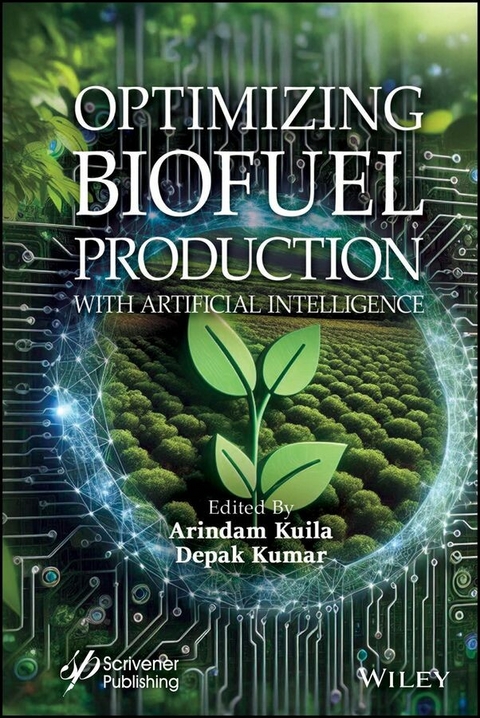
Optimizing Biofuel Production with Artificial Intelligence (eBook)
375 Seiten
Wiley-Scrivener (Verlag)
978-1-394-30127-0 (ISBN)
Optimizing Biofuel Production with Artificial Intelligence will help readers discover how integrating artificial intelligence with biotechnological advancements can revolutionize biofuel production, ensuring a sustainable energy future in response to pressing global challenges like pollution and climate change.
This book presents artificial intelligence as a technique to aid the production of biofuels. Recently, tremendous developments have been made in energy and environmental biotechnologies, spurred by societal issues like pollution control, energy security, and climate change. Energy can be obtained from a variety of sources, including coal, oil, natural gas, solar, wind, and nuclear energy. The need to transition to new energy results from finite resources and economic sustainability. Biotechnological process optimization is crucial for ensuring a quality final product and boosting bioconversion performance efficiency. When combined with traditional simulation and modeling methods, artificial intelligence and computer technology can help define ideal process parameters and save total process costs. The energy sector can benefit from artificial intelligence in several ways, including increased asset efficiency, early detection and assessment of wildfire risks, assistance with vegetation management and storm recovery, and optimized energy use. The new frontier for energy is biomass.
Arindam Kuila, PhD, is an assistant professor in the Department of Bioscience and Biotechnology, Banasthali Vidyapith, Rajasthan, India. He has co-authored 35 peer-reviewed articles and 18 book chapters, edited 12 books, and filed six patents. In addition to his written work, he has completed an Indo-Brazil collaborative project funded by India's Department of Biotechnology. His research interests include environmental biotechnology, lignocellulosic biofuel, and bioremediation.
Depak Kumar, PhD, is an assistant professor in the Department of Chemical Engineering, Banasthali Vidyapith, Rajasthan, India. He has published several articles in international journals of repute, as well as three book chapters and three books. His research interests include solar cell degradation, stability of solar cells, and energy conversion devices.
Optimizing Biofuel Production with Artificial Intelligence will help readers discover how integrating artificial intelligence with biotechnological advancements can revolutionize biofuel production, ensuring a sustainable energy future in response to pressing global challenges like pollution and climate change. This book presents artificial intelligence as a technique to aid the production of biofuels. Recently, tremendous developments have been made in energy and environmental biotechnologies, spurred by societal issues like pollution control, energy security, and climate change. Energy can be obtained from a variety of sources, including coal, oil, natural gas, solar, wind, and nuclear energy. The need to transition to new energy results from finite resources and economic sustainability. Biotechnological process optimization is crucial for ensuring a quality final product and boosting bioconversion performance efficiency. When combined with traditional simulation and modeling methods, artificial intelligence and computer technology can help define ideal process parameters and save total process costs. The energy sector can benefit from artificial intelligence in several ways, including increased asset efficiency, early detection and assessment of wildfire risks, assistance with vegetation management and storm recovery, and optimized energy use. The new frontier for energy is biomass.
| Erscheint lt. Verlag | 18.4.2025 |
|---|---|
| Sprache | englisch |
| Themenwelt | Informatik ► Theorie / Studium ► Künstliche Intelligenz / Robotik |
| Technik ► Elektrotechnik / Energietechnik | |
| Schlagworte | Artificial Intelligence • bioconversion • Biofuel production • Biofuels • Energy • environmental biotechnology • lignocellulosic biomass • Renewables |
| ISBN-10 | 1-394-30127-8 / 1394301278 |
| ISBN-13 | 978-1-394-30127-0 / 9781394301270 |
| Informationen gemäß Produktsicherheitsverordnung (GPSR) | |
| Haben Sie eine Frage zum Produkt? |
 PDF (Adobe DRM)
Kopierschutz: Adobe-DRM
Adobe-DRM ist ein Kopierschutz, der das eBook vor Mißbrauch schützen soll. Dabei wird das eBook bereits beim Download auf Ihre persönliche Adobe-ID autorisiert. Lesen können Sie das eBook dann nur auf den Geräten, welche ebenfalls auf Ihre Adobe-ID registriert sind.
Details zum Adobe-DRM
Dateiformat: PDF (Portable Document Format)
Mit einem festen Seitenlayout eignet sich die PDF besonders für Fachbücher mit Spalten, Tabellen und Abbildungen. Eine PDF kann auf fast allen Geräten angezeigt werden, ist aber für kleine Displays (Smartphone, eReader) nur eingeschränkt geeignet.
Systemvoraussetzungen:
PC/Mac: Mit einem PC oder Mac können Sie dieses eBook lesen. Sie benötigen eine
eReader: Dieses eBook kann mit (fast) allen eBook-Readern gelesen werden. Mit dem amazon-Kindle ist es aber nicht kompatibel.
Smartphone/Tablet: Egal ob Apple oder Android, dieses eBook können Sie lesen. Sie benötigen eine
Geräteliste und zusätzliche Hinweise
Buying eBooks from abroad
For tax law reasons we can sell eBooks just within Germany and Switzerland. Regrettably we cannot fulfill eBook-orders from other countries.
aus dem Bereich