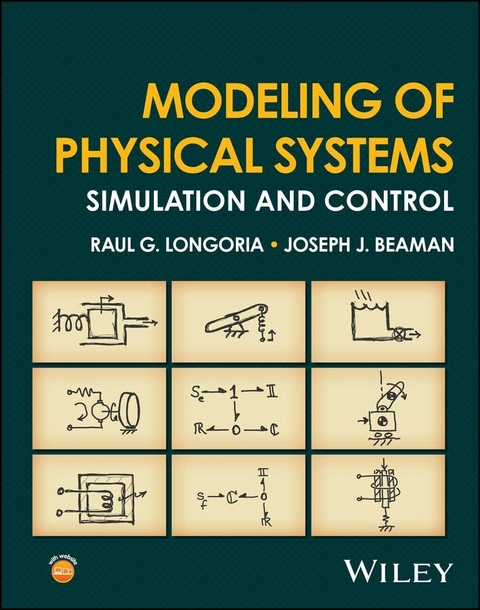
Modeling of Physical Systems (eBook)
1594 Seiten
Wiley (Verlag)
978-1-118-38763-4 (ISBN)
Introductory text on nonlinear and continuous-time dynamic systems using bond graph methodology to enable readers to develop and apply physical system models
Through an integrated and uniform approach to system modeling, analysis, and control, Modeling of Physical Systems uses realistic examples to link empirical, analytical, and numerical approaches and provide readers with the essential foundation needed to move towards more advanced topics in systems engineering. Rather than use only a linear modeling methodology, this book also incorporates nonlinear modeling approaches.
The authors approach the topic using bond graph methodology, a well-known and highly effective method for the modeling and analysis of multi-energy domain systems at the physical level. With a strong focus on fundamentals, this book begins by reviewing core topics which engineering students will have been exposed to in their first two years of study. It then expands into introducing systematic model development using a bond graph approach. Later chapters expand on the fundamental understanding of systems, with insights regarding how to make decisions on what to model and how much complexity is needed for a particular problem.
Written by two professors with nearly a century of combined research and industry experience, Modeling of Physical Systems explores topics including:
- Basic Kirchoff systems, covering mechanical translation and rotation, electrical, hydraulic, and thermal systems, and ideal couplers
- A complete introduction to bond graph methods and their application to practical engineering system modeling
- Computer-based analysis and simulation, covering algebraic analysis of system equation and semi-analytical analysis for linear system response
- Multiport fields, distributed systems and transmission elements, covering heat and magnetism power lines and wave propagation modeling with W- and H-Lines
- Signal and power in measurement and control, covering derivative control and effect of feedback
Modeling of Physical Systems is an essential learning resource for mechanical, mechatronics, and aerospace engineering students at the graduate and senior graduate level. The text is also valuable for professional engineers and researchers, controls engineers, and computer scientists seeking an understanding of engineering system modeling.
Raul G. Longoria, Professor, Walker Department of Mechanical Engineering, University of Texas at Austin. Professor Longoria has over 30 years of experience in the field and has taught the methods described in this book in undergraduate and graduate level courses. He has applied these multidisciplinary modeling and simulation methods in a wide-range of industry and government projects throughout his academic research and consulting career.
Joseph J. Beaman, Professor and former Department Chair (2001 to 2012) of Walker Department of Mechanical Engineering, University of Texas at Austin, has more than 40 years of experience in the field. He was one of the founders of DTM Corporation (now merged with 3D systems). Professor Beaman was elected to the National Academy of Engineers and the National Academy of Inventors, given the CIRP Nicolau award, and elected Honorary Member of ASME.
Introductory text on nonlinear and continuous-time dynamic systems using bond graph methodology to enable readers to develop and apply physical system models Through an integrated and uniform approach to system modeling, analysis, and control, Modeling of Physical Systems uses realistic examples to link empirical, analytical, and numerical approaches and provide readers with the essential foundation needed to move towards more advanced topics in systems engineering. Rather than use only a linear modeling methodology, this book also incorporates nonlinear modeling approaches. The authors approach the topic using bond graph methodology, a well-known and highly effective method for the modeling and analysis of multi-energy domain systems at the physical level. With a strong focus on fundamentals, this book begins by reviewing core topics which engineering students will have been exposed to in their first two years of study. It then expands into introducing systematic model development using a bond graph approach. Later chapters expand on the fundamental understanding of systems, with insights regarding how to make decisions on what to model and how much complexity is needed for a particular problem. Written by two professors with nearly a century of combined research and industry experience, Modeling of Physical Systems explores topics including: Basic Kirchoff systems, covering mechanical translation and rotation, electrical, hydraulic, and thermal systems, and ideal couplersA complete introduction to bond graph methods and their application to practical engineering system modelingComputer-based analysis and simulation, covering algebraic analysis of system equation and semi-analytical analysis for linear system responseMultiport fields, distributed systems and transmission elements, covering heat and magnetism power lines and wave propagation modeling with W- and H-LinesSignal and power in measurement and control, covering derivative control and effect of feedback Modeling of Physical Systems is an essential learning resource for mechanical, mechatronics, and aerospace engineering students at the graduate and senior graduate level. The text is also valuable for professional engineers and researchers, controls engineers, and computer scientists seeking an understanding of engineering system modeling.
1
Introduction
This chapter introduces some basic concepts useful in modeling physical systems. Simple examples are used to illustrate how these concepts are helpful when developing models. Making decisions about how models are composed of more basic elements is a key step, as is adopting discipline‐specific knowledge, unified within an energetic basis for modeling physical systems using bond graphs. A short discussion of classical dynamics is presented for historical perspective as well as to provide a comparison with the energetic basis for system modeling to be used throughout this book. Some preliminary concepts in bond graph methods are introduced along with the concept of a word bond graph. Lastly, problems at the end of the chapter are meant to review these concepts as well as to motivate using modeling and analysis methods to answer practical questions about systems of interest.
1.1 System Modeling Concepts
Modeling is central to all activities in dynamic systems and control. The goal is to generate a model to describe the functional behavior of a system, which is needed in almost any design or analysis problem. This model may take the form of an actual physical prototype, although for many systems the time and cost may be prohibitive. For this reason, an emphasis in this book will be on the development of mathematical models, especially those that can be effectively solved by computer‐based analysis and simulation. Once a valid “computer model” has been developed for a system, the effect of design changes, parameter variations, and the influence of different stimuli on system performance can be studied expeditiously.
The type of model that we need to develop is often highly dependent on the engineering task at hand. There are basically two main subclasses for the uses of models: (i) models for understanding and (ii) models for prediction. Consider the simple case of a rock supported with a string and under the influence of the earth's gravitational field as shown in Figure 1.1(a). Assuming that the swinging motion is confined to a two‐dimensional plane, a system model can be composed of a point mass with a massless inextensible support as shown in Figure 1.1(b). This idealized model of the actual system can be used to approximate the actual motion of the rock. The schematic representation conveys physical parameters based on geometrical and material properties that are considered important: , mass of the rock, , distance from the fixed point to the center of mass, , gravitational acceleration, and , initial angular displacement at time . The identification of useful physical parameters of a system is a critical part in understanding the system performance.
Figure 1.1 (a) Physical system: string‐supported rock and (b) idealized model for understanding: ideal planar pendulum.
Models for understanding can be an important part of a creative design. From an experiment, one could see that the suspended rock when released with an initial (angular) displacement will oscillate with fairly uniform period. This uniform period could be used as a basis for keeping time, but a more thorough understanding of variation from a constant period would be needed in order to design a pendulum clock. An empirical approach would require performing a large number of experiments with a combination of masses, lengths, gravity accelerations, and initial displacements, tabulating the change in observed oscillation period. Such a method can be very inefficient and time‐consuming. An alternative approach would be to develop a mathematical description, such as,
which results from a summation of torques about the fixed pivot, where represents unmodeled disturbance torques. Dividing this equation by the and defining a nondimensional time as, , results in,
Then assuming that the disturbance torque is small compared to , this equation implies that the period can be determined from a single set of parameters of , , and , while varying only the initial angle. Although it requires prior knowledge from dynamics, the insight gained in this approach represents a tremendous reduction in experimental effort.
Note that neither a closed‐form nor a numerical solution of the differential equation for the “rock‐pendulum” was needed in order to derive benefit from the modeling effort; however, there are also circumstances when it is appropriate and desirable to obtain detailed solutions. This is especially the case when using models for prediction. For systems that are too time‐consuming or expensive to build and test, one can resort to detailed simulation for prediction of the unbuilt system. Even if the system has been built, it may be difficult to perform extended and detailed tests, especially if it is in operation, so that simulation can provide an alternative means for insight. One particularly important example is use of simulation for conditions that could possibly be destructive to the system, and so experimental testing would be prohibitive.
1.2 General Steps in Modeling
Modeling in many respects is a mixture of art, science, and experience. Another key element is making decisions about what is relevant to the modeling task at hand. The detail of the model is highly dependent on its intended use, and many idealizations and approximations are used in any model. The following steps are intended as guidelines and not as hard‐and‐fast rules for the modeling procedure.
- Define the system. Before one can start the modeling procedure, the object or system of interest and its inputs and outputs need to be identified. This is often done almost subconsciously but unclear identification can be the source of modeling errors.
- Divide and conquer. Separate the system into its essential components. The internal structure and function of each component should be understood.
- Interconnect. Identify the interrelationships between the components.
- Quantify the components. By using physical theories, the functional description of the components can be described in mathematical terms.
- Formulate system equations. By using the component interconnections and mathematical descriptions, the system equations can be formulated.
- Analyze the system. Apply mathematical techniques to study the model's behavior.
- Test the model. Compare the predicted system behavior of the model against actual system behavior, if available, or engineering judgment, if not. Change the model (repeating steps a–f) as necessary.
To illustrate the steps above, consider Figure 1.2, which illustrates a mass suspended at the end of a rubber band. The other end of the rubber band is held between two fingers. It is desired to construct a model that can be used to predict the vertical displacement of the block. In the first step, defining the system, we idealize the two fingers as being capable of prescribing a motion at one end independent of the motion of the rubber band and block, . If this approximation is made, the system consists of the rubber band and the block. The inputs to the system are the finger motion and a gravity force on the block. The system can be naturally divided into the rubber band component and the block component. The rubber band is primarily a compliant (or spring‐like) component while the block is primarily a mass component. Any damping in the rubber band is ignored for now.
Figure 1.2 (a) Mass held at end of rubber band, and (b) an idealized model for understanding: base‐excited spring–mass system with one degree of freedom.
The interconnection consists of the geometric connection between the rubber band and the block and between the band and the fingers. We are assuming implicitly by this statement that there is no rubber band slip between the fingers, and the connection between the block and the band remains fixed. There is also a dynamic interconnection between the gravity force and the block. The idealized model with these assumptions is shown in Figure 1.2, which implies purely translational motion of the mass in the vertical direction.
A quantitative description of the components is found by assuming that the rubber band force is proportional to the extension in the band and the velocity of the block is proportional to the momentum of the block. System equations are formulated by using kinematic and dynamic relations. From kinematics, we then know the time rate of change of the extension in the band can be found from the difference in the velocity of the fingers and that of the block. From dynamics, we know that the time rate of change of the block's momentum can be found from the difference in the rubber band force and the gravity force. This entire process can be represented in mathematical form by identifying the key variables and their relations as follows:
These relations can then be used in Newton's second law (dynamics) to write,
These equations collectively form a dynamic model of our system. If we define to be the position of the block and the position of the fingers, these equations can be put in a more classical second‐order differential equation form,
An analysis of this mathematical model would yield an...
| Erscheint lt. Verlag | 9.4.2025 |
|---|---|
| Sprache | englisch |
| Themenwelt | Technik ► Maschinenbau |
| Schlagworte | bond graph methodology • Kirchhoff systems • Linear modeling • modeling decisions • multi-energy domain systems • Nonlinear modeling • physical modeling • System Analysis • System control • System Modeling • Systems Engineering |
| ISBN-10 | 1-118-38763-5 / 1118387635 |
| ISBN-13 | 978-1-118-38763-4 / 9781118387634 |
| Informationen gemäß Produktsicherheitsverordnung (GPSR) | |
| Haben Sie eine Frage zum Produkt? |
 EPUB (Adobe DRM)
Kopierschutz: Adobe-DRM
Adobe-DRM ist ein Kopierschutz, der das eBook vor Mißbrauch schützen soll. Dabei wird das eBook bereits beim Download auf Ihre persönliche Adobe-ID autorisiert. Lesen können Sie das eBook dann nur auf den Geräten, welche ebenfalls auf Ihre Adobe-ID registriert sind.
Details zum Adobe-DRM
Dateiformat: EPUB (Electronic Publication)
EPUB ist ein offener Standard für eBooks und eignet sich besonders zur Darstellung von Belletristik und Sachbüchern. Der Fließtext wird dynamisch an die Display- und Schriftgröße angepasst. Auch für mobile Lesegeräte ist EPUB daher gut geeignet.
Systemvoraussetzungen:
PC/Mac: Mit einem PC oder Mac können Sie dieses eBook lesen. Sie benötigen eine
eReader: Dieses eBook kann mit (fast) allen eBook-Readern gelesen werden. Mit dem amazon-Kindle ist es aber nicht kompatibel.
Smartphone/Tablet: Egal ob Apple oder Android, dieses eBook können Sie lesen. Sie benötigen eine
Geräteliste und zusätzliche Hinweise
Buying eBooks from abroad
For tax law reasons we can sell eBooks just within Germany and Switzerland. Regrettably we cannot fulfill eBook-orders from other countries.
aus dem Bereich