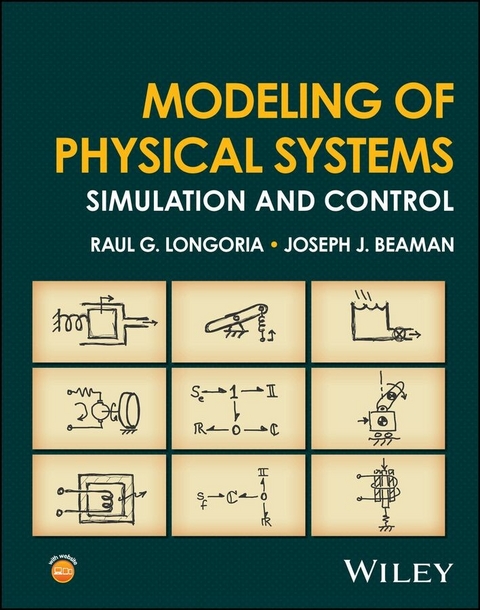
Modeling of Physical Systems (eBook)
659 Seiten
Wiley (Verlag)
978-1-118-38762-7 (ISBN)
Introductory text on nonlinear and continuous-time dynamic systems using bond graph methodology to enable readers to develop and apply physical system models
Through an integrated and uniform approach to system modeling, analysis, and control, Modeling of Physical Systems uses realistic examples to link empirical, analytical, and numerical approaches and provide readers with the essential foundation needed to move towards more advanced topics in systems engineering. Rather than use only a linear modeling methodology, this book also incorporates nonlinear modeling approaches.
The authors approach the topic using bond graph methodology, a well-known and highly effective method for the modeling and analysis of multi-energy domain systems at the physical level. With a strong focus on fundamentals, this book begins by reviewing core topics which engineering students will have been exposed to in their first two years of study. It then expands into introducing systematic model development using a bond graph approach. Later chapters expand on the fundamental understanding of systems, with insights regarding how to make decisions on what to model and how much complexity is needed for a particular problem.
Written by two professors with nearly a century of combined research and industry experience, Modeling of Physical Systems explores topics including:
- Basic Kirchoff systems, covering mechanical translation and rotation, electrical, hydraulic, and thermal systems, and ideal couplers
- A complete introduction to bond graph methods and their application to practical engineering system modeling
- Computer-based analysis and simulation, covering algebraic analysis of system equation and semi-analytical analysis for linear system response
- Multiport fields, distributed systems and transmission elements, covering heat and magnetism power lines and wave propagation modeling with W- and H-Lines
- Signal and power in measurement and control, covering derivative control and effect of feedback
Modeling of Physical Systems is an essential learning resource for mechanical, mechatronics, and aerospace engineering students at the graduate and senior graduate level. The text is also valuable for professional engineers and researchers, controls engineers, and computer scientists seeking an understanding of engineering system modeling.
Raul G. Longoria, Professor, Walker Department of Mechanical Engineering, University of Texas at Austin. Professor Longoria has over 30 years of experience in the field and has taught the methods described in this book in undergraduate and graduate level courses. He has applied these multidisciplinary modeling and simulation methods in a wide-range of industry and government projects throughout his academic research and consulting career.
Joseph J. Beaman, Professor and former Department Chair (2001 to 2012) of Walker Department of Mechanical Engineering, University of Texas at Austin, has more than 40 years of experience in the field. He was one of the founders of DTM Corporation (now merged with 3D systems). Professor Beaman was elected to the National Academy of Engineers and the National Academy of Inventors, given the CIRP Nicolau award, and elected Honorary Member of ASME.
Introductory text on nonlinear and continuous-time dynamic systems using bond graph methodology to enable readers to develop and apply physical system models Through an integrated and uniform approach to system modeling, analysis, and control, Modeling of Physical Systems uses realistic examples to link empirical, analytical, and numerical approaches and provide readers with the essential foundation needed to move towards more advanced topics in systems engineering. Rather than use only a linear modeling methodology, this book also incorporates nonlinear modeling approaches. The authors approach the topic using bond graph methodology, a well-known and highly effective method for the modeling and analysis of multi-energy domain systems at the physical level. With a strong focus on fundamentals, this book begins by reviewing core topics which engineering students will have been exposed to in their first two years of study. It then expands into introducing systematic model development using a bond graph approach. Later chapters expand on the fundamental understanding of systems, with insights regarding how to make decisions on what to model and how much complexity is needed for a particular problem. Written by two professors with nearly a century of combined research and industry experience, Modeling of Physical Systems explores topics including: Basic Kirchoff systems, covering mechanical translation and rotation, electrical, hydraulic, and thermal systems, and ideal couplersA complete introduction to bond graph methods and their application to practical engineering system modelingComputer-based analysis and simulation, covering algebraic analysis of system equation and semi-analytical analysis for linear system responseMultiport fields, distributed systems and transmission elements, covering heat and magnetism power lines and wave propagation modeling with W- and H-LinesSignal and power in measurement and control, covering derivative control and effect of feedback Modeling of Physical Systems is an essential learning resource for mechanical, mechatronics, and aerospace engineering students at the graduate and senior graduate level. The text is also valuable for professional engineers and researchers, controls engineers, and computer scientists seeking an understanding of engineering system modeling.
| Erscheint lt. Verlag | 4.4.2025 |
|---|---|
| Sprache | englisch |
| Themenwelt | Technik ► Maschinenbau |
| Schlagworte | bond graph methodology • Kirchhoff systems • Linear modeling • modeling decisions • multi-energy domain systems • Nonlinear modeling • physical modeling • System Analysis • System control • System Modeling • Systems Engineering |
| ISBN-10 | 1-118-38762-7 / 1118387627 |
| ISBN-13 | 978-1-118-38762-7 / 9781118387627 |
| Informationen gemäß Produktsicherheitsverordnung (GPSR) | |
| Haben Sie eine Frage zum Produkt? |
 PDF (Adobe DRM)
Kopierschutz: Adobe-DRM
Adobe-DRM ist ein Kopierschutz, der das eBook vor Mißbrauch schützen soll. Dabei wird das eBook bereits beim Download auf Ihre persönliche Adobe-ID autorisiert. Lesen können Sie das eBook dann nur auf den Geräten, welche ebenfalls auf Ihre Adobe-ID registriert sind.
Details zum Adobe-DRM
Dateiformat: PDF (Portable Document Format)
Mit einem festen Seitenlayout eignet sich die PDF besonders für Fachbücher mit Spalten, Tabellen und Abbildungen. Eine PDF kann auf fast allen Geräten angezeigt werden, ist aber für kleine Displays (Smartphone, eReader) nur eingeschränkt geeignet.
Systemvoraussetzungen:
PC/Mac: Mit einem PC oder Mac können Sie dieses eBook lesen. Sie benötigen eine
eReader: Dieses eBook kann mit (fast) allen eBook-Readern gelesen werden. Mit dem amazon-Kindle ist es aber nicht kompatibel.
Smartphone/Tablet: Egal ob Apple oder Android, dieses eBook können Sie lesen. Sie benötigen eine
Geräteliste und zusätzliche Hinweise
Buying eBooks from abroad
For tax law reasons we can sell eBooks just within Germany and Switzerland. Regrettably we cannot fulfill eBook-orders from other countries.
aus dem Bereich