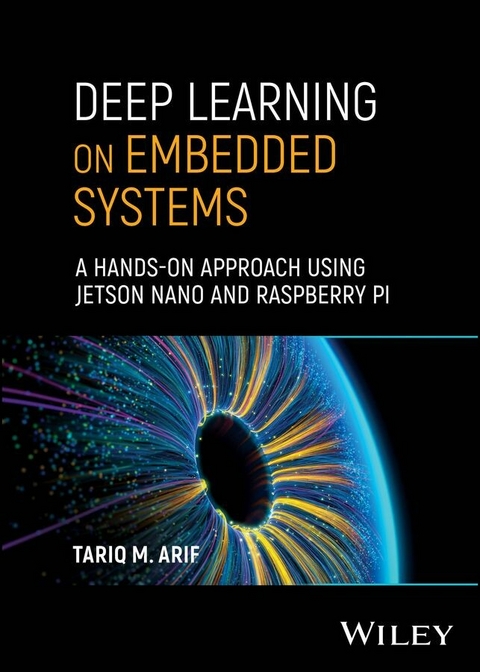
Deep Learning on Embedded Systems (eBook)
486 Seiten
Wiley (Verlag)
978-1-394-26927-3 (ISBN)
Comprehensive, accessible introduction to deep learning for engineering tasks through Python programming, low-cost hardware, and freely available software
Deep Learning on Embedded Systems is a comprehensive guide to the practical implementation of deep learning for engineering tasks through computers and embedded hardware such as Raspberry Pi and Nvidia Jetson Nano. After an introduction to the field, the book provides fundamental knowledge on deep learning, convolutional and recurrent neural networks, computer vision, and basics of Linux terminal and docker engines. This book shows detailed setup steps of Jetson Nano and Raspberry Pi for utilizing essential frameworks such as PyTorch and OpenCV. GPU configuration and dependency installation procedure for using PyTorch is also discussed allowing newcomers to seamlessly navigate the learning curve.
A key challenge of utilizing deep learning on embedded systems is managing limited GPU and memory resources. This book outlines a strategy of training complex models on a desktop computer and transferring them to embedded systems for inference. Also, students and researchers often face difficulties with the varying probabilistic theories and notations found in data science literature. To simplify this, the book mainly focuses on the practical implementation part of deep learning using Python programming, low-cost hardware, and freely available software such as Anaconda and Visual Studio Code. To aid in reader learning, questions and answers are included at the end of most chapters.
Written by a highly qualified author, Deep Learning on Embedded Systems includes discussion on:
- Fundamentals of deep learning, including neurons and layers, activation functions, network architectures, hyperparameter tuning, and convolutional and recurrent neural networks (CNNs & RNNs)
- PyTorch, OpenCV, and other essential framework setups for deep transfer learning, along with Linux terminal operations, docker engine, docker images, and virtual environments in embedded devices
- Training models for image classification and object detection with classification, then converting trained PyTorch models to ONNX format for efficient deployment on Jetson Nano and Raspberry Pi
Deep Learning on Embedded Systems serves as an excellent introduction to the field for undergraduate engineering students seeking to learn deep learning implementations for their senior capstone or class projects and graduate researchers and educators who wish to implement deep learning in their research.
Tariq M. Arif, PhD, is an Associate Professor at WSU since 2019. Prior to that, he worked at the University of Wisconsin, Platteville. His primary research interests include artificial intelligence and genetic algorithms for robotics control, computer vision, and biomedical simulations involving machine learning algorithms. He also worked in the Japanese automobile industry for three and a half years as a CAD/CAE engineer.
Comprehensive, accessible introduction to deep learning for engineering tasks through Python programming, low-cost hardware, and freely available software Deep Learning on Embedded Systems is a comprehensive guide to the practical implementation of deep learning for engineering tasks through computers and embedded hardware such as Raspberry Pi and Nvidia Jetson Nano. After an introduction to the field, the book provides fundamental knowledge on deep learning, convolutional and recurrent neural networks, computer vision, and basics of Linux terminal and docker engines. This book shows detailed setup steps of Jetson Nano and Raspberry Pi for utilizing essential frameworks such as PyTorch and OpenCV. GPU configuration and dependency installation procedure for using PyTorch is also discussed allowing newcomers to seamlessly navigate the learning curve. A key challenge of utilizing deep learning on embedded systems is managing limited GPU and memory resources. This book outlines a strategy of training complex models on a desktop computer and transferring them to embedded systems for inference. Also, students and researchers often face difficulties with the varying probabilistic theories and notations found in data science literature. To simplify this, the book mainly focuses on the practical implementation part of deep learning using Python programming, low-cost hardware, and freely available software such as Anaconda and Visual Studio Code. To aid in reader learning, questions and answers are included at the end of most chapters. Written by a highly qualified author, Deep Learning on Embedded Systems includes discussion on: Fundamentals of deep learning, including neurons and layers, activation functions, network architectures, hyperparameter tuning, and convolutional and recurrent neural networks (CNNs & RNNs)PyTorch, OpenCV, and other essential framework setups for deep transfer learning, along with Linux terminal operations, docker engine, docker images, and virtual environments in embedded devicesTraining models for image classification and object detection with classification, then converting trained PyTorch models to ONNX format for efficient deployment on Jetson Nano and Raspberry Pi Deep Learning on Embedded Systems serves as an excellent introduction to the field for undergraduate engineering students seeking to learn deep learning implementations for their senior capstone or class projects and graduate researchers and educators who wish to implement deep learning in their research.
Chapter 1
Introduction
1.1 Machine Learning to Deep Learning
Machine learning is one of the artificial intelligence (AI) tools that emphasizes developing computer algorithms and statistical models to learn from data. It originated from computational learning theory and pattern recognition within AI. Machine learning algorithms create mathematical models using sample data (training data) to perform tasks without being explicitly programmed. To model complex patterns and relationships from training data, one can use neural networks, which consist of interconnected layers of nodes or neurons. This process of learning using neural networks emulates the information processing methods of human brains, which is why it is also referred to as artificial intelligence or AI. Over the last two decades, as the training data volume and complexity increased, traditional machine learning methods such as decision trees and support vector machines struggled with large-scale unstructured data such as images and text. This limitation led to the emergence of deep learning, a more advanced form of machine learning that utilizes many hidden layers in a neural network (typically 5–100) to analyze vast amounts of data and extract features. This sophisticated deep neural network approach, inspired by the human brain, has recently seen tremendous progress and accomplished significant milestones that would have been deemed impossible just a few decades ago.
The growth in deep learning technology can be attributed to several key factors: the exponential increase in computational power through the use of graphical processing units (GPUs) and tensor processing units (TPUs), advancements in neural network architectures, and the development of user-friendly, open-source deep learning frameworks such as TensorFlow and PyTorch. This field has become more accessible to researchers and practitioners, and substantial investments in this field from both academia and industry are helping continuous innovations in similar fields such as computer vision, natural language processing, and autonomous systems. As deep learning is reaching a more advanced stage of development, various scientific and engineering disciplines are recognizing its practical use cases. The emerging fields of robotics, AI, finance, environmental science, bioinformatics, genetics, and healthcare are increasingly adopting deep learning models, acknowledging their potential to drive significant advancements in their respective domains. This growing integration across diverse areas of study highlights the versatility and far-reaching impact of deep learning technology.
1.2 Modern Embedded Systems
In the last few years, the accessibility of powerful electronic processors has led to a surge in the incorporation of deep learning models into smaller devices. Also, as the electronic devices required for edge computing are getting cheaper and more accessible, there is a growing interest in using AI applications in embedded systems such as NVIDIA Jetson devices, Google Coral, Luxonis OAK-D cameras, Intel Movidius, etc. [1–4]. Deep learning enables these systems to perform complex tasks such as image and speech recognition, natural language processing, and anomaly detection, which were previously limited to larger, more powerful systems. Nowadays, many other embedded devices can process data locally and make real-time predictions and decisions, which is essential for autonomous driving, Internet of Things (IoT), robotics, and smart home devices.
Jetson’s embedded device is utilized for a wide range of applications in industry due to its powerful AI processing capabilities in a compact space. In manufacturing, it is commonly used in computer vision tasks, such as quality control and defect detection, which can enable real-time production line monitoring and analysis [5–7]. In robotics, it supports autonomous navigation and manipulation, which is crucial for improving the efficiency and accuracy of automated systems in warehouses and logistics [8, 9]. The Jetson devices play a wide variety of roles in IoT applications, including smart city infrastructure, where it helps manage traffic flow, monitor environmental conditions, and enhance public safety [10–13]. It is also employed in numerous other areas, such as retail for customer behavior analysis and inventory management and agriculture for crop monitoring and precision farming [7, 14–16]. In academia, embedded devices such as the Jetson Nano serve as a key tool in research and development, providing practical platforms for AI, machine learning, computer vision, and robotics experiments. Recently, these devices have been continuously integrated into AI courses, robotics and mechatronics programs, and IoT based lab applications, offering hands-on experience and enabling student capstone projects [17, 18]. They are also used extensively in hackathons and robotics competitions, fostering innovation and interdisciplinary collaborations. Overall, the combination of deep learning and embedded systems opens up numerous opportunities across various science and engineering domains by making advanced AI-driven functionalities widely accessible.
Currently, several embedded AI devices are utilized in industry and academia due to their powerful processing power, compact design, and real-time data analysis capabilities. These include the NVIDIA Jetson series, such as Jetson Nano, Jetson Xavier NX, and Jetson AGX Xavier, which are popular for computer vision, robotics, and IoT applications [19]. Google Coral devices, such as the Coral Dev Board and Coral USB Accelerator, are popular for prototyping and deploying machine learning models [20]. The Intel Neural Compute Stick 2 (discontinued after 2023) is known for AI capabilities in IoT devices, and the Raspberry Pi, often paired with AI accelerators such as the Coral USB Accelerator, is widely used in educational labs, projects, and small-scale AI experiments [21, 22]. A list of common embedded devices that can be utilized for small-scale AI applications and deep learning inference is summarized in Table 1.1.
Table 1.1 Processing power and memory of common embedded devices.
| Embedded device | Configuration: AI performance, processing power, and memory |
|---|
| NVIDIA Jetson series |
| Jetson Nano | 472 GFLOPs, Advanced RISC Machine (ARM) Cortex-A57 CPU, and a 128-core Maxwell GPU 2 GB or 4 GB LPDDR4 memory (https://www.nvidia.com/en-us/autonomous-machines/embedded-systems/jetson-nano/product-development/) |
| Jetson TX2 | 1.33 TFLOPs, Dual-core Denver 2 + Quad-core ARM Cortex-A57 CPU and 256-core Pascal GPU 32 GB eMMC 5.1 memory (https://www.nvidia.com/en-us/autonomous-machines/embedded-systems/jetson-tx2/) |
| Jetson Xavier NX | 21 TOPs, 6-core NVIDIA Carmel ARM v8.2 64-bit CPU, and 384-core Volta with 48 Tensor Cores GPU 8 GB or 16 GB LPDDR4x memory (https://www.arrow.com/en/products/900-83668-0000-000/nvidia) |
| Jetson AGX Xavier | 32 TOPs, 8-core ARM v8.2 64-bit CPU, 8 MB L2 + 4 MB L3, and 512-core Volta with 64 Tensor Cores GPU 32 GB LPDDR4x memory and 32 GB eMMC 5.1 storage (https://www.arrow.com/en/products/900-83668-0000-000/nvidia) |
| Other Jetson devices | Other variations of Jetson devices are available. A comprehensive list of specifications for these edge computing devices is available on their website. |
| Google coral devices |
| Coral Dev Board | 4 TOPs, Integrated GC7000 Lite Graphics NXP i.MX 8M system-on-chip (SoC) with a quad-core ARM Cortex-A53 CPU 1 or 4 GB LPDDR4 memory |
| Coral USB accelerator | Google Edge TPU coprocessor: 4 TOPS (int8), 2 TOPS per watt It connects to an embedded system via USB 3.0 to provide AI acceleration. |
| Coral Dev Board Mini | 4 TOPs, IMG PowerVR GE8300 (integrated in SoC) MediaTek 8167s SoC (Quad-core Arm Cortex-A35) CPU 2 GB LPDDR3 memory and 8 GB eMMC flash memory. |
| Coral system-on-module (SoM) | 4 TOPs, Integrated GC7000 Lite Graphics NXP i.MX 8M SoC (quad Cortex-A53, Cortex-M4F) CPU 1 GB LPDDR3 memory and 8 GB eMMC flash memory. |
| Intel Compute Stick |
| Intel Neural Compute Stick 2 | 1 TOPs, Intel Movidius Myriad X VPU (Vision Processing Unit) 4 GB LPDDR4 Supports a wider range of AI frameworks through the OpenVINO toolkit. However, it is currently being phased out. (https://www.intel.com/content/www/us/en/products/sku/125743/intel-movidius-neural-compute-stick/specifications.html) |
| Raspberry Pi Boards |
| Raspberry Pi 5 | VideoCore VII... |
| Erscheint lt. Verlag | 8.4.2025 |
|---|---|
| Sprache | englisch |
| Themenwelt | Technik ► Maschinenbau |
| Schlagworte | cnns • Dataset creation • deep learning engineers • deep learning free software • deep learning low cost • deep learning python • Deep Learning textbook • Docker Engine • docker image • Embedded System • gpu configuration deep learning • image classification • Image Processing • Jetson Nano • Neural networks • Object detection • ONNX • onnx runtime • pytorch installation • Raspberry Pi • RNNs • transfer learning |
| ISBN-10 | 1-394-26927-7 / 1394269277 |
| ISBN-13 | 978-1-394-26927-3 / 9781394269273 |
| Informationen gemäß Produktsicherheitsverordnung (GPSR) | |
| Haben Sie eine Frage zum Produkt? |
 EPUB (Adobe DRM)
Kopierschutz: Adobe-DRM
Adobe-DRM ist ein Kopierschutz, der das eBook vor Mißbrauch schützen soll. Dabei wird das eBook bereits beim Download auf Ihre persönliche Adobe-ID autorisiert. Lesen können Sie das eBook dann nur auf den Geräten, welche ebenfalls auf Ihre Adobe-ID registriert sind.
Details zum Adobe-DRM
Dateiformat: EPUB (Electronic Publication)
EPUB ist ein offener Standard für eBooks und eignet sich besonders zur Darstellung von Belletristik und Sachbüchern. Der Fließtext wird dynamisch an die Display- und Schriftgröße angepasst. Auch für mobile Lesegeräte ist EPUB daher gut geeignet.
Systemvoraussetzungen:
PC/Mac: Mit einem PC oder Mac können Sie dieses eBook lesen. Sie benötigen eine
eReader: Dieses eBook kann mit (fast) allen eBook-Readern gelesen werden. Mit dem amazon-Kindle ist es aber nicht kompatibel.
Smartphone/Tablet: Egal ob Apple oder Android, dieses eBook können Sie lesen. Sie benötigen eine
Geräteliste und zusätzliche Hinweise
Buying eBooks from abroad
For tax law reasons we can sell eBooks just within Germany and Switzerland. Regrettably we cannot fulfill eBook-orders from other countries.
aus dem Bereich