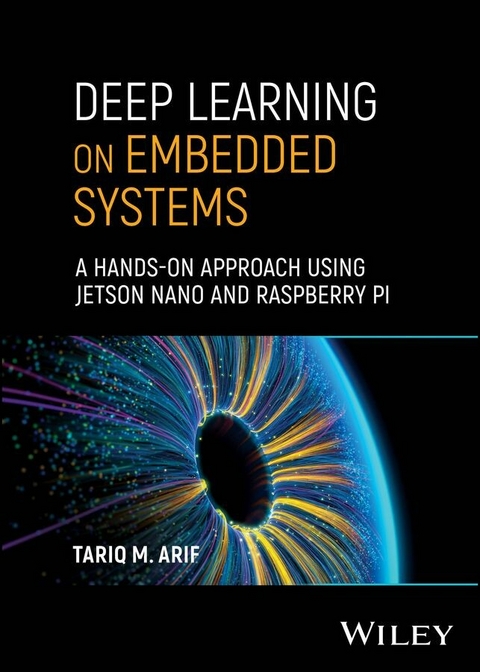
Deep Learning on Embedded Systems (eBook)
259 Seiten
Wiley (Verlag)
978-1-394-26928-0 (ISBN)
Comprehensive, accessible introduction to deep learning for engineering tasks through Python programming, low-cost hardware, and freely available software
Deep Learning on Embedded Systems is a comprehensive guide to the practical implementation of deep learning for engineering tasks through computers and embedded hardware such as Raspberry Pi and Nvidia Jetson Nano. After an introduction to the field, the book provides fundamental knowledge on deep learning, convolutional and recurrent neural networks, computer vision, and basics of Linux terminal and docker engines. This book shows detailed setup steps of Jetson Nano and Raspberry Pi for utilizing essential frameworks such as PyTorch and OpenCV. GPU configuration and dependency installation procedure for using PyTorch is also discussed allowing newcomers to seamlessly navigate the learning curve.
A key challenge of utilizing deep learning on embedded systems is managing limited GPU and memory resources. This book outlines a strategy of training complex models on a desktop computer and transferring them to embedded systems for inference. Also, students and researchers often face difficulties with the varying probabilistic theories and notations found in data science literature. To simplify this, the book mainly focuses on the practical implementation part of deep learning using Python programming, low-cost hardware, and freely available software such as Anaconda and Visual Studio Code. To aid in reader learning, questions and answers are included at the end of most chapters.
Written by a highly qualified author, Deep Learning on Embedded Systems includes discussion on:
- Fundamentals of deep learning, including neurons and layers, activation functions, network architectures, hyperparameter tuning, and convolutional and recurrent neural networks (CNNs & RNNs)
- PyTorch, OpenCV, and other essential framework setups for deep transfer learning, along with Linux terminal operations, docker engine, docker images, and virtual environments in embedded devices
- Training models for image classification and object detection with classification, then converting trained PyTorch models to ONNX format for efficient deployment on Jetson Nano and Raspberry Pi
Deep Learning on Embedded Systems serves as an excellent introduction to the field for undergraduate engineering students seeking to learn deep learning implementations for their senior capstone or class projects and graduate researchers and educators who wish to implement deep learning in their research.
Tariq M. Arif, PhD, is an Associate Professor at WSU since 2019. Prior to that, he worked at the University of Wisconsin, Platteville. His primary research interests include artificial intelligence and genetic algorithms for robotics control, computer vision, and biomedical simulations involving machine learning algorithms. He also worked in the Japanese automobile industry for three and a half years as a CAD/CAE engineer.
Comprehensive, accessible introduction to deep learning for engineering tasks through Python programming, low-cost hardware, and freely available software Deep Learning on Embedded Systems is a comprehensive guide to the practical implementation of deep learning for engineering tasks through computers and embedded hardware such as Raspberry Pi and Nvidia Jetson Nano. After an introduction to the field, the book provides fundamental knowledge on deep learning, convolutional and recurrent neural networks, computer vision, and basics of Linux terminal and docker engines. This book shows detailed setup steps of Jetson Nano and Raspberry Pi for utilizing essential frameworks such as PyTorch and OpenCV. GPU configuration and dependency installation procedure for using PyTorch is also discussed allowing newcomers to seamlessly navigate the learning curve. A key challenge of utilizing deep learning on embedded systems is managing limited GPU and memory resources. This book outlines a strategy of training complex models on a desktop computer and transferring them to embedded systems for inference. Also, students and researchers often face difficulties with the varying probabilistic theories and notations found in data science literature. To simplify this, the book mainly focuses on the practical implementation part of deep learning using Python programming, low-cost hardware, and freely available software such as Anaconda and Visual Studio Code. To aid in reader learning, questions and answers are included at the end of most chapters. Written by a highly qualified author, Deep Learning on Embedded Systems includes discussion on: Fundamentals of deep learning, including neurons and layers, activation functions, network architectures, hyperparameter tuning, and convolutional and recurrent neural networks (CNNs & RNNs)PyTorch, OpenCV, and other essential framework setups for deep transfer learning, along with Linux terminal operations, docker engine, docker images, and virtual environments in embedded devicesTraining models for image classification and object detection with classification, then converting trained PyTorch models to ONNX format for efficient deployment on Jetson Nano and Raspberry Pi Deep Learning on Embedded Systems serves as an excellent introduction to the field for undergraduate engineering students seeking to learn deep learning implementations for their senior capstone or class projects and graduate researchers and educators who wish to implement deep learning in their research.
| Erscheint lt. Verlag | 8.4.2025 |
|---|---|
| Sprache | englisch |
| Themenwelt | Technik ► Maschinenbau |
| Schlagworte | cnns • Dataset creation • deep learning engineers • deep learning free software • deep learning low cost • deep learning python • Deep Learning textbook • Docker Engine • docker image • Embedded System • gpu configuration deep learning • image classification • Image Processing • Jetson Nano • Neural networks • Object detection • ONNX • onnx runtime • pytorch installation • Raspberry Pi • RNNs • transfer learning |
| ISBN-10 | 1-394-26928-5 / 1394269285 |
| ISBN-13 | 978-1-394-26928-0 / 9781394269280 |
| Informationen gemäß Produktsicherheitsverordnung (GPSR) | |
| Haben Sie eine Frage zum Produkt? |
 PDF (Adobe DRM)
Kopierschutz: Adobe-DRM
Adobe-DRM ist ein Kopierschutz, der das eBook vor Mißbrauch schützen soll. Dabei wird das eBook bereits beim Download auf Ihre persönliche Adobe-ID autorisiert. Lesen können Sie das eBook dann nur auf den Geräten, welche ebenfalls auf Ihre Adobe-ID registriert sind.
Details zum Adobe-DRM
Dateiformat: PDF (Portable Document Format)
Mit einem festen Seitenlayout eignet sich die PDF besonders für Fachbücher mit Spalten, Tabellen und Abbildungen. Eine PDF kann auf fast allen Geräten angezeigt werden, ist aber für kleine Displays (Smartphone, eReader) nur eingeschränkt geeignet.
Systemvoraussetzungen:
PC/Mac: Mit einem PC oder Mac können Sie dieses eBook lesen. Sie benötigen eine
eReader: Dieses eBook kann mit (fast) allen eBook-Readern gelesen werden. Mit dem amazon-Kindle ist es aber nicht kompatibel.
Smartphone/Tablet: Egal ob Apple oder Android, dieses eBook können Sie lesen. Sie benötigen eine
Geräteliste und zusätzliche Hinweise
Buying eBooks from abroad
For tax law reasons we can sell eBooks just within Germany and Switzerland. Regrettably we cannot fulfill eBook-orders from other countries.
aus dem Bereich