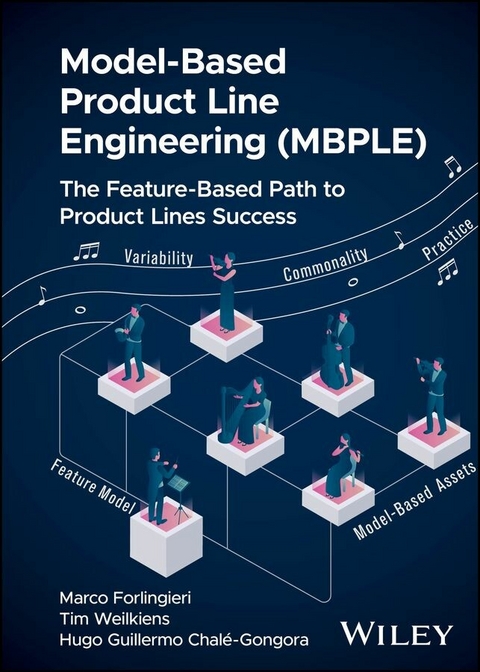
Model-Based Product Line Engineering (MBPLE) (eBook)
339 Seiten
Wiley (Verlag)
978-1-394-20467-0 (ISBN)
Clear and concise guide to MBPLE, with industrial case studies
Written in a to-the-point style, Model-Based Product Line Engineering (MBPLE) is the only theoretical and practical foundational book on MBPLE that brings together the topics of model-based systems engineering (MBSE) and feature-based product line engineering (PLE). It examines how PLE can benefit from a model-based and model-centric approach and, in turn, how MBSE combined with holistic PLE can boost model reuse and improve the MBSE business case.
The book combines both management and engineering aspects to deliver comprehensive coverage of the subject. The book covers real-life challenges and implementations of MBPLE, discussing adoption obstacles faced by engineering organizations and how to overcome them to ensure a successful MBPLE deployment.
Dozens of SysML v2 views, SysML v1 diagrams, SysML v2 code snippets and illustrations are included throughout to elucidate key concepts. Additional supplementary learning materials are available on a companion website.
Written by a team of expert authors and contributors with significant experience in the field of applied MBPLE, Model-Based Product Line Engineering (MBPLE) discusses sample topics including:
- Motivation for MBPLE, covering document-based to model-based engineering, project-oriented to product-line-oriented engineering, and digital continuity and system lifecycle management
- Foundations of MBPLE, covering basic definitions, the history of MBPLE, recent MBPLE works and standards, and the impact of MBPLE on engineering processes
- Implementation of MBPLE using the next generation modeling language SysML v2
- Adoption of MBPLE, covering investment interests, company processes, change management and digital transformation, and methods, guidelines, coaching
Model-Based Product Line Engineering (MBPLE) delivers vision, benefits, and strategic guidance for managers, executives, and business leaders while serving as a practical guide for system engineers who are new to the MBPLE discipline or already familiar with it.
Marco Forlingieri is Senior Director for Solutions Engineering at PTC, leading worldwide the PLE technical area, with several years of experience in PLE and MBSE domains across Asia, Europe and US. He is also chair of the INCOSE PLE International Working Group.
Tim Weilkiens is a member of the executive board of the German consulting company oose, an MBSE consultant with 20+ years of experience, and an active member of the OMG and INCOSE communities.
Hugo Guillermo Chalé-Gongora is Head of Product Lines and Multi-Disciplinary Analysis & Optimisation at Airbus with over 24 years of experience in SE, MBSE and MBPLE in different industries, and founder of the PLE International Working Group and the Automotive Working Group of INCOSE.
Clear and concise guide to MBPLE, with industrial case studies Written in a to-the-point style, Model-Based Product Line Engineering (MBPLE) is the only theoretical and practical foundational book on MBPLE that brings together the topics of model-based systems engineering (MBSE) and feature-based product line engineering (PLE). It examines how PLE can benefit from a model-based and model-centric approach and, in turn, how MBSE combined with holistic PLE can boost model reuse and improve the MBSE business case. The book combines both management and engineering aspects to deliver comprehensive coverage of the subject. The book covers real-life challenges and implementations of MBPLE, discussing adoption obstacles faced by engineering organizations and how to overcome them to ensure a successful MBPLE deployment. Dozens of SysML v2 views, SysML v1 diagrams, SysML v2 code snippets and illustrations are included throughout to elucidate key concepts. Additional supplementary learning materials are available on a companion website. Written by a team of expert authors and contributors with significant experience in the field of applied MBPLE, Model-Based Product Line Engineering (MBPLE) discusses sample topics including: Motivation for MBPLE, covering document-based to model-based engineering, project-oriented to product-line-oriented engineering, and digital continuity and system lifecycle managementFoundations of MBPLE, covering basic definitions, the history of MBPLE, recent MBPLE works and standards, and the impact of MBPLE on engineering processesImplementation of MBPLE using the next generation modeling language SysML v2Adoption of MBPLE, covering investment interests, company processes, change management and digital transformation, and methods, guidelines, coaching Model-Based Product Line Engineering (MBPLE) delivers vision, benefits, and strategic guidance for managers, executives, and business leaders while serving as a practical guide for system engineers who are new to the MBPLE discipline or already familiar with it.
Cover 1
Half Title Page 3
Title Page 5
Copyright 6
Contents 9
Foreword 12
Preface 14
About the Companion Website 16
Chapter 1: Introduction 17
Part I: Motivation 19
Chapter 2: Complexity and Variability 21
Chapter 3: Reuse Strategies 27
Chapter 4: From Document-based to Model-based Engineering 33
Chapter 5: From Single Product to Product-line-based Delivery Approach 37
Chapter 6: Digital Continuity and System Life Cycle Management 43
Part II: Foundations of MBPLE 49
Chapter 7: Past, Present, and Future of MBPLE 51
Chapter 8: Shifting to a Model-based Approach 59
Chapter 9: MBPLE Concepts and Definitions 65
Chapter 10: MBPLE Modeling Languages 73
Chapter 11: The MBPLE Foundation in the Standards 79
Part III: Implementation of MBPLE 83
Chapter 12: The MBPLE Paradigm 85
Chapter 13: Define Feature Models 89
Chapter 14: Define Feature Configurations 99
Chapter 15: Define Shared Assets 103
Chapter 16: Define Product Models 119
Chapter 17: The Four Dimensions of Variability 127
Chapter 18: Digital End-to-end Continuity with MBPLE 133
Chapter 19: Configuration and Model Management for MBPLE 141
Chapter 20: MBPLE and Artificial Intelligence 151
Part IV: Adoption of MBPLE 167
Chapter 21: A Business Case for MBPLE 169
Chapter 22: The MBPLE Adoption Quadrant 179
Chapter 23: The MBPLE Adoption Framework 183
Chapter 24: MBPLE Process 193
Chapter 25: MBPLE Methods 201
Chapter 26: MBPLE Information Model 207
Chapter 27: MBPLE Tool Chain 217
Chapter 28: MBPLE Organization 227
Chapter 29: PLE Pioneers’ Perspectives: Beyond Tools and Tool Vendors 235
Part V: MBPLE Industrial Cases 247
Chapter 30: Airbus: MBPLE in Commercial Aviation 249
Chapter 31: MBDA: Building an End-to-end Model-based Framework for Product Lines 261
Chapter 32: Thales: A Long Road to MBPLE – from Initial Conception to Completion 277
Chapter 33: Raytheon: System Family Engineering – Innovating at the Speed of Relevance 289
Chapter 34: Belimo: Innovation in Comfort, Energy Efficiency, and Safety Solutions with Product Lines 303
Chapter 35: MBPLE in Action: What We Can Learn from the Five Industrial Cases? 319
Chapter 36: Conclusion 331
Annex A: MBPLE Glossary 333
Index 337
EULA 339
| Erscheint lt. Verlag | 13.3.2025 |
|---|---|
| Sprache | englisch |
| Themenwelt | Technik ► Elektrotechnik / Energietechnik |
| Schlagworte | 150 percent Models • feature models • ISO 2568x • MBSE • PLE • Product Configuration Management • Product Instantiation • Product lines • product platform • SysML v2 • Systems Engineering • variant management • Variant modeling |
| ISBN-10 | 1-394-20467-1 / 1394204671 |
| ISBN-13 | 978-1-394-20467-0 / 9781394204670 |
| Informationen gemäß Produktsicherheitsverordnung (GPSR) | |
| Haben Sie eine Frage zum Produkt? |
 PDF (Adobe DRM)
Kopierschutz: Adobe-DRM
Adobe-DRM ist ein Kopierschutz, der das eBook vor Mißbrauch schützen soll. Dabei wird das eBook bereits beim Download auf Ihre persönliche Adobe-ID autorisiert. Lesen können Sie das eBook dann nur auf den Geräten, welche ebenfalls auf Ihre Adobe-ID registriert sind.
Details zum Adobe-DRM
Dateiformat: PDF (Portable Document Format)
Mit einem festen Seitenlayout eignet sich die PDF besonders für Fachbücher mit Spalten, Tabellen und Abbildungen. Eine PDF kann auf fast allen Geräten angezeigt werden, ist aber für kleine Displays (Smartphone, eReader) nur eingeschränkt geeignet.
Systemvoraussetzungen:
PC/Mac: Mit einem PC oder Mac können Sie dieses eBook lesen. Sie benötigen eine
eReader: Dieses eBook kann mit (fast) allen eBook-Readern gelesen werden. Mit dem amazon-Kindle ist es aber nicht kompatibel.
Smartphone/Tablet: Egal ob Apple oder Android, dieses eBook können Sie lesen. Sie benötigen eine
Geräteliste und zusätzliche Hinweise
Buying eBooks from abroad
For tax law reasons we can sell eBooks just within Germany and Switzerland. Regrettably we cannot fulfill eBook-orders from other countries.
aus dem Bereich