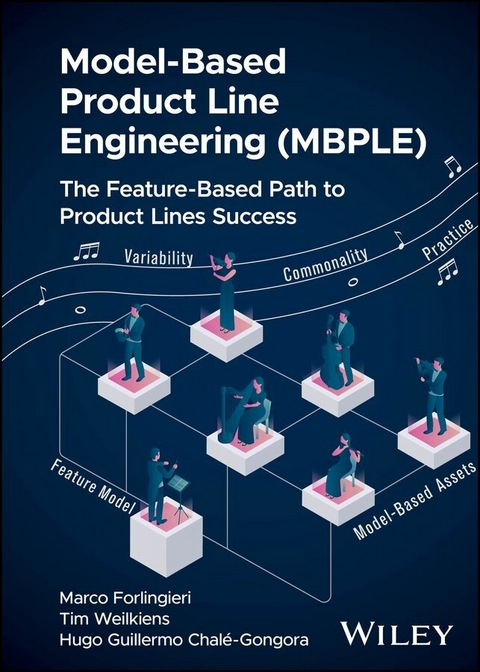
Model-Based Product Line Engineering (MBPLE) (eBook)
637 Seiten
Wiley (Verlag)
978-1-394-20468-7 (ISBN)
Clear and concise guide to MBPLE, with industrial case studies
Written in a to-the-point style, Model-Based Product Line Engineering (MBPLE) is the only theoretical and practical foundational book on MBPLE that brings together the topics of model-based systems engineering (MBSE) and feature-based product line engineering (PLE). It examines how PLE can benefit from a model-based and model-centric approach and, in turn, how MBSE combined with holistic PLE can boost model reuse and improve the MBSE business case.
The book combines both management and engineering aspects to deliver comprehensive coverage of the subject. The book covers real-life challenges and implementations of MBPLE, discussing adoption obstacles faced by engineering organizations and how to overcome them to ensure a successful MBPLE deployment.
Dozens of SysML v2 views, SysML v1 diagrams, SysML v2 code snippets and illustrations are included throughout to elucidate key concepts. Additional supplementary learning materials are available on a companion website.
Written by a team of expert authors and contributors with significant experience in the field of applied MBPLE, Model-Based Product Line Engineering (MBPLE) discusses sample topics including:
- Motivation for MBPLE, covering document-based to model-based engineering, project-oriented to product-line-oriented engineering, and digital continuity and system lifecycle management
- Foundations of MBPLE, covering basic definitions, the history of MBPLE, recent MBPLE works and standards, and the impact of MBPLE on engineering processes
- Implementation of MBPLE using the next generation modeling language SysML v2
- Adoption of MBPLE, covering investment interests, company processes, change management and digital transformation, and methods, guidelines, coaching
Model-Based Product Line Engineering (MBPLE) delivers vision, benefits, and strategic guidance for managers, executives, and business leaders while serving as a practical guide for system engineers who are new to the MBPLE discipline or already familiar with it.
Marco Forlingieri is Senior Director for Solutions Engineering at PTC, leading worldwide the PLE technical area, with several years of experience in PLE and MBSE domains across Asia, Europe and US. He is also chair of the INCOSE PLE International Working Group.
Tim Weilkiens is a member of the executive board of the German consulting company oose, an MBSE consultant with 20+ years of experience, and an active member of the OMG and INCOSE communities.
Hugo Guillermo Chalé-Gongora is Head of Product Lines and Multi-Disciplinary Analysis & Optimisation at Airbus with over 24 years of experience in SE, MBSE and MBPLE in different industries, and founder of the PLE International Working Group and the Automotive Working Group of INCOSE.
Clear and concise guide to MBPLE, with industrial case studies Written in a to-the-point style, Model-Based Product Line Engineering (MBPLE) is the only theoretical and practical foundational book on MBPLE that brings together the topics of model-based systems engineering (MBSE) and feature-based product line engineering (PLE). It examines how PLE can benefit from a model-based and model-centric approach and, in turn, how MBSE combined with holistic PLE can boost model reuse and improve the MBSE business case. The book combines both management and engineering aspects to deliver comprehensive coverage of the subject. The book covers real-life challenges and implementations of MBPLE, discussing adoption obstacles faced by engineering organizations and how to overcome them to ensure a successful MBPLE deployment. Dozens of SysML v2 views, SysML v1 diagrams, SysML v2 code snippets and illustrations are included throughout to elucidate key concepts. Additional supplementary learning materials are available on a companion website. Written by a team of expert authors and contributors with significant experience in the field of applied MBPLE, Model-Based Product Line Engineering (MBPLE) discusses sample topics including: Motivation for MBPLE, covering document-based to model-based engineering, project-oriented to product-line-oriented engineering, and digital continuity and system lifecycle managementFoundations of MBPLE, covering basic definitions, the history of MBPLE, recent MBPLE works and standards, and the impact of MBPLE on engineering processesImplementation of MBPLE using the next generation modeling language SysML v2Adoption of MBPLE, covering investment interests, company processes, change management and digital transformation, and methods, guidelines, coaching Model-Based Product Line Engineering (MBPLE) delivers vision, benefits, and strategic guidance for managers, executives, and business leaders while serving as a practical guide for system engineers who are new to the MBPLE discipline or already familiar with it.
Chapter 2
Complexity and Variability
2.1 Introduction
As the discipline of systems engineering evolves, it must confront the growing complexity inherent in its expansive scope. This chapter first explores in Section 2.2 the dual drivers of complexity identified by the International Council on Systems Engineering (INCOSE) in its Vision 2035 (INCOSE 2022): technology-driven and scope-driven complexity. Technology-driven complexity is fueled by fast technological advancements, while scope-driven complexity emerges from the increasing size and interdependencies within the development scope. We explore deeper each driver, emphasizing their distinctive impacts on the field.
Section 2.3 addresses the concept of variability driven by customization in product development. Customization, while enhancing individuality and flexibility, often results in a diverse range of product variants.
The combination of complexity and variability are discussed in Section 2.4, two trends that are deeply interrelated and form the challenges in modern product and systems engineering, emerging as a key focus of the chapter. Through a few examples, it illustrates the difficulties of balancing high variability demands with the need to manage complexity effectively.
Ultimately, this chapter contextualizes these concepts within the broader framework of systems engineering, emphasizing the criticality of innovative development paradigms to address the combined challenges of increasing complexity and variability demands in the development of complex systems.
2.2 Complexity
In systems engineering, complexity has always been a key aspect to address. The field itself developed to better handle the increasing scale, interconnections, and complexity in systems development. Professor de Weck (Conservation of Complexity 2023) discussed the rising complexity in today’s products and systems, noting that it is much higher than in the past, as highlighted in Figure 2.1. This complexity is intended to lead to enhanced performance and, possibly, increased resilience. It is a common understanding among systems engineers that complexity is escalating each year due to rapidly changing contexts, the growing interdependencies of systems, and more challenging projects taken on by organizations and governments. He also pointed out how monumental achievements like the lunar landing, the International Space Station, 20-hour transoceanic flights, or capturing images of the earliest proto-galaxies post-Big Bang are made possible by the coordinated effort of numerous components, including hardware, software, and human collaboration. However, he also emphasized that many aerospace programs are facing rising costs and challenges in management, partly due to a limited grasp of how system performance, complexity, and the effort needed for design, construction, and validation are interrelated. This can be also explained by what he theorizes as the “First Law of System Science for Conservation of Complexity.” In simpler terms, it suggests that the complexity of a system is directly related to expected improvement in its performance, adjusted by the amount of work and resources put into its development and construction (Conservation of Complexity 2023).
Figure 2.1 Representation of the increasing complexity in history.
Source: Adapted from INCOSE 2022.
In systems engineering, the typical process that aims at managing complexity involves breaking down a “problem” into smaller, more manageable parts, designing solutions for these individual parts, and then reassembling them to form the complete system. This approach is effective for “complicated” systems with fixed interactions among parts, even if they contain many interrelated components and may exhibit unpredictable behavior (INCOSE 2016).
However, this method encounters difficulties when new technologies are integrated into traditional systems and when the scope of these systems expands to ambitious developments. In complex systems, the emergent properties crucial to the system’s functionality cannot be fully understood by examining the individual components separately. These properties only become apparent when considering the system as a whole. According to INCOSE’s Vision 2035 (INCOSE 2022), the complexity in engineering is continuously escalating, primarily due to two key factors: technology-driven complexity and scope-driven complexity. Other factors contribute to an increase of complexity in systems engineering, such as the complexity of the business context or of the organization in which the systems are developed. However, the focus here is on the complexity intrinsic to the system under development. Let’s examine both drivers in detail.
2.2.1 Technology-driven Complexity
Technology-driven complexity arises from the rapid pace of technological advancements and their integration into systems and products. This type of complexity is often characterized by the incorporation of cutting-edge technologies, which, while enhancing capabilities, also add challenges to the system’s design, operation, and maintenance, as exemplified in Figure 2.2.
Figure 2.2 Representation of the technology-driven complexity driver.
Source: Adapted from INCOSE 2022.
For instance, the implementation of software-defined vehicles in the automotive industry describes the complexity of technology-driven vehicles well. A software-defined vehicle is any vehicle that manages its operations, adds functionality, and enables new features primarily or entirely through software. Tesla cars are the most famous example. Software-defined vehicles are the next evolution of the automotive industry. Their architecture usually divides the vehicle’s functions into different server zones, such as infotainment, safety systems, and vehicle control. Each zone integrates advanced technologies like sensor fusion, connectivity modules, and real-time data processing. The challenge lies in harmonizing these technologies to work together, ensuring vehicle performance and safety in diverse driving conditions. This complexity is compounded by the need to constantly update and maintain each server zone over the air to meet evolving technological standards and consumer demands (Burkacky et al. 2023).
2.2.2 Scope-driven Complexity
Scope-driven complexity emerges from the expansion in the scale and interconnectedness of systems. It reflects the transition from developing standalone products to creating systems part of more extensive, often interconnected networks, as illustrated in Figure 2.3.
Figure 2.3 Representation of the scope-driven complexity driver.
Source: Adapted from INCOSE 2022.
Extending the example of software-defined vehicles, scope-driven complexity becomes apparent when these vehicles connect to more extensive networks. Features like over-the-air software updates and vehicle-to-everything communication add layers of complexity. The challenge is ensuring the vehicle’s different server zones work well with these external connections, maintaining reliable and secure performance in an interconnected setting. This shows how expanding the scope of vehicle systems naturally makes them more complex.
In summary, understanding complexity in systems engineering involves recognizing the multifaceted challenges posed by technological advancements and expanding project scopes. As we continue to push the boundaries of what is possible, mastery of complexity becomes a critical skill in the engineer’s toolkit.
2.3 Variability
In product development, customization refers to the process of tailoring products or systems to meet the specific requirements of a customer or market segment. This often involves modifying or configuring the design, features, functionalities, or even the aesthetics of a product to align with distinct preferences, needs, or operational environments. From a portfolio perspective, customized products or systems exhibit variability, as their characteristics may differ among the members of the product portfolio. Unlike mass production, which focuses on uniformity and scale, customization emphasizes individuality and flexibility, often resulting in diverse product variants. Customization is the primary driver of variability within a product portfolio.
With increasing demand for customization, companies face the double challenge of providing market – or customer-specific variety while mastering the consequences of high variability in engineering and production. Especially in an increasingly saturated market, new products must find ways to differentiate themselves from the competition, like distinctively meeting specific customer needs to enhance customer’s satisfaction (Simpson et al. 2005).
However, as observed by Meyer and Lehnerd (1997), focusing on individual customer preferences often leads to overlooking commonality and standardization across product lines. This can result in an overwhelming diversification of products and parts. While offering a comprehensive product variety has merits, it can also incur significant costs and complexity within a company.
Have you ever noticed, while traveling on different flights, even within the exact airline or across various airlines, which the airplane model might be the same, yet many aspects inside differ significantly? For instance, consider the variability in-cabin configuration and layout, the number and style of toilets, infotainment systems, or even the types of...
| Erscheint lt. Verlag | 11.3.2025 |
|---|---|
| Sprache | englisch |
| Themenwelt | Technik ► Elektrotechnik / Energietechnik |
| Schlagworte | 150 percent Models • feature models • ISO 2568x • MBSE • PLE • Product Configuration Management • Product Instantiation • Product lines • product platform • SysML v2 • Systems Engineering • variant management • Variant modeling |
| ISBN-10 | 1-394-20468-X / 139420468X |
| ISBN-13 | 978-1-394-20468-7 / 9781394204687 |
| Informationen gemäß Produktsicherheitsverordnung (GPSR) | |
| Haben Sie eine Frage zum Produkt? |
 EPUB (Adobe DRM)
Kopierschutz: Adobe-DRM
Adobe-DRM ist ein Kopierschutz, der das eBook vor Mißbrauch schützen soll. Dabei wird das eBook bereits beim Download auf Ihre persönliche Adobe-ID autorisiert. Lesen können Sie das eBook dann nur auf den Geräten, welche ebenfalls auf Ihre Adobe-ID registriert sind.
Details zum Adobe-DRM
Dateiformat: EPUB (Electronic Publication)
EPUB ist ein offener Standard für eBooks und eignet sich besonders zur Darstellung von Belletristik und Sachbüchern. Der Fließtext wird dynamisch an die Display- und Schriftgröße angepasst. Auch für mobile Lesegeräte ist EPUB daher gut geeignet.
Systemvoraussetzungen:
PC/Mac: Mit einem PC oder Mac können Sie dieses eBook lesen. Sie benötigen eine
eReader: Dieses eBook kann mit (fast) allen eBook-Readern gelesen werden. Mit dem amazon-Kindle ist es aber nicht kompatibel.
Smartphone/Tablet: Egal ob Apple oder Android, dieses eBook können Sie lesen. Sie benötigen eine
Geräteliste und zusätzliche Hinweise
Buying eBooks from abroad
For tax law reasons we can sell eBooks just within Germany and Switzerland. Regrettably we cannot fulfill eBook-orders from other countries.
aus dem Bereich