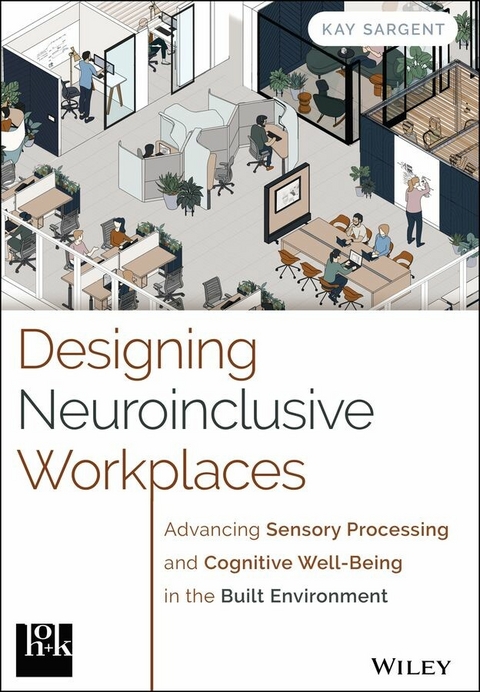
Designing Neuroinclusive Workplaces (eBook)
351 Seiten
Wiley (Verlag)
978-1-394-30935-1 (ISBN)
Assist the growing neurodivergent population with strategic adjustments to physical spaces
Designing Neuroinclusive Workplaces: Advancing Sensory Processing and Cognitive Well-Being in the Built Environment explores how to employ strategic spatial zoning and sequencing, sensory zones, patterns, textures, colors, lighting, and soundscaping to create spaces that cater to the various sensory needs of neurodivergent individuals, who now make up 1/5 of the world's population. This group possesses unique strengths that can be harnessed if they are in environments designed to be welcoming and supportive of their needs.
Written by Kay Sargent of HOK, a leader in the field of workplace design and architecture, this groundbreaking book argues that even minor adjustments to physical spaces can drive giant improvements in cognitive function, fulfillment, and belonging for both neurodivergent and neurotypical individuals.
Some of the topics explored in this book include:
- Reimagining the design of offices and workplaces through a neuroinclusive lens
- Optimizing spaces to accommodate hypersensitivities across all six work modalities, ranging from focused tasks to collaborative endeavors
- Inclusion practices to boost productivity in the workplace and transform high-stress environments into more welcoming and functional spaces for everyone
Filled with practical, actionable strategies for designing spaces that embrace and empower individuals across the neurodiversity spectrum, Designing Neuroinclusive Workplaces is a timely, essential read for all forward-thinking HR, DEI, and accessibility teams, as well as architects and interior designers.
KAY SARGENT is the Director of Thought Leadership, Interiors, at HOK, a leading organization in the field of workplace design and architecture. She sits on the Delos Advisory Board alongside renowned wellness and sustainability advocates and is the winner of the IFMA Distinguished Author Award for research on neurodiversity.
Assist the growing neurodivergent population with strategic adjustments to physical spaces Designing Neuroinclusive Workplaces: Advancing Sensory Processing and Cognitive Well-Being in the Built Environment explores how to employ strategic spatial zoning and sequencing, sensory zones, patterns, textures, colors, lighting, and soundscaping to create spaces that cater to the various sensory needs of neurodivergent individuals, who now make up 1/5 of the world's population. This group possesses unique strengths that can be harnessed if they are in environments designed to be welcoming and supportive of their needs. Written by Kay Sargent of HOK, a leader in the field of workplace design and architecture, this groundbreaking book argues that even minor adjustments to physical spaces can drive giant improvements in cognitive function, fulfillment, and belonging for both neurodivergent and neurotypical individuals. Some of the topics explored in this book include: Reimagining the design of offices and workplaces through a neuroinclusive lens Optimizing spaces to accommodate hypersensitivities across all six work modalities, ranging from focused tasks to collaborative endeavors Inclusion practices to boost productivity in the workplace and transform high-stress environments into more welcoming and functional spaces for everyone Filled with practical, actionable strategies for designing spaces that embrace and empower individuals across the neurodiversity spectrum, Designing Neuroinclusive Workplaces is a timely, essential read for all forward-thinking HR, DEI, and accessibility teams, as well as architects and interior designers.
| Erscheint lt. Verlag | 4.3.2025 |
|---|---|
| Sprache | englisch |
| Themenwelt | Technik ► Architektur |
| Schlagworte | neurodiversity interior design • neurodiversity lighting • neurodiversity patterns • neurodiversity sensory zones • neurodiversity soundscape • neurodiversity spatial sequencing • neurodiversity spatial zoning • neurodiversity textures |
| ISBN-10 | 1-394-30935-X / 139430935X |
| ISBN-13 | 978-1-394-30935-1 / 9781394309351 |
| Informationen gemäß Produktsicherheitsverordnung (GPSR) | |
| Haben Sie eine Frage zum Produkt? |
 PDF (Adobe DRM)
Kopierschutz: Adobe-DRM
Adobe-DRM ist ein Kopierschutz, der das eBook vor Mißbrauch schützen soll. Dabei wird das eBook bereits beim Download auf Ihre persönliche Adobe-ID autorisiert. Lesen können Sie das eBook dann nur auf den Geräten, welche ebenfalls auf Ihre Adobe-ID registriert sind.
Details zum Adobe-DRM
Dateiformat: PDF (Portable Document Format)
Mit einem festen Seitenlayout eignet sich die PDF besonders für Fachbücher mit Spalten, Tabellen und Abbildungen. Eine PDF kann auf fast allen Geräten angezeigt werden, ist aber für kleine Displays (Smartphone, eReader) nur eingeschränkt geeignet.
Systemvoraussetzungen:
PC/Mac: Mit einem PC oder Mac können Sie dieses eBook lesen. Sie benötigen eine
eReader: Dieses eBook kann mit (fast) allen eBook-Readern gelesen werden. Mit dem amazon-Kindle ist es aber nicht kompatibel.
Smartphone/Tablet: Egal ob Apple oder Android, dieses eBook können Sie lesen. Sie benötigen eine
Geräteliste und zusätzliche Hinweise
Buying eBooks from abroad
For tax law reasons we can sell eBooks just within Germany and Switzerland. Regrettably we cannot fulfill eBook-orders from other countries.
aus dem Bereich