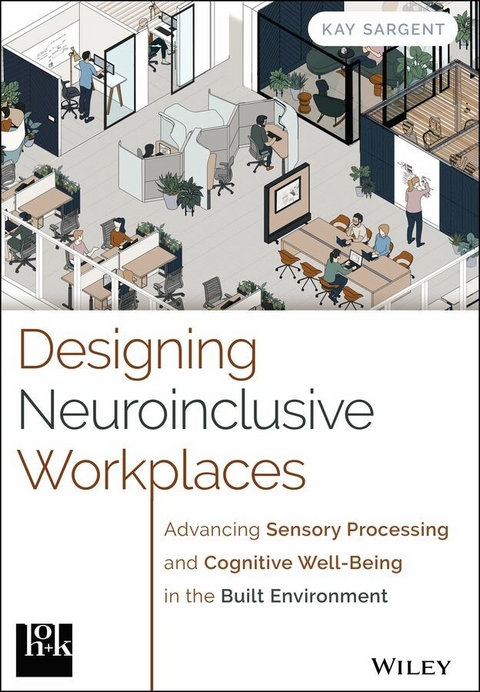
Designing Neuroinclusive Workplaces (eBook)
446 Seiten
Wiley (Verlag)
978-1-394-30934-4 (ISBN)
Assist the growing neurodivergent population with strategic adjustments to physical spaces
Designing Neuroinclusive Workplaces: Advancing Sensory Processing and Cognitive Well-Being in the Built Environment explores how to employ strategic spatial zoning and sequencing, sensory zones, patterns, textures, colors, lighting, and soundscaping to create spaces that cater to the various sensory needs of neurodivergent individuals, who now make up 1/5 of the world's population. This group possesses unique strengths that can be harnessed if they are in environments designed to be welcoming and supportive of their needs.
Written by Kay Sargent of HOK, a leader in the field of workplace design and architecture, this groundbreaking book argues that even minor adjustments to physical spaces can drive giant improvements in cognitive function, fulfillment, and belonging for both neurodivergent and neurotypical individuals.
Some of the topics explored in this book include:
- Reimagining the design of offices and workplaces through a neuroinclusive lens
- Optimizing spaces to accommodate hypersensitivities across all six work modalities, ranging from focused tasks to collaborative endeavors
- Inclusion practices to boost productivity in the workplace and transform high-stress environments into more welcoming and functional spaces for everyone
Filled with practical, actionable strategies for designing spaces that embrace and empower individuals across the neurodiversity spectrum, Designing Neuroinclusive Workplaces is a timely, essential read for all forward-thinking HR, DEI, and accessibility teams, as well as architects and interior designers.
KAY SARGENT is the Director of Thought Leadership, Interiors, at HOK, a leading organization in the field of workplace design and architecture. She sits on the Delos Advisory Board alongside renowned wellness and sustainability advocates and is the winner of the IFMA Distinguished Author Award for research on neurodiversity.
Assist the growing neurodivergent population with strategic adjustments to physical spaces Designing Neuroinclusive Workplaces: Advancing Sensory Processing and Cognitive Well-Being in the Built Environment explores how to employ strategic spatial zoning and sequencing, sensory zones, patterns, textures, colors, lighting, and soundscaping to create spaces that cater to the various sensory needs of neurodivergent individuals, who now make up 1/5 of the world's population. This group possesses unique strengths that can be harnessed if they are in environments designed to be welcoming and supportive of their needs. Written by Kay Sargent of HOK, a leader in the field of workplace design and architecture, this groundbreaking book argues that even minor adjustments to physical spaces can drive giant improvements in cognitive function, fulfillment, and belonging for both neurodivergent and neurotypical individuals. Some of the topics explored in this book include: Reimagining the design of offices and workplaces through a neuroinclusive lens Optimizing spaces to accommodate hypersensitivities across all six work modalities, ranging from focused tasks to collaborative endeavors Inclusion practices to boost productivity in the workplace and transform high-stress environments into more welcoming and functional spaces for everyone Filled with practical, actionable strategies for designing spaces that embrace and empower individuals across the neurodiversity spectrum, Designing Neuroinclusive Workplaces is a timely, essential read for all forward-thinking HR, DEI, and accessibility teams, as well as architects and interior designers.
Preface
We welcome the move to a neuroaffirming society, which recognizes the range of neurodivergent conditions in addition to autism and learning disabiity.
—Alison Clarke, chair of the task and finish group that developed the British Psychological Society's Neurodiversity Manager's Guide
HOK's team began exploring the topic of neurodiversity in 2016. At the time, many people were not familiar with the term. When a client asked about it, we had an answer, but we wanted to know more. So, we started to research the topic. What we found were a drought of information on how the built environment could be designed to support neuroinclusion. We saw an opportunity to rectify that and our team started to conduct research on the topic. In this book, we share what we have learned so far.
Key Terms
Words matter, and language is ever‐evolving. While we understand that different groups prefer different terminology, we have strived to use the most accepted nonableist and neuroinclusive terminology. The majority of neurodivergents and their advocates we talked to during this process said they prefer identity‐first language, such as “autistic person,” “ADHDer,” or “dyslexic person,” so we have followed that preference. These definitions reflect commonly accepted terminology synthesized from various authoritative sources in this evolving field as of 2024.
These are key terms used in the book:
- Neurodiversity: The breadth of human cognitive functioning, including both typical and atypical cognition
- Neurotypical: Individuals whose neurological development and functioning are consistent with what is perceived to be the predominant societal standard
- Neurotype or neurodistinct: A collection of traits common to people with similar neurological structures
- Neurodivergent individuals or neurominorities: People whose neurocognitive functioning differs from the predominant societal standards
- Neurodivergence: A naturally occurring variation in neurocognitive functioning that differs from the predominant neurotype
Personally, I dislike the reference to “typical” and “divergence.” We all function differently, so is there really any “typical” or “average” way to think or function? I would suggest that “neuropredictable” is a better term to use than “neurotypical.” But since these are the words most commonly used today, we will use them until we collectively make our language more inclusive.
Individual preferences vary. When interacting with someone directly, we can simply ask about their preferred terminology. Consider asking whether they prefer person‐first language, like “person with autism,” or identity‐first language, such as “autistic person,” and how they would like to be addressed.
Setting the Stage
Kai steps off the packed elevator into the lobby of his new office. His heart is pounding. Sounds assault him from all sides. Conversations echo off hard floors, phones ring nonstop, and the fluorescent light feels like it is pulsing through his body. He searches in vain for refuge among countless rows of identical gray desks. There is no landmark to guide him.
Zara is still struggling in the new open office. She flinches every time someone passes behind her workstation. The enormous company logos plastered across the walls flash in her peripheral vision and conversations between her coworkers on calls are overwhelming. She turns up the music playing through her headphones and wonders how she is supposed to focus.
Jamie gazes at the blank white walls of the meeting room, trying to concentrate on a colleague's presentation. Bright overhead lights make the text on their laptop screen almost illegible. The sterile room lacks plants or art, and there is no visual connection to the outdoors. The seats around the table are tightly packed, and there is no space to stand, move, or fidget without impacting others.
Does any of this seem familiar? These issues afflict millions of employees every day—some more severely than others. The unfortunate reality is that most of today's offices fail to accommodate the spectrum of people's diverse sensory needs.
This book describes how we can close this divide and use neuroinclusive design to create workplace environments where everyone can thrive.
Research and Objectives
Much of the current body of research focuses on single neurotypes, such as autism, obsessive‐compulsive disorder (OCD), or attention‐deficit/hyperactivity disorder (ADHD). Our goal is to take a more holistic approach and address the environmental impact, needs, and strategies of various neurotypes that fall under the neurodiversity umbrella. This more accurately reflects the dynamics one is likely to encounter in a general office population.
Current studies indicating that at least 20 percent of people identify as neurodivergent, but our most research studies indicate that 20 percent might be conservative. And in sectors like life sciences and technology, that percentage can be much higher. Yet neurominorities often suffer from “ableism,” a form of discrimination where neurodivergents are seen as lesser and negatively impacted by prejudice and lack of access or accommodation. To us, addressing the needs of a diverse population is an inclusion imperative and what good design should be about—empowering people. So, we decided to leverage our skills and develop material that addresses the needs of various neurotypes in workplace settings.
When you consider that:
- Hearing loss or severe auditory impairment affects 6.2 percent of U.S. adults1
- Even with corrective lenses, 5.5 percent of American adults experience significant visual impairment or blindness2
- Mobility challenges or difficulty walking affect 6.8 percent of U.S. adults3
These physical disabilities affect 18.5 percent of the population, and we have rightly adapted how we design buildings to meet their needs. Yet while at least 20 percent of people are neurodivergent—and that is on the conservative side—relatively little has been done to address their needs in the built environment. That needs to change.
Article 23 of the Universal Declaration of Human Rights addresses workers' rights, recognizing the opportunity for gainful employment free of discrimination. This includes the right to “just and favorable conditions of work,” ensuring that employees are treated fairly and provided with suitable working conditions that uphold their dignity.4 As designers and architects, we have a responsibility to create inclusive work environments that support these fundamental rights.
HOK's Mission and Commitment
As a firm, HOK wants to be a leader on topics impacting people in the built environment. We are always working to provide clients with more human‐centric, evidence‐based solutions. Our mission is clear: “HOK is a collective of future‐forward thinkers and designers who are driven to face the critical challenges of our time. We are dedicated to improving people's lives, serving our clients, and healing the planet.”
Early in our research on addressing neuroinclusion in the built environment, we shared the material around the firm for feedback and vetting. One colleague was so excited about the potential that she declared, “We're going to own this topic!” We quickly clarified that this was not our intention. No one is going to “own” this topic because it is too vast and important to control. Instead, our intention is to design the most inclusive environments possible, while sharing what we learn to help advance the entire profession.
Collaboration and Industry Progress
The research on designing for neuroinclusion is constantly growing and improving. From the outset, we committed to leading on neurodiversity while openly sharing our findings. Though I know this was the right decision, there were times when I questioned it. The design profession is competitive, and sharing proprietary research is not common, but this topic is different. I recall a pivotal discussion with HOK’s then chief executive officer, Bill Hellmuth, where we agreed that some topics transcend competitive advantage and become a moral imperative. This is one of those topics.
We appreciate all the others who have waded in to help expand this knowledge. We need the industry to come together around neuroinclusion, set aside attempts to own the subject, and collaborate however we can. The last thing we need is 10 different neurodiversity checklists. Instead, we need one comprehensive resource that everyone can use. What if every design firm had created its own version of the Americans with Disabilities Act (ADA) in 1990? That would have been chaos, and we would never have made the progress that we have to date on designing for physical inclusion.
Going far together was our goal when we began collaborating with the International WELL Building Institute (IWBI) on this topic in 2022. We co‐hosted several workshops that brought together members of the design community, neurodivergent individuals, neuroinclusion advocates, environmental and organizational psychologists, and HR...
| Erscheint lt. Verlag | 4.3.2025 |
|---|---|
| Sprache | englisch |
| Themenwelt | Technik ► Architektur |
| Schlagworte | neurodiversity interior design • neurodiversity lighting • neurodiversity patterns • neurodiversity sensory zones • neurodiversity soundscape • neurodiversity spatial sequencing • neurodiversity spatial zoning • neurodiversity textures |
| ISBN-10 | 1-394-30934-1 / 1394309341 |
| ISBN-13 | 978-1-394-30934-4 / 9781394309344 |
| Informationen gemäß Produktsicherheitsverordnung (GPSR) | |
| Haben Sie eine Frage zum Produkt? |
 EPUB (Adobe DRM)
Kopierschutz: Adobe-DRM
Adobe-DRM ist ein Kopierschutz, der das eBook vor Mißbrauch schützen soll. Dabei wird das eBook bereits beim Download auf Ihre persönliche Adobe-ID autorisiert. Lesen können Sie das eBook dann nur auf den Geräten, welche ebenfalls auf Ihre Adobe-ID registriert sind.
Details zum Adobe-DRM
Dateiformat: EPUB (Electronic Publication)
EPUB ist ein offener Standard für eBooks und eignet sich besonders zur Darstellung von Belletristik und Sachbüchern. Der Fließtext wird dynamisch an die Display- und Schriftgröße angepasst. Auch für mobile Lesegeräte ist EPUB daher gut geeignet.
Systemvoraussetzungen:
PC/Mac: Mit einem PC oder Mac können Sie dieses eBook lesen. Sie benötigen eine
eReader: Dieses eBook kann mit (fast) allen eBook-Readern gelesen werden. Mit dem amazon-Kindle ist es aber nicht kompatibel.
Smartphone/Tablet: Egal ob Apple oder Android, dieses eBook können Sie lesen. Sie benötigen eine
Geräteliste und zusätzliche Hinweise
Buying eBooks from abroad
For tax law reasons we can sell eBooks just within Germany and Switzerland. Regrettably we cannot fulfill eBook-orders from other countries.
aus dem Bereich