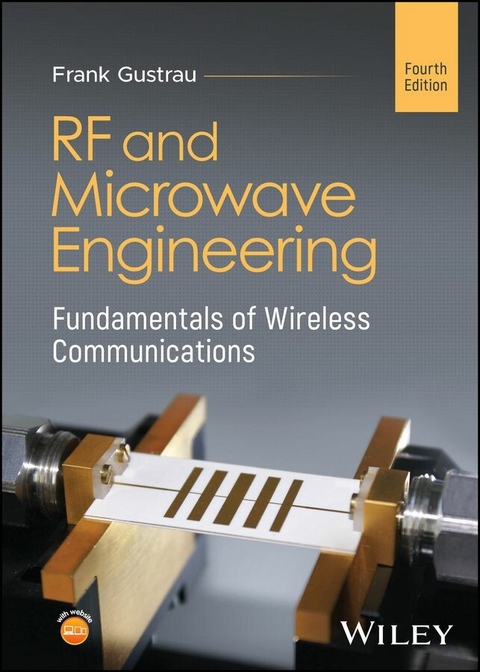
RF and Microwave Engineering (eBook)
696 Seiten
Wiley (Verlag)
978-1-394-28347-7 (ISBN)
A comprehensive guide to the fundamentals of radio frequency (RF), microwave engineering, and the physical aspects of wireless communications.
Combining physical-technical fundamentals with numerical simulations, RF and Microwave Engineering presents a wide range of RF topics with emphasis on physical aspects such as electromagnetic (EM) and voltage waves, transmission lines, passive circuits, and antennas. The text discusses the propagation of waves and their representation, effects, and utilization in passive circuits and antenna structures, incorporates various design examples using circuit and EM simulation software, and gives examples of modern RF tools to show how methods can be applied productively in RF engineering practice.
This revised edition includes new chapters on monostatic and bistatic radar cross sections (RCS), horn antennas, 5G mobile communications, substrate-integrated-waveguides (SIW), slot antennas, characteristics of resonators, and other topics.
A list of practice problems is provided at the end of each chapter and a companion website hosts solutions to the problem sets.
Written by a highly qualified professor this is the English language translation of the German original. RF and Microwave Engineering includes:
- Transmission line theory and transient signals on lines, covering characteristic line impedances, voltage waves, idealized lossless lines and cables with low losses, impedance transformation, reflection coefficient, and Smith chart diagram
- Waveguides, covering coaxial lines, including weak losses, parallel wire lines, microstrip lines, rectangular waveguides, substrate-integrated-waveguides, and three-wire systems
- Scattering parameters, covering multiport equations in matrix form, special network properties of circuits, and the signal flow method
- High-frequency components and circuits, covering line filters, couplers, power dividers, and matching circuits
- Antenna concepts and radio wave propagation in complex environments
RF and Microwave Engineering is an essential text for undergraduate and graduate students in electrical engineering courses including microwave engineering, basic circuit theory, electromagnetic fields, and wireless communications as well as early-stage RF practitioners and engineers.
Frank Gustrau has been a Professor at the University of Applied Sciences and Arts in Dortmund, Germany since 2003. Throughout his career in industry and academia, Professor Gustrau has supervised students in their project work, given lectures on different RF related topics, and worked extensively with EM and RF circuit simulation tools.
A comprehensive guide to the fundamentals of radio frequency (RF), microwave engineering, and the physical aspects of wireless communications. Combining physical-technical fundamentals with numerical simulations, RF and Microwave Engineering presents a wide range of RF topics with emphasis on physical aspects such as electromagnetic (EM) and voltage waves, transmission lines, passive circuits, and antennas. The text discusses the propagation of waves and their representation, effects, and utilization in passive circuits and antenna structures, incorporates various design examples using circuit and EM simulation software, and gives examples of modern RF tools to show how methods can be applied productively in RF engineering practice. This revised edition includes new chapters on monostatic and bistatic radar cross sections (RCS), horn antennas, 5G mobile communications, substrate-integrated-waveguides (SIW), slot antennas, characteristics of resonators, and other topics. A list of practice problems is provided at the end of each chapter and a companion website hosts solutions to the problem sets. Written by a highly qualified professor this is the English language translation of the German original. RF and Microwave Engineering includes: Transmission line theory and transient signals on lines, covering characteristic line impedances, voltage waves, idealized lossless lines and cables with low losses, impedance transformation, reflection coefficient, and Smith chart diagram Waveguides, covering coaxial lines, including weak losses, parallel wire lines, microstrip lines, rectangular waveguides, substrate-integrated-waveguides, and three-wire systemsScattering parameters, covering multiport equations in matrix form, special network properties of circuits, and the signal flow methodHigh-frequency components and circuits, covering line filters, couplers, power dividers, and matching circuitsAntenna concepts and radio wave propagation in complex environments RF and Microwave Engineering is an essential text for undergraduate and graduate students in electrical engineering courses including microwave engineering, basic circuit theory, electromagnetic fields, and wireless communications as well as early-stage RF practitioners and engineers.
1
Introduction
1.1 Radiofrequency and Microwave Applications
Today at home or on the move, every one of us uses devices that employ wireless technology to an increasing extent. Figure 1.1a shows a selection of wireless communication, navigation, identification and detection applications.
In the future we will see a growing progression of the trend to apply components and systems of high‐frequency technology in new areas of application. Development and maintenance of such systems requires an extensive knowledge of high‐frequency behavior of basic elements (e.g. resistors, capacitors, inductors, transmission lines, transistors), components (e.g. antennas), circuits (e.g. filters, amplifiers, mixers) including physical issues such as electromagnetic wave propagation (Figure 1.1b).
Table 1.1 shows a number of standard RF and microwave applications and their associated frequency bands [1–3]. The applications include terrestrial voice and data communication, which means cellular networks and wireless communication networks, as well as terrestrial and satellite‐based broadcasting systems. Wireless identification systems (RFID) within industrial, scientific, and medical (ISM) bands enjoy increasing popularity among cargo traffic and logistics businesses. As for the field of navigation, GPS should be pointed out, which today is already installed in numerous vehicles and mobile devices. Looking at the automotive sector, radar systems are being used to monitor the surrounding area or serve as sensors for driver assistance systems.
The various application areas are developing rapidly. Let's take a look at the development of mobile telephony as an example. In the early days of mobile telephony, the focus was on voice communication. Analog terminals were bulky and expensive. With the second generation (2G/GSM), digital technology was introduced to mobile telephony in the 1990s. Terminals became more compact and affordable for the masses. In addition to voice communication, a text service or short message service (SMS) was established. At the turn of the millennium, the third generation (3G/UMTS) saw the development of mobile broadband applications with the possibility of using multimedia content (photo, video, music) and the Internet on the move. Under the influence of the new technical possibilities, the operating concepts of the end devices changed (touchscreen instead of the keyboard) and the equipment of the devices became more complex (e.g. built‐in cameras).
Figure 1.1 (a) Examples of wireless applications and (b) RF components and propagation of electromagnetic waves.
With the fourth‐generation mobile communications standard (4G/LTE‐Advanced1) from around 2010, mobile broadband access was further developed, data rates were increased and capacity (number of simultaneously active subscribers in the network) was increased. Inexpensive devices and tariffs led to mobile broadband access for everyone. In addition to fast mobile broadband access, an expansion of the LTE standard (NB‐IoT2) also included applications in the area of Industry 4.0 and the Internet of Things. The data rates in this field of application are comparatively low, but the requirements for energy efficiency and reliability are very high.
A fifth‐generation mobile communications standard (5G) is currently being established in order to meet increasing requirements and open up further fields of application for mobile communications [4, 5]. A total of three application scenarios are being addressed:
- Improvements in mobile broadband applications (eMBB = enhanced Mobile Broadband): Higher data rates and reduced delay rates for VR3 and AR4 applications, among others.
- Communication between a large number of low‐cost and energy‐efficient devices for industrial applications (mMTC = massive Machine Type Communications).
- Applications with low latency and high reliability for autonomous driving, for example (URLLC = Ultra Reliable Low Latency Communications).
Table 1.1 Wireless applications and frequency ranges
| Cellular mobile telephony |
| GSM | Global System for Mobile Communication | 900 MHz, 1800 MHz |
| (2nd generation mobile communication standard) |
| UMTS | Universal Mobile Telecommunications System | 2100 MHz |
| (3rd generation mobile communication standard) |
| LTE | Long Term Evolution | 800 MHz, 1800 MHz, 2600 MHz |
| (4th generation mobile communication standard) |
| 5G | 5th generation mobile communication standard | 700 MHz, 3400 3800 MHz, |
| ((*) Other frequency ranges planned) | 28 GHz (*) |
| Tetra | Trunked radio | 450 MHz |
| Wireless networks |
| WLAN | Wireless local area network | 2.45 GHz, 5 GHz |
| Bluetooth | Short range radio | 2.45 GHz |
| Navigation |
| GPS | Global Positioning System | 1.2 GHz, 1.575 GHz |
| Identification |
| RFID | Radio‐Frequency Identification | 13.56 MHz, 868 MHz, |
| 2.45 GHz, 5 GHz |
| Radio broadcasting |
| FM | Analog broadcast transmitter network | MHz |
| DAB | Digital Audio Broadcasting | 200 MHz |
| DVB‐T2 | Digital Video Broadcasting – Terrestrial | MHz |
| DVB‐S | Digital Video Broadcasting – Satellite | GHz |
| Radar applications |
| SRR | Automotive short range radar | 24 GHz |
| ACC | Adaptive cruise control radar | 77 GHz |
Significant changes have been made to the radio interface, among other things, in order to meet the requirements of the various application scenarios. All previous standards operated in the frequency range below 3 ĠHz (Table 1.1). The radio interface of the fifth generation of mobile communications (5G NR = 5G New Radio) distinguishes between the frequency range FR1 (Frequency Range 1) below 6 GHz and the frequency range FR2 (Frequency Range 2) above 24.25 GHz. The low frequencies (e.g. 700 MHz) are suitable for good network coverage in the area and for coverage in critical building areas (e.g. basements). In the 3–4 GHz range, propagation conditions are similar to those of the previous standards. The newly added millimeter wave range (e.g. 28 GHz) allows very high data rates and a very high capacity in small spatial areas. Multi‐antenna concepts with beamforming can be realized at high frequencies with the help of very compact antenna systems. Overall, the development in the field of mobile radio is not foreseeable. In this book, we will lay the physical‐technical foundations for understanding the high‐frequency technical aspects of the various radio technologies and, for example, discuss antenna technology and wave propagation on lines, in circuits and in complex spatial environments.
However, high‐frequency technology does not only play a decisive role in radio technology. Due to the increasing processing speed of digital circuits, high‐frequency signal components are emerging, which means that high‐frequency engineering design methods are also used for fast digital circuits.
Due to its proximity to electromagnetic field theory, high‐frequency technology also extends into the field of electromagnetic compatibility.5 On the one hand, the measurement setups used here with cables and antennas are based directly on high‐frequency principles. On the other hand, non‐compliance with specified EMC limits generally requires a detailed analysis of the situation in order to achieve improvements. The inclusion of high‐frequency aspects often leads to significant progress.
1.2 Frequency Bands
For better orientation, the electromagnetic spectrum is divided into a number of frequency bands. Various naming conventions have been established in different parts of the world, which often are used in parallel. Table 1.2 shows a customary classification of the frequency range from 3 kHz to 300 GHz into eight frequency decades according to a recommendation of the International Telecommunications Union (ITU) [6].
Figure 1.2a shows commonly used designation of different frequency bands according to...
| Erscheint lt. Verlag | 21.2.2025 |
|---|---|
| Sprache | englisch |
| Themenwelt | Technik ► Elektrotechnik / Energietechnik |
| Schlagworte | Antenna Arrays • antennas • Beam Forming • filters and couplers • radar backscatter cross sections • radio wave propagation • Scattering parameters • substrate-integrated-waveguides • Transmission Lines • voltage waves |
| ISBN-10 | 1-394-28347-4 / 1394283474 |
| ISBN-13 | 978-1-394-28347-7 / 9781394283477 |
| Informationen gemäß Produktsicherheitsverordnung (GPSR) | |
| Haben Sie eine Frage zum Produkt? |
 EPUB (Adobe DRM)
Kopierschutz: Adobe-DRM
Adobe-DRM ist ein Kopierschutz, der das eBook vor Mißbrauch schützen soll. Dabei wird das eBook bereits beim Download auf Ihre persönliche Adobe-ID autorisiert. Lesen können Sie das eBook dann nur auf den Geräten, welche ebenfalls auf Ihre Adobe-ID registriert sind.
Details zum Adobe-DRM
Dateiformat: EPUB (Electronic Publication)
EPUB ist ein offener Standard für eBooks und eignet sich besonders zur Darstellung von Belletristik und Sachbüchern. Der Fließtext wird dynamisch an die Display- und Schriftgröße angepasst. Auch für mobile Lesegeräte ist EPUB daher gut geeignet.
Systemvoraussetzungen:
PC/Mac: Mit einem PC oder Mac können Sie dieses eBook lesen. Sie benötigen eine
eReader: Dieses eBook kann mit (fast) allen eBook-Readern gelesen werden. Mit dem amazon-Kindle ist es aber nicht kompatibel.
Smartphone/Tablet: Egal ob Apple oder Android, dieses eBook können Sie lesen. Sie benötigen eine
Geräteliste und zusätzliche Hinweise
Buying eBooks from abroad
For tax law reasons we can sell eBooks just within Germany and Switzerland. Regrettably we cannot fulfill eBook-orders from other countries.
aus dem Bereich