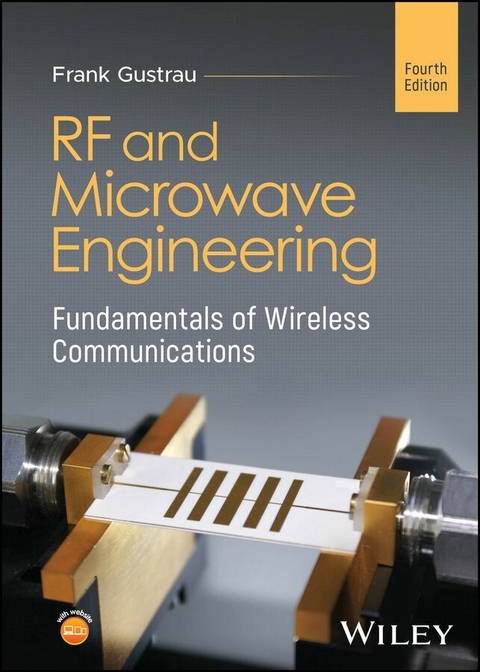
RF and Microwave Engineering (eBook)
355 Seiten
Wiley (Verlag)
978-1-394-28348-4 (ISBN)
A comprehensive guide to the fundamentals of radio frequency (RF), microwave engineering, and the physical aspects of wireless communications.
Combining physical-technical fundamentals with numerical simulations, RF and Microwave Engineering presents a wide range of RF topics with emphasis on physical aspects such as electromagnetic (EM) and voltage waves, transmission lines, passive circuits, and antennas. The text discusses the propagation of waves and their representation, effects, and utilization in passive circuits and antenna structures, incorporates various design examples using circuit and EM simulation software, and gives examples of modern RF tools to show how methods can be applied productively in RF engineering practice.
This revised edition includes new chapters on monostatic and bistatic radar cross sections (RCS), horn antennas, 5G mobile communications, substrate-integrated-waveguides (SIW), slot antennas, characteristics of resonators, and other topics.
A list of practice problems is provided at the end of each chapter and a companion website hosts solutions to the problem sets.
Written by a highly qualified professor this is the English language translation of the German original. RF and Microwave Engineering includes:
- Transmission line theory and transient signals on lines, covering characteristic line impedances, voltage waves, idealized lossless lines and cables with low losses, impedance transformation, reflection coefficient, and Smith chart diagram
- Waveguides, covering coaxial lines, including weak losses, parallel wire lines, microstrip lines, rectangular waveguides, substrate-integrated-waveguides, and three-wire systems
- Scattering parameters, covering multiport equations in matrix form, special network properties of circuits, and the signal flow method
- High-frequency components and circuits, covering line filters, couplers, power dividers, and matching circuits
- Antenna concepts and radio wave propagation in complex environments
RF and Microwave Engineering is an essential text for undergraduate and graduate students in electrical engineering courses including microwave engineering, basic circuit theory, electromagnetic fields, and wireless communications as well as early-stage RF practitioners and engineers.
Frank Gustrau has been a Professor at the University of Applied Sciences and Arts in Dortmund, Germany since 2003. Throughout his career in industry and academia, Professor Gustrau has supervised students in their project work, given lectures on different RF related topics, and worked extensively with EM and RF circuit simulation tools.
A comprehensive guide to the fundamentals of radio frequency (RF), microwave engineering, and the physical aspects of wireless communications. Combining physical-technical fundamentals with numerical simulations, RF and Microwave Engineering presents a wide range of RF topics with emphasis on physical aspects such as electromagnetic (EM) and voltage waves, transmission lines, passive circuits, and antennas. The text discusses the propagation of waves and their representation, effects, and utilization in passive circuits and antenna structures, incorporates various design examples using circuit and EM simulation software, and gives examples of modern RF tools to show how methods can be applied productively in RF engineering practice. This revised edition includes new chapters on monostatic and bistatic radar cross sections (RCS), horn antennas, 5G mobile communications, substrate-integrated-waveguides (SIW), slot antennas, characteristics of resonators, and other topics. A list of practice problems is provided at the end of each chapter and a companion website hosts solutions to the problem sets. Written by a highly qualified professor this is the English language translation of the German original. RF and Microwave Engineering includes: Transmission line theory and transient signals on lines, covering characteristic line impedances, voltage waves, idealized lossless lines and cables with low losses, impedance transformation, reflection coefficient, and Smith chart diagram Waveguides, covering coaxial lines, including weak losses, parallel wire lines, microstrip lines, rectangular waveguides, substrate-integrated-waveguides, and three-wire systemsScattering parameters, covering multiport equations in matrix form, special network properties of circuits, and the signal flow methodHigh-frequency components and circuits, covering line filters, couplers, power dividers, and matching circuitsAntenna concepts and radio wave propagation in complex environments RF and Microwave Engineering is an essential text for undergraduate and graduate students in electrical engineering courses including microwave engineering, basic circuit theory, electromagnetic fields, and wireless communications as well as early-stage RF practitioners and engineers.
| Erscheint lt. Verlag | 19.2.2025 |
|---|---|
| Sprache | englisch |
| Themenwelt | Technik ► Elektrotechnik / Energietechnik |
| Schlagworte | Antenna Arrays • antennas • Beam Forming • filters and couplers • radar backscatter cross sections • radio wave propagation • Scattering parameters • substrate-integrated-waveguides • Transmission Lines • voltage waves |
| ISBN-10 | 1-394-28348-2 / 1394283482 |
| ISBN-13 | 978-1-394-28348-4 / 9781394283484 |
| Informationen gemäß Produktsicherheitsverordnung (GPSR) | |
| Haben Sie eine Frage zum Produkt? |
 PDF (Adobe DRM)
Kopierschutz: Adobe-DRM
Adobe-DRM ist ein Kopierschutz, der das eBook vor Mißbrauch schützen soll. Dabei wird das eBook bereits beim Download auf Ihre persönliche Adobe-ID autorisiert. Lesen können Sie das eBook dann nur auf den Geräten, welche ebenfalls auf Ihre Adobe-ID registriert sind.
Details zum Adobe-DRM
Dateiformat: PDF (Portable Document Format)
Mit einem festen Seitenlayout eignet sich die PDF besonders für Fachbücher mit Spalten, Tabellen und Abbildungen. Eine PDF kann auf fast allen Geräten angezeigt werden, ist aber für kleine Displays (Smartphone, eReader) nur eingeschränkt geeignet.
Systemvoraussetzungen:
PC/Mac: Mit einem PC oder Mac können Sie dieses eBook lesen. Sie benötigen eine
eReader: Dieses eBook kann mit (fast) allen eBook-Readern gelesen werden. Mit dem amazon-Kindle ist es aber nicht kompatibel.
Smartphone/Tablet: Egal ob Apple oder Android, dieses eBook können Sie lesen. Sie benötigen eine
Geräteliste und zusätzliche Hinweise
Buying eBooks from abroad
For tax law reasons we can sell eBooks just within Germany and Switzerland. Regrettably we cannot fulfill eBook-orders from other countries.
aus dem Bereich