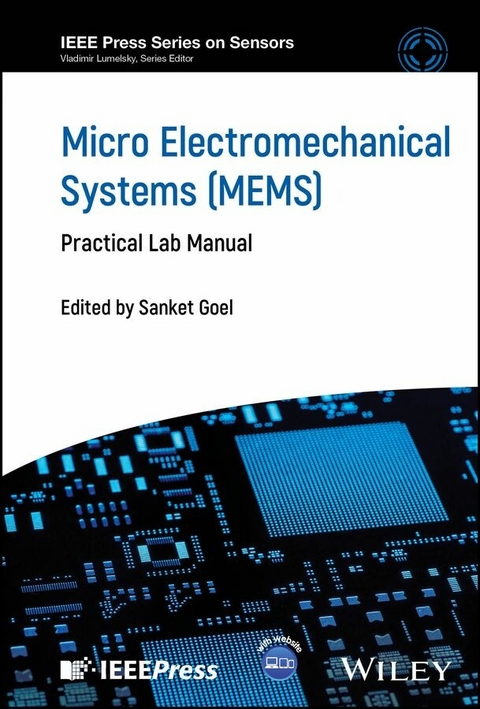
Micro Electromechanical Systems (MEMS) (eBook)
298 Seiten
Wiley-IEEE Press (Verlag)
978-1-394-22984-0 (ISBN)
Practical lab manual on the stepwise description of the experimental procedures of micro electromechanical systems (MEMS) devices
Micro Electromechanical Systems (MEMS) is a highly practical lab manual on the relevant experimental procedures of MEMS devices, covering technical aspects including simulations and modeling, practical steps involved in fabrication, thorough characterizations of developed MEMS sensors, and leveraging these sensors in real-time targeted applications.
The book provides in-depth coverage of multi-physics modeling for various sensors, as well as fabrication methodologies for photolithography, soft lithography, 3D printing, and laser processing-based experimental details for the realization of MEMS devices. It also covers characterization techniques from morphological to compositional, and applications of MEMS devices in contemporary fields such as microfluidics, wearables, and energy harvesters. The text also includes a foundational introduction to the subject.
The book covers additional topics such as:
- Basic fluid flow and heat transfer in microfabrication, Y and T channel mixing, and simulation processes for Droplet generation
- Simulations based on cyclic voltammetry and electrochemical impedance spectroscopy, screen and ink-jet printing, laser-induced graphene, reduced graphene oxide, and 3D printing
- X-ray diffraction, scanning electron microscopy, optical microscopy, Raman spectroscopy, energy dispersive spectroscopy, and Fourier Transform Infrared (FTIR) Spectroscopy
- Experimental stepwise details to enable students to perform the experiments in the practical laboratory and future outlooks on the direction of the field
A practical guidebook on the subject, Micro Electromechanical Systems (MEMS) is a must-have resource for students, academicians, and lab technicians seeking to conduct experiments in real-time.
SANKET GOEL, PH.D., is a Professor with the Department of Electrical and Electronics Engineering and Principal Investigator with the MEMS, Microfluidics and Nanoelectronics (MMNE) Lab at BITS Pilani, Hyderabad Campus, Hyderabad, India.
Practical lab manual on the stepwise description of the experimental procedures of micro electromechanical systems (MEMS) devices Micro Electromechanical Systems (MEMS) is a highly practical lab manual on the relevant experimental procedures of MEMS devices, covering technical aspects including simulations and modeling, practical steps involved in fabrication, thorough characterizations of developed MEMS sensors, and leveraging these sensors in real-time targeted applications. The book provides in-depth coverage of multi-physics modeling for various sensors, as well as fabrication methodologies for photolithography, soft lithography, 3D printing, and laser processing-based experimental details for the realization of MEMS devices. It also covers characterization techniques from morphological to compositional, and applications of MEMS devices in contemporary fields such as microfluidics, wearables, and energy harvesters. The text also includes a foundational introduction to the subject. The book covers additional topics such as: Basic fluid flow and heat transfer in microfabrication, Y and T channel mixing, and simulation processes for Droplet generationSimulations based on cyclic voltammetry and electrochemical impedance spectroscopy, screen and ink-jet printing, laser-induced graphene, reduced graphene oxide, and 3D printingX-ray diffraction, scanning electron microscopy, optical microscopy, Raman spectroscopy, energy dispersive spectroscopy, and Fourier Transform Infrared (FTIR) Spectroscopy Experimental stepwise details to enable students to perform the experiments in the practical laboratory and future outlooks on the direction of the field A practical guidebook on the subject, Micro Electromechanical Systems (MEMS) is a must-have resource for students, academicians, and lab technicians seeking to conduct experiments in real-time.
Preface
Emerging technologies assist in effortlessly identifying and addressing crucial scientific challenges in multiple fields. Of these, prominent contemporary areas include molecular diagnostics, cell biology, neuroscience, drug delivery, micro‐biotechnology, micro‐engineering (fabrication), sensors (wearable), and nano/micro‐material engineering, micro electro mechanical systems (MEMS) and microfluidics. MEMS technology excels in integrating microsensors within the system, using its submicron precision fabrication process. At the same time, microfluidics advances its potential in manipulating nano/micro‐volume fluids for automated testing through MEMS‐supported microchannel fabrications. Interestingly, MEMS technology encompasses a broad range of advanced microfabrication techniques, including photolithography, submicron additive manufacturing, printed electronics, nano/micron thin film depositions, hot embossing, e‐beam deposition, laser micromachining, laser‐assisted fabrications, micro‐electro discharge machining, and phase etching.
The potential of MEMS technologies is often limited due to their inaccessibility and high‐level technical language, which poses challenges for undergrads, postgrads, and entry‐level industrial researchers. To unlock the great potential and ensure that these researchers can make real‐time advances in MEMS products, the language must be made more understandable to a broader audience.
The book addresses this critical gap by compiling technical information into a lab manual designed for hands‐on practice and clear understanding. It provides expertise from research scholars to create a comprehensive library to facilitate knowledge transfer. The written content is supported by detailed instructional videos, offering the readers additional step‐by‐step guidance.
This book is classified into four major parts:
- Microfluidic simulations (Chapters 1–2)
- Advanced MEMS fabrication techniques (Chapter 3–7)
- Material characterizations (Chapters 8–9)
- Interesting applications (Chapters 10–12), followed by the outlook of the book and future scope (Chapter 13)
The complexity in experimental studies can be overcome by using computational tools, which help uncover and optimize unknown parameters for deeper insights. Chapter 1 offers a step‐by‐step guide on using the COMSOL simulation tool to understand concentration profiles in microfluidic channels (Y‐shaped and T‐shaped designs). The chapter begins with the fundamentals of CAD design for required microfluidic channel shapes, file conversions, and setting of computational parameters. The reader will explore how variations in flow rates of two fluids with unique concentrations affect mixing or concentration profiles. Moreover, this simulation allows the reader to create individual concentration profiles by changing the concentrations of fluids, flow parameters, and channel shapes at the end of this experiment.
Chapter 2 highlights the importance of microfluidic droplet generations, exploring the mechanism of generation and their applications in real‐time scenarios. The most used microfluidic shapes for droplet generations include T‐Junction, flow focusing, and co‐flow devices. This chapter focuses on the T‐Junction design (CAD modeling is discussed in Chapter 1 as well) and sets up the process parameters in computational tools to obtain numerical data for generating varying microdroplets. This will help the reader to simulate and generate microdroplets before conducting real‐time studies for multiple applications, including lab‐on‐chip experimentations, chemical synthesis, and cell analysis.
Further, this book provides practical insights into advanced microfabrication concepts using MEMS technologies. Chapter 3 emphasizes the critical role of the photolithography process and photoresist material for MEMS device development. It highlights the information on the classification of clean rooms and the comparison between both processes (i.e., clean room assisted and unassisted). It discusses dimensional accuracy, cost, training, automation, and suitability. Additionally, step‐by‐step information on these two processes is disclosed, i.e., via cleanroom assistance (i.e., conventional masked lithography) and without cleanroom assistance (i.e., using a laser unit) to develop microdevices. Moreover, the pictorial flowchart representations of both photolithography processes simplify complex concepts, enabling readers to come up with innovative ideas for develop microdevices.
Advances in additive manufacturing are documented in state‐of‐the‐art literature; however, translating this research into practical applications remains a challenge. Chapter 4 provides insights into two important 3D printing technologies (i.e., stereolithography (SLA) or dynamic light processing (DLP) and fused deposition modeling (FDM). This chapter introduces the concepts of 3D printing, types, their functioning, and related applications, all of which add hands‐on value to the reader. It begins with designing and developing a practical functioning Y‐shaped microfluidic device fabricated using SLA technology. All the steps are clearly explained, from the initial design of the chip to the slicing operations performed in 3D printing software until the final printed part is achieved. Further, the printed microfluidic device is validated through generating microdroplets, offering proof of concept.
In FDM‐based printing, the use of the thermoplastic filaments and the slice parameters are discussed in detail. As with other 3D printing methods, FDM‐based printing requires the initial CAD modeling, followed by the slicing tool used to load to the respective 3D printer. Each step is discussed in detail to help the reader easily reproduce the results. This chapter demonstrates the fabrication of an electrochemiluminescence (ECL) sensor to capture the luminescence signals. Interestingly, this process combines conductive PLA filament (for the sensor region) and standard PLA filament (for the supporting structure) to create the complete sensor. This process creates never‐before‐seen insights for the reader in making customized sensors using 3D printing technology.
Graphene is a revolutionary 2D material with exceptional electrophysical properties, making it a key component in developing sensitive sensors for multiple applications. Nevertheless, the tedious conventional production process limits its potential for real‐time applications. Chapter 5 introduces an alternative, ultrafast process for the one‐step production of graphene‐based sensors. The chapter also details the production of a one‐step graphene derivative (reduced graphene oxide (rGO)). The assistance of an advanced photothermal reduction approach via two different laser systems, CO2 (10.6 μm) and blue diode (450 nm) lasers, respectively, in producing graphene and rGO, is also elaborated. The process leverages commercially available substrates like polyimide (PI) and grade 1 filter paper to produce user‐defined conductive graphene and rGO patterns. Critical laser optimization and working parameters are demonstrated to help readers reproduce the process to obtain conductive graphenized material. In addition, detailed steps for designing and fabricating a three‐electrode sensor for electrochemical validations are provided. The chapter’s detailed guidance of this process encourages the reader to utilize this advanced laser‐assisted technology to develop one‐step user‐defined graphene traces for additional applications.
Microfluidics, a fascinating micro‐world field that delivers faster reaction responses with low consumption of reagent volumes, is first introduced in Chapter 1 (via simulations) and revisited in Chapter 3 to familiarize the reader with key concepts. Chapter 6 then provides the fundamentals for producing microfluidic devices using a soft lithography technique (i.e., using cleanroom free fabrication). This chapter also discusses the properties of flexible polymer polydimethylsiloxane (PDMS). Interestingly, a nonconventional direct laser writing (DLW) system is introduced to perform maskless lithography. It benefits the reader to develop microfluidic devices in the quickest possible technology at high resolutions. The chapter discusses photosensitive material coatings on glass slides (positive and negative resists), on which the mold formations are made via laser writings. The chapter details the development and etching mechanism, including suitable reagents needed to produce the desired pattern. Later, the concentration ratios of PDMS elastomers to their curing agents are discussed. Step‐by‐step guidance ensures proper spreading and curing of the mixture on the glass mold so that readers can avoid potential handling errors. Further, the stamped patterns onto the cured polymer are bonded to the glass slides through plasma treatment to make a functioning microfluidic device. This information encourages the reader to design their own microchannels and devices in multiple fields, from biomedical diagnostics to engineering.
One‐step production of graphene electrodes was introduced in Chapter 5, while Chapter 7 explores the next generation methods for electrode fabrication. The three prominent ways (automated inkjet printing, screen printing, and...
| Erscheint lt. Verlag | 6.2.2025 |
|---|---|
| Reihe/Serie | IEEE Press Series on Sensors |
| Sprache | englisch |
| Themenwelt | Technik ► Elektrotechnik / Energietechnik |
| Schlagworte | 3D Printing • Electrochemical Impedance Spectroscopy • Energy harvesting • MEMS devices • MEMS modeling • Optical microscopy • photolithography • pollution • Raman spectroscopy • Scanning Electron Microscopy • Soft Lithography • X-ray diffraction |
| ISBN-10 | 1-394-22984-4 / 1394229844 |
| ISBN-13 | 978-1-394-22984-0 / 9781394229840 |
| Informationen gemäß Produktsicherheitsverordnung (GPSR) | |
| Haben Sie eine Frage zum Produkt? |
 EPUB (Adobe DRM)
Kopierschutz: Adobe-DRM
Adobe-DRM ist ein Kopierschutz, der das eBook vor Mißbrauch schützen soll. Dabei wird das eBook bereits beim Download auf Ihre persönliche Adobe-ID autorisiert. Lesen können Sie das eBook dann nur auf den Geräten, welche ebenfalls auf Ihre Adobe-ID registriert sind.
Details zum Adobe-DRM
Dateiformat: EPUB (Electronic Publication)
EPUB ist ein offener Standard für eBooks und eignet sich besonders zur Darstellung von Belletristik und Sachbüchern. Der Fließtext wird dynamisch an die Display- und Schriftgröße angepasst. Auch für mobile Lesegeräte ist EPUB daher gut geeignet.
Systemvoraussetzungen:
PC/Mac: Mit einem PC oder Mac können Sie dieses eBook lesen. Sie benötigen eine
eReader: Dieses eBook kann mit (fast) allen eBook-Readern gelesen werden. Mit dem amazon-Kindle ist es aber nicht kompatibel.
Smartphone/Tablet: Egal ob Apple oder Android, dieses eBook können Sie lesen. Sie benötigen eine
Geräteliste und zusätzliche Hinweise
Buying eBooks from abroad
For tax law reasons we can sell eBooks just within Germany and Switzerland. Regrettably we cannot fulfill eBook-orders from other countries.
aus dem Bereich