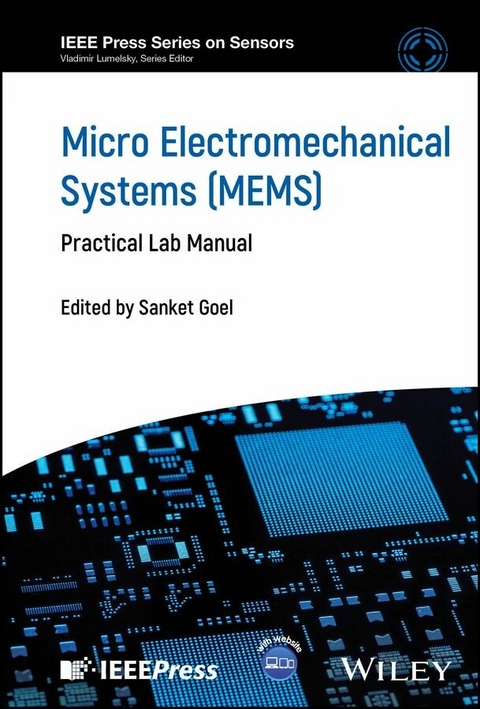
Micro Electromechanical Systems (MEMS) (eBook)
203 Seiten
Wiley-IEEE Press (Verlag)
978-1-394-22985-7 (ISBN)
Practical lab manual on the stepwise description of the experimental procedures of micro electromechanical systems (MEMS) devices
Micro Electromechanical Systems (MEMS) is a highly practical lab manual on the relevant experimental procedures of MEMS devices, covering technical aspects including simulations and modeling, practical steps involved in fabrication, thorough characterizations of developed MEMS sensors, and leveraging these sensors in real-time targeted applications.
The book provides in-depth coverage of multi-physics modeling for various sensors, as well as fabrication methodologies for photolithography, soft lithography, 3D printing, and laser processing-based experimental details for the realization of MEMS devices. It also covers characterization techniques from morphological to compositional, and applications of MEMS devices in contemporary fields such as microfluidics, wearables, and energy harvesters. The text also includes a foundational introduction to the subject.
The book covers additional topics such as:
- Basic fluid flow and heat transfer in microfabrication, Y and T channel mixing, and simulation processes for Droplet generation
- Simulations based on cyclic voltammetry and electrochemical impedance spectroscopy, screen and ink-jet printing, laser-induced graphene, reduced graphene oxide, and 3D printing
- X-ray diffraction, scanning electron microscopy, optical microscopy, Raman spectroscopy, energy dispersive spectroscopy, and Fourier Transform Infrared (FTIR) Spectroscopy
- Experimental stepwise details to enable students to perform the experiments in the practical laboratory and future outlooks on the direction of the field
A practical guidebook on the subject, Micro Electromechanical Systems (MEMS) is a must-have resource for students, academicians, and lab technicians seeking to conduct experiments in real-time.
SANKET GOEL, PH.D., is a Professor with the Department of Electrical and Electronics Engineering and Principal Investigator with the MEMS, Microfluidics and Nanoelectronics (MMNE) Lab at BITS Pilani, Hyderabad Campus, Hyderabad, India.
Practical lab manual on the stepwise description of the experimental procedures of micro electromechanical systems (MEMS) devices Micro Electromechanical Systems (MEMS) is a highly practical lab manual on the relevant experimental procedures of MEMS devices, covering technical aspects including simulations and modeling, practical steps involved in fabrication, thorough characterizations of developed MEMS sensors, and leveraging these sensors in real-time targeted applications. The book provides in-depth coverage of multi-physics modeling for various sensors, as well as fabrication methodologies for photolithography, soft lithography, 3D printing, and laser processing-based experimental details for the realization of MEMS devices. It also covers characterization techniques from morphological to compositional, and applications of MEMS devices in contemporary fields such as microfluidics, wearables, and energy harvesters. The text also includes a foundational introduction to the subject. The book covers additional topics such as: Basic fluid flow and heat transfer in microfabrication, Y and T channel mixing, and simulation processes for Droplet generationSimulations based on cyclic voltammetry and electrochemical impedance spectroscopy, screen and ink-jet printing, laser-induced graphene, reduced graphene oxide, and 3D printingX-ray diffraction, scanning electron microscopy, optical microscopy, Raman spectroscopy, energy dispersive spectroscopy, and Fourier Transform Infrared (FTIR) Spectroscopy Experimental stepwise details to enable students to perform the experiments in the practical laboratory and future outlooks on the direction of the field A practical guidebook on the subject, Micro Electromechanical Systems (MEMS) is a must-have resource for students, academicians, and lab technicians seeking to conduct experiments in real-time.
| Erscheint lt. Verlag | 6.2.2025 |
|---|---|
| Reihe/Serie | IEEE Press Series on Sensors |
| Sprache | englisch |
| Themenwelt | Technik ► Elektrotechnik / Energietechnik |
| Schlagworte | 3D Printing • Electrochemical Impedance Spectroscopy • Energy harvesting • MEMS devices • MEMS modeling • Optical microscopy • photolithography • pollution • Raman spectroscopy • Scanning Electron Microscopy • Soft Lithography • X-ray diffraction |
| ISBN-10 | 1-394-22985-2 / 1394229852 |
| ISBN-13 | 978-1-394-22985-7 / 9781394229857 |
| Informationen gemäß Produktsicherheitsverordnung (GPSR) | |
| Haben Sie eine Frage zum Produkt? |
 PDF (Adobe DRM)
Kopierschutz: Adobe-DRM
Adobe-DRM ist ein Kopierschutz, der das eBook vor Mißbrauch schützen soll. Dabei wird das eBook bereits beim Download auf Ihre persönliche Adobe-ID autorisiert. Lesen können Sie das eBook dann nur auf den Geräten, welche ebenfalls auf Ihre Adobe-ID registriert sind.
Details zum Adobe-DRM
Dateiformat: PDF (Portable Document Format)
Mit einem festen Seitenlayout eignet sich die PDF besonders für Fachbücher mit Spalten, Tabellen und Abbildungen. Eine PDF kann auf fast allen Geräten angezeigt werden, ist aber für kleine Displays (Smartphone, eReader) nur eingeschränkt geeignet.
Systemvoraussetzungen:
PC/Mac: Mit einem PC oder Mac können Sie dieses eBook lesen. Sie benötigen eine
eReader: Dieses eBook kann mit (fast) allen eBook-Readern gelesen werden. Mit dem amazon-Kindle ist es aber nicht kompatibel.
Smartphone/Tablet: Egal ob Apple oder Android, dieses eBook können Sie lesen. Sie benötigen eine
Geräteliste und zusätzliche Hinweise
Buying eBooks from abroad
For tax law reasons we can sell eBooks just within Germany and Switzerland. Regrettably we cannot fulfill eBook-orders from other countries.
aus dem Bereich