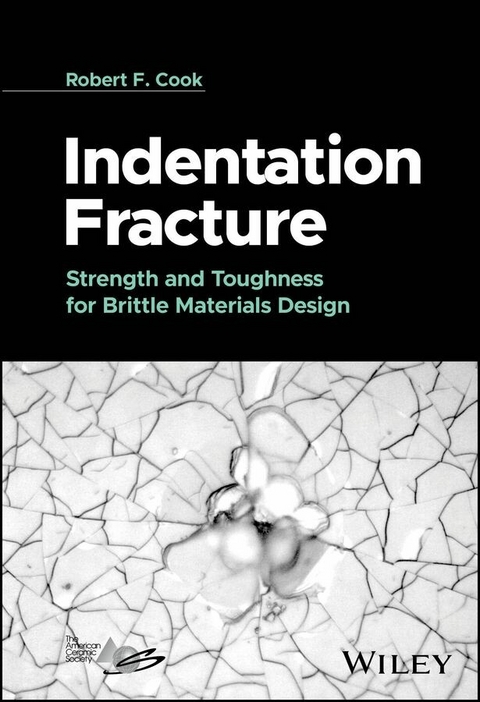
Indentation Fracture (eBook)
1062 Seiten
Wiley-American Ceramic Society (Verlag)
978-1-394-20722-0 (ISBN)

A comprehensive reference with demonstrations of advanced indentation fracture techniques in practical applications to enable better design and more efficient manufacturing
Indentation Fracture describes and illustrates advanced applications of indentation fracture in evaluating strength, toughness, and related properties of brittle materials. The book enables better design, manufacture, performance, and reliability of brittle materials as elements in structural components. Emphasizing the practical applications of indentation fracture techniques, especially those of indentation-strength, the book builds on a development of indentation fracture mechanics to demonstrate clear quantitative comparisons and rankings of material fracture behavior, including the behavior of toughened materials.
The book includes several case studies linking indentation fracture analyses and measurements to other phenomena including fragmentation cracking, edge chipping and dicing damage, scratching and the Mohs scale, and semiconductor grinding damage. Each case study highlights a different aspect of controlled flaw fracture measurements.
The book enables readers to increase the utilization of glasses, ceramics, semiconductors, and similar brittle materials in load-bearing applications by demonstrating experimental indentation techniques to better characterize fracture. A primary focus of the book is demonstration of controlled flaw indentation-strength measurements.
Written by an independent scientist with significant research contributions to the field, Indentation Fracture explores a range of topics including:
- Brittle fracture fundamentals, discussing equilibrium fractures on uniform and localized loading leading to the Griffith and Roesler equations
- Indentation strength variation, covering the effects of contact angle, spherical and flat punch contacts, and contacts in stressed and layered components
- Toughened materials strength observations in alumina, silicon nitride, glass ceramics, ferroelastics, and zirconia
- Strengths of silicon devices determined by wafer backgrinding, covering linear flaws in silicon, including single and multiple scratches, as well as linear, general, controlled, and grinding flaws
Indentation Fracture is an essential reference on the subject for engineers across disciplines, nanotechnologists, geophysicists, and environmental scientists, along with graduate students in materials science and related programs of study.
Robert F. Cook, PhD, is a former NIST Fellow at the National Institute of Standards and Technology (NIST), Gaithersburg, Maryland, USA, and an independent scientist. He was a 2008 recipient of a U.S. Department of Commerce Silver Medal for Scientific/Engineering Achievement and is the author of over 200 peer-reviewed publications, 16 patents, and the book Particle Strengths.
A comprehensive reference with demonstrations of advanced indentation fracture techniques in practical applications to enable better design and more efficient manufacturing Indentation Fracture describes and illustrates advanced applications of indentation fracture in evaluating strength, toughness, and related properties of brittle materials. The book enables better design, manufacture, performance, and reliability of brittle materials as elements in structural components. Emphasizing the practical applications of indentation fracture techniques, especially those of indentation-strength, the book builds on a development of indentation fracture mechanics to demonstrate clear quantitative comparisons and rankings of material fracture behavior, including the behavior of toughened materials. The book includes several case studies linking indentation fracture analyses and measurements to other phenomena including fragmentation cracking, edge chipping and dicing damage, scratching and the Mohs scale, and semiconductor grinding damage. Each case study highlights a different aspect of controlled flaw fracture measurements. The book enables readers to increase the utilization of glasses, ceramics, semiconductors, and similar brittle materials in load-bearing applications by demonstrating experimental indentation techniques to better characterize fracture. A primary focus of the book is demonstration of controlled flaw indentation-strength measurements. Written by an independent scientist with significant research contributions to the field, Indentation Fracture explores a range of topics including: Brittle fracture fundamentals, discussing equilibrium fractures on uniform and localized loading leading to the Griffith and Roesler equationsIndentation strength variation, covering the effects of contact angle, spherical and flat punch contacts, and contacts in stressed and layered componentsToughened materials strength observations in alumina, silicon nitride, glass ceramics, ferroelastics, and zirconiaStrengths of silicon devices determined by wafer backgrinding, covering linear flaws in silicon, including single and multiple scratches, as well as linear, general, controlled, and grinding flaws Indentation Fracture is an essential reference on the subject for engineers across disciplines, nanotechnologists, geophysicists, and environmental scientists, along with graduate students in materials science and related programs of study.
1
Brittle Fracture Fundamentals
This chapter defines and describes in clear, simple mathematical terms the physical, thermodynamic, and mechanical basis and associated terminology of brittle fracture. The transformation on fracture of mechanical energy (including work and elastic energy) into surface energy is shown as the fundamental brittle fracture process. From an energy viewpoint, fracture equilibrium is defined by the balance between configurational forces associated with these energies: the mechanical energy release rate and the fracture resistance. From an equivalent stress viewpoint, fracture equilibrium is defined by the balance between the stress‐intensity factor and the toughness. The limiting cases of uniform and localized loading of cracks are shown to correspond to mechanical energy release rates that increase and decrease with crack area, respectively, leading to the well-established Griffith and Roesler equations of fracture. The limiting cases are similarly described by stress‐intensity factors that increase and decrease with crack length. Nonequilibrium fracture is described by the addition of a kinetic energy term into analysis of adiabatic fast fracture and the addition of an entropy term into analysis of isothermal slow fracture. Fracture in a spatially varying loading field is considered through the example of crack initiation at a misfitting inclusion. The example is based on stress‐intensity factor behavior and highlights considerations of fracture stability.
1.1 Brittle Components and Materials
Many of the objects encountered in everyday life are composed of brittle materials. On mechanical loading such materials are characterized by several distinctive responses—of particular distinction is the nature of failure on tensile loading. On exposure to excess tension brittle materials exhibit limited deformation followed by instability and failure in the form of abrupt fracture and separation into two or more fragments. After failure the fragments recover their initial unloaded and undeformed shapes. The fragments include newly formed surfaces on which the fracture and separation took place. Prior to failure, deformation is elastic and reversible. In a related phenomenon, on excess compressive loading at surface contacts brittle materials exhibit a mixture of localized reversible and irreversible deformation followed by adjacent cracking and chipping. After contact the surface recovers its unloaded shape, usually incompletely, and newly formed fracture surfaces remain in the form of stable cracks and chips. These two characteristic responses are often related: components formed of brittle materials often fail in applied tension from cracks generated by prior compressive contacts.
This book combines the two related responses just discussed in a deliberate way, showing how indentation fracture (intentionally introduced contact cracks) can be used to both evaluate parameters for brittle materials design (and avoid component failure) and understand everyday brittle fracture phenomena (such as fragmentation and chipping). This chapter develops and summarizes the fundamental mechanics and thermodynamics of brittle fracture as a basis for Chapters 2–12 to follow. The chapter begins with phenomenological descriptions of brittle fracture and failure and the transformations of energy that characterize such behavior. This is followed by development from an energy viewpoint of analyses describing equilibrium fracture in limiting stable and unstable configurations, and how such analyses are implemented in practice from a stress viewpoint. The limiting stability configurations are shown to correspond to the two characteristic brittle fracture responses discussed earlier. Experimental data from the last 100 years that exemplify stable and unstable equilibrium fracture are given. Nonequilibrium fracture is then considered, also in two limits, as adiabatic and isothermal behaviors that pertain to these responses. Finally, a practical example of fracture mechanics is given, that of cracking in a brittle material at a misfitting inclusion. The example highlights the stress‐based analysis method used throughout the book and demonstrates unstable, stable, adiabatic, and isothermal fracture behavior in a single system. The inclusion system exhibits the phenomenon of crack initiation and provides a basis for description of many other fracture systems. Although intended as a basis for the analysis and application of indentation fracture, the material in this chapter is general and applies to all fracture.
1.1.1 Components
Figure 1.1 illustrates a brittle bar loaded in tension. The bar is gripped at each end and loading consists of forces applied at each grip. The directions of the forces are outward, tensile, and parallel to the bar axis. The bar is rectangular in cross section with dimensions and and has length between the grips. Under the actions of the forces, the bar extends by a load‐point displacement . and are taken as positive in tension and directed as drawn. The force–displacement – response of the bar is shown in Figure 1.2a. At a maximum force , the bar fractures and separates into fragments, and the force supported by the bar decreases to zero with negligible further increase in displacement. The fragments recover to their unloaded, undeformed configurations. Schematic diagrams of the unloaded bar (dashed outline), loaded bar (shaded), and unloaded fragments (solid outline) are also shown in Figure 1.2a. This process is brittle failure.
Figure 1.1 Schematic diagram of a bar under uniform tensile loading. On application of forces the bar ends between the grips undergo relative displacement .
The force–displacement behavior of most brittle components is linear elastic, most noticeably prior to component failure. The behavior is linear, as the – relationship is given by , where is a displacement‐independent stiffness. In Figure 1.2a, is the stiffness of the bar. The behavior is elastic, as is also time‐invariant, such that the relation represents reversible equilibrium bar and fragment configurations. Prior to failure these are the loaded configurations of the bar. After failure, these are the unloaded configurations of the fragments. Macroscopically, the prefailure equilibrium states are balances between the applied forces at the grips. Microscopically, these equilibrium states are balances between the applied forces and the restoring forces exerted by atomic interactions within the bar. The parameters , , , and are indicated in Figure 1.2a. Linear elastic behavior for most components usually requires to be very small. After failure, the bar ceases to function as a structural component capable of supporting a mechanical force. Equivalently, linear elastic behavior and failure may also be caused by an imposed displacement , in which the applied loading generates an associated force such that , where is the compliance of the bar. For linear elastic behavior . A structural component is thus also capable of supporting an imposed deformation. In Figure 1.1 the applied forces are shown as dark shaded arrows and loading fixtures indicated by hatching—unless otherwise stated, this scheme is used throughout the book. Terms in italics are mostly definitions to be used throughout—some are specific to this book.
Figure 1.2 Brittle failure behavior of the bar and beam shown in Figures 1.1 and 1.3: (a) as a component, shown in a force–displacement plot and (b) as the underlying material, shown in a stress–strain plot. On application of loading, the force or stress increases linearly with displacement or strain. At a maximum force or stress, the supported load abruptly decreases to zero. The resulting fragments are undeformed. Schematic diagrams of the bar responses are shown in (a).
To perform as a structural component the condition must pertain for all forces and displacements imposed in application. To include an engineering “safety factor,” this operational condition is usually extended to . However, it is often not obvious that a functional brittle component is also acting as a structural component and that comparisons of and are thus necessary to guarantee component performance. Atomic interactions within brittle materials often impart useful material properties that lead to more obvious material and component functions. For example, the thermal insulating nature and small manufacturing costs of ceramics lead to their common use as house bricks and tableware; the controllable electrical conductivity of silicon leads to its extensive use as a semiconductor in myriad microelectronic devices; the optical transparency of glasses leads to their wide use as building windows, camera lenses, and mobile device screens; the electrical insulating nature of glasses and ceramics is also critical in microelectronic devices; the chemical and wear resistance of ceramics and glasses lead to their use as coatings in corrosive and abrasive environments; and, finally, most brittle materials are also resistant to elastic deformation and have small densities, rendering them ideal for applications in which dimensional stability is required, such as telescope mirrors.
The brittle materials used in microelectronic devices provide a pervasive example of the structural requirements “hidden” in many functional applications. To span a range of electrical properties—conducting,...
| Erscheint lt. Verlag | 6.2.2025 |
|---|---|
| Sprache | englisch |
| Themenwelt | Naturwissenschaften ► Chemie |
| Technik ► Maschinenbau | |
| Schlagworte | brittle fracture • ceramic strength • Crack propagation • crack velocity • dynamic fragmentation • edge chipping • indentation cracking • indentation strength • lateral cracking • linear contacts • material toughness • toughness variation |
| ISBN-10 | 1-394-20722-0 / 1394207220 |
| ISBN-13 | 978-1-394-20722-0 / 9781394207220 |
| Informationen gemäß Produktsicherheitsverordnung (GPSR) | |
| Haben Sie eine Frage zum Produkt? |
 EPUB (Adobe DRM)
Kopierschutz: Adobe-DRM
Adobe-DRM ist ein Kopierschutz, der das eBook vor Mißbrauch schützen soll. Dabei wird das eBook bereits beim Download auf Ihre persönliche Adobe-ID autorisiert. Lesen können Sie das eBook dann nur auf den Geräten, welche ebenfalls auf Ihre Adobe-ID registriert sind.
Details zum Adobe-DRM
Dateiformat: EPUB (Electronic Publication)
EPUB ist ein offener Standard für eBooks und eignet sich besonders zur Darstellung von Belletristik und Sachbüchern. Der Fließtext wird dynamisch an die Display- und Schriftgröße angepasst. Auch für mobile Lesegeräte ist EPUB daher gut geeignet.
Systemvoraussetzungen:
PC/Mac: Mit einem PC oder Mac können Sie dieses eBook lesen. Sie benötigen eine
eReader: Dieses eBook kann mit (fast) allen eBook-Readern gelesen werden. Mit dem amazon-Kindle ist es aber nicht kompatibel.
Smartphone/Tablet: Egal ob Apple oder Android, dieses eBook können Sie lesen. Sie benötigen eine
Geräteliste und zusätzliche Hinweise
Buying eBooks from abroad
For tax law reasons we can sell eBooks just within Germany and Switzerland. Regrettably we cannot fulfill eBook-orders from other countries.
aus dem Bereich