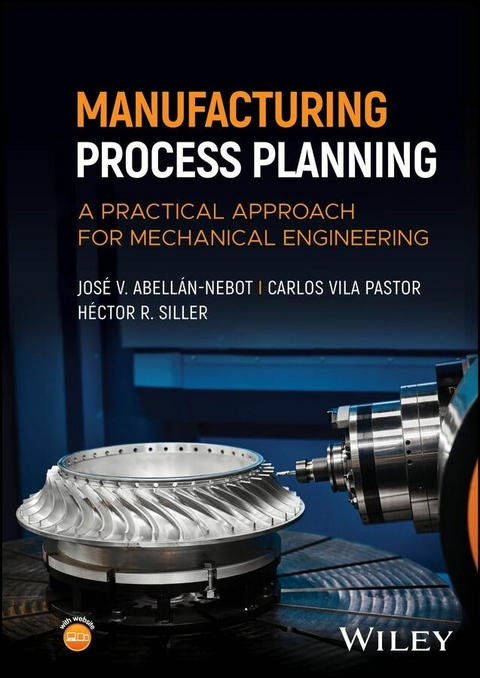
Manufacturing Process Planning (eBook)
785 Seiten
Wiley (Verlag)
978-1-394-27351-5 (ISBN)
Comprehensive introduction to manufacturing process planning in the context of the latest techniques being used in industry
Manufacturing Process Planning is a comprehensive guide to the intricacies of the manufacturing planning process that leads readers through each stage of planning while providing practical examples that illustrate the manufacturing activities taking place at every juncture. Beginning with the fundamentals, the book bridges the gap between technical documents and product specifications, and how the information they contain can be effectively applied on the shop floor.
The book focuses around four key areas: selection of manufacturing processes, process planning in sand casting, process planning in machining, and process planning in inspection. Each chapter highlights best practices for activities such as casting, mold design, machining sequence identification, geometrical validation, CNC programming, the preparation of inspection reports, and more. Special attention is paid to manufacturing cost estimation and pricing, ensuring that the production process is not only feasible but also cost-effective.
To enhance the learning experience, the book comes complete with an active learning project brief and tutorial sessions covering casting simulation, pattern design, and CNC simulation using freely available software.
Manufacturing Process Planning includes information on:
- Fundamentals of casting, including heating the metal, pouring the molten metal, solidification and cooling, determining casting quality, and performing cleaning operations
- Definition and selection of workholding systems, covering principles of workholding, types of workholding systems, and general purpose of workholding devices for turning and milling
- Machine and cutting tool selection, and process parameter selection, covering specific guidelines in turning, milling, and drilling
- Documents for process planning, including process flow charts, routing sheets, and operation and tooling lists
Providing a hands-on approach to mastering the principles of manufacturing process planning, Manufacturing Process Planning is an ideal resource for undergraduate and graduate academic courses that incorporate a lab component, as well as production planning supervisors and managers looking to hone their knowledge base.
José V. Abellán-Nebot, PhD, is an Associate Professor at Universitat Jaume I in Spain and an expert in intelligent machining systems. He has co-authored over 60 international publications.
Carlos Vila Pastor, PhD, is an Associate Professor at Universidad Politécnica de Valencia in Spain. He is an expert in CAM systems.
Héctor R. Siller, PhD, is an Associate Professor at the University of North Texas, USA. He specializes in additive manufacturing and process planning.
Comprehensive introduction to manufacturing process planning in the context of the latest techniques being used in industry Manufacturing Process Planning is a comprehensive guide to the intricacies of the manufacturing planning process that leads readers through each stage of planning while providing practical examples that illustrate the manufacturing activities taking place at every juncture. Beginning with the fundamentals, the book bridges the gap between technical documents and product specifications, and how the information they contain can be effectively applied on the shop floor. The book focuses around four key areas: selection of manufacturing processes, process planning in sand casting, process planning in machining, and process planning in inspection. Each chapter highlights best practices for activities such as casting, mold design, machining sequence identification, geometrical validation, CNC programming, the preparation of inspection reports, and more. Special attention is paid to manufacturing cost estimation and pricing, ensuring that the production process is not only feasible but also cost-effective. To enhance the learning experience, the book comes complete with an active learning project brief and tutorial sessions covering casting simulation, pattern design, and CNC simulation using freely available software. Manufacturing Process Planning includes information on: Fundamentals of casting, including heating the metal, pouring the molten metal, solidification and cooling, determining casting quality, and performing cleaning operationsDefinition and selection of workholding systems, covering principles of workholding, types of workholding systems, and general purpose of workholding devices for turning and millingMachine and cutting tool selection, and process parameter selection, covering specific guidelines in turning, milling, and drillingDocuments for process planning, including process flow charts, routing sheets, and operation and tooling lists Providing a hands-on approach to mastering the principles of manufacturing process planning, Manufacturing Process Planning is an ideal resource for undergraduate and graduate academic courses that incorporate a lab component, as well as production planning supervisors and managers looking to hone their knowledge base.
1
Introduction to Process Planning
1.1 Introduction
Manufacturing process planning involves figuring out the best way to make a product or component, from choosing the right materials and methods to determining the most efficient sequence of steps. The main goal of manufacturing process planning is to optimize the production process, making it cost‐effective while ensuring high‐quality results. In small manufacturing companies, process planning is still conducted by manual methods that rely on experienced process planners who apply their knowledge in design and manufacturing to produce efficient and cost‐effective process plans. More advanced manufacturing companies may utilize computer‐aided process‐planning (CAPP) systems to help in process‐planning activities, saving money, and making more efficient process plans.
In this chapter, an overview of the manufacturing process‐planning activities is presented, and the importance of these activities and the communication between design and manufacturing departments is highlighted to ensure competitive products in shorter lead times. The chapter briefly describes CAPP methods, whereas the manual methods are just schematically presented since this method is covered in detail throughout this book.
1.2 Process Planning Within Product Development Cycle
Process planning is the deliberate selection of the techniques needed to make a product affordable and competitive. Procedures, machine tools, and other equipment must be devised, chosen, and determined to transform raw materials into finished and assembled goods.
Process planning may be also considered as a bridge between product design and manufacturing, as illustrated in Figure 1.1. The initial steps of process planning coincide with the product design phase, involving decisions such as material selection and manufacturing methods such as casting, forging, or die casting. The formal endpoint for product design is marked by the release of all product data, usually in the form of three‐dimensional (3D) models and engineering drawings, which specify the precise product details. At this juncture, process planning takes charge, outlining the comprehensive manufacturing plan for each component of the product.
Figure 1.1 Traditional process planning deployment where machining operations are involved.
Process planning derives its input from 3D models or engineering drawings that detail what needs to be produced and in what quantity. These drawings are carefully scrutinized to determine the project's overall scope. For complex assembled products, considerable effort may be invested in breaking down the product into its constituent parts and subassemblies. Initial decisions regarding subassembly groupings, such as whether to manufacture certain parts or purchase them, as well as determining the general tooling requirements, may also be made. Subsequently, a detailed routing plan is developed for each part, requiring technical expertise in processes, machinery, and production economics. In essence, process planning translates the engineering drawing of a component into a group of manufacturing process steps, leading to the creation of a route sheet, which outlines the sequence of operations necessary for the component. The term “route sheet” is used because it also specifies the machines through which the part must pass to complete the sequence of operations (Kesavan 2009).
In the context of product design and manufacturing on a global scale, three key functions are involved: marketing and sales, design, and manufacturing. These functions traditionally follow a sequential process. Marketing assesses the contemporary market trends and requirements, creating new product concepts based on its findings. It also formulates specifications for the further enhancement of existing products, guided by market assessments. The design function utilizes these product concepts and specifications from marketing, providing a comprehensive overview of all parts and subassemblies required for the final product. This includes detailed 3D models, drawings, assembly plans, and bills of materials. The product requirements determined during the design phase are then assigned to the process‐planning team. This information serves as the basis for creating detailed work instructions needed for production, defining, in case the part should be manufactured in‐house, the manufacturing processes, the machine/equipment needed, tooling requirements, etc. These instructions are transferred to the manufacturing facility for production, as depicted in Figure 1.1.
Consequently, even though the design and manufacturing departments operate independently, the process‐planning activity serves as a connection between them, following a sequential approach. This sequential approach, traditionally utilized in product design and manufacturing, assumes a lengthy lifespan for the product with a consistent demand over an extended period. However, in current competitive global markets, this assumption often does not hold true. As a result, manufacturing organizations have explored ways to reduce the time required for product design and manufacturing, commonly known as time to market. Some organizations have prioritized organizational changes with the intention of forcing all the stakeholders to be involved in the whole product development cycle and fostering cross‐functional collaboration to expedite the design and manufacturing processes of their products. This method, based on the collaboration of cross‐functional teams, is commonly known as concurrent engineering. However, it can be found with other terms such as simultaneous engineering or integrated product development.
Unlike a sequential approach, commonly referred to as “over‐the‐wall engineering” since no bidirectional communication exists to ensure product performance and manufacturability, concurrent engineering can be seen as a cooperative approach where members from all stages are in continuous communication to improve product design and facilitate the subsequent stages of production (Figure 1.2). Some activities that may be found under a concurrent engineering approach are listed in the following:
- Collaborate in the definition of product design specifications.
- Choose the best design and manufacturing techniques to employ.
- Propose modifications of geometrical specifications or relaxation of tolerances.
- Evaluate the design's manufacturability and modify it accordingly.
- Evaluate the assembly of the design to detect potential assembly issues and improvements.
Figure 1.2 Sequential engineering versus concurrent engineering.
Besides reducing time to market, the main benefits of applying concurrent engineering are reducing cost and increasing product quality and productivity. However, managing concurrent engineering is challenging, and it requires the commitment of all stakeholders, and very often some of them are reticent to multidisciplinary collaboration.
Regarding product and production costs, it is important to note that approximately 70% of the total cost of a product is determined during the design phase (Ullman 1992). However, some studies reduce this impact to 47% on average (Ulrich and Pearson 1993). This cost allocation is primarily influenced by material selection and the associated manufacturing methods. The remaining 30% is attributed to decisions made regarding the manufacturing process, such as the utilization of production equipment and tooling. Additionally, it is widely recognized that any modifications made to the product during later stages have a greater impact on production costs compared to earlier stages, and the time required to implement such changes is longer. Figure 1.3 shows the impact of product design on product cost and production cost in common manufacturing companies.
Due to these reasons, concurrent engineering should be considered a widespread practice within manufacturing companies to minimize lead times and decrease the overall costs associated with the final product.
1.3 Process‐Planning Levels of Detail and Activities
As stated earlier, process planning seeks to completely define the manufacturing processes, tools, process parameters, inspection methods, etc., required to manufacture a product according to the 3D models and technical drawings from the design office. Process planning can be conducted at different levels of detail defining four different types of process planning (ElMaraghy and Nassehi 2014): generic planning, macroplanning, detailed planning, and microplanning.
Figure 1.3 Impact of product design on product cost and production cost in common manufacturing companies.
Source: Adapted from Munro and Associates (1989).
Generic planning refers to rough process planning where only manufacturing process selection is conducted according to material, production volume, process capabilities, and cost. Macroplanning details the equipment selection related to manufacturing, assembly, and inspection, and defines the routing sheets, a document that shows the route of each part with the stations and equipment involved at each step. Detailed planning refers to specific information at each station about the sequence of operations, tooling, fixtures, etc. Finally, microplanning describes process and operation parameters, NC...
| Erscheint lt. Verlag | 4.2.2025 |
|---|---|
| Sprache | englisch |
| Themenwelt | Technik ► Bauwesen |
| Technik ► Maschinenbau | |
| Schlagworte | CNC programming • geometrical validation • inspection reports • Machining • machining sequence identification • Manufacturing Processes • Mold Design • parameter selection • Process Planning • Sand Casting • Tool Selection • workholding |
| ISBN-10 | 1-394-27351-7 / 1394273517 |
| ISBN-13 | 978-1-394-27351-5 / 9781394273515 |
| Informationen gemäß Produktsicherheitsverordnung (GPSR) | |
| Haben Sie eine Frage zum Produkt? |
 EPUB (Adobe DRM)
Kopierschutz: Adobe-DRM
Adobe-DRM ist ein Kopierschutz, der das eBook vor Mißbrauch schützen soll. Dabei wird das eBook bereits beim Download auf Ihre persönliche Adobe-ID autorisiert. Lesen können Sie das eBook dann nur auf den Geräten, welche ebenfalls auf Ihre Adobe-ID registriert sind.
Details zum Adobe-DRM
Dateiformat: EPUB (Electronic Publication)
EPUB ist ein offener Standard für eBooks und eignet sich besonders zur Darstellung von Belletristik und Sachbüchern. Der Fließtext wird dynamisch an die Display- und Schriftgröße angepasst. Auch für mobile Lesegeräte ist EPUB daher gut geeignet.
Systemvoraussetzungen:
PC/Mac: Mit einem PC oder Mac können Sie dieses eBook lesen. Sie benötigen eine
eReader: Dieses eBook kann mit (fast) allen eBook-Readern gelesen werden. Mit dem amazon-Kindle ist es aber nicht kompatibel.
Smartphone/Tablet: Egal ob Apple oder Android, dieses eBook können Sie lesen. Sie benötigen eine
Geräteliste und zusätzliche Hinweise
Buying eBooks from abroad
For tax law reasons we can sell eBooks just within Germany and Switzerland. Regrettably we cannot fulfill eBook-orders from other countries.
aus dem Bereich