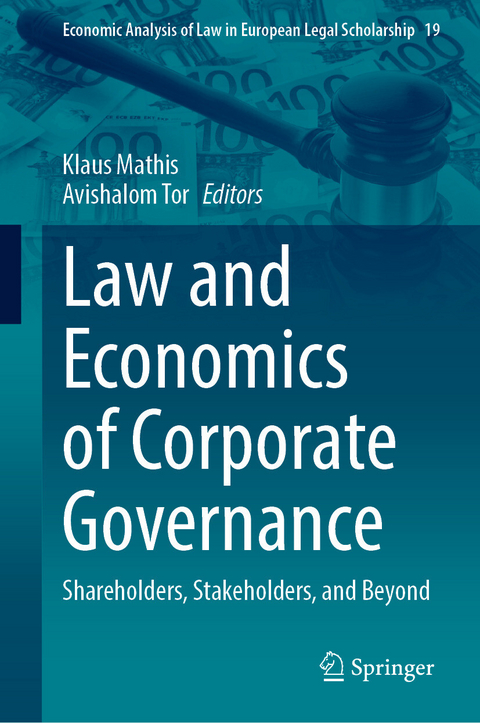
Law and Economics of Corporate Governance (eBook)
X, 245 Seiten
Springer Nature Switzerland (Verlag)
978-3-031-76021-1 (ISBN)
This book aims to analyse the principles and merits of CSR and ESG approaches using a law and economics perspective. The traditional law and economics view of corporate governance emphasises profit-maximisation and a shareholder-oriented approach. This perspective, famously endorsed by Milton Friedman, suggests that a business's sole social responsibility is to maximise profits within legal boundaries. Consequently, mainstream corporate governance scholarship has focused on structuring and regulating business organisations to achieve efficiency and minimise agency costs arising from diverging interests and asymmetric information among managers, shareholders, and creditors. However, recent decades have seen increased attention to the role and interests of other corporate stakeholders, such as employees, consumers, and communities. This shift includes the concept of corporate social responsibility (CSR), which addresses ethics-based issues like working conditions, human rights, fair competition, and environmental protection. While CSR has often been a form of self-regulation, regulatory schemes now support and incentivise this practice, promoting 'stakeholderism' to enhance corporate reputation and profitability while ensuring social accountability. More recently, the focus on business sustainability has intensified under the banner of environmental, social, and governance (ESG) criteria. ESG considerations are now central in the corporate world, influencing ratings, investment decisions, and corporate strategies. Despite support from some scholars and institutions, critics argue that CSR and ESG may fail to benefit stakeholders and could impose high costs on businesses and the economy. Additionally, there are concerns about whether board members and managers are properly incentivised to protect stakeholder interests, as CSR and ESG can sometimes be used to avoid regulation or advance private interests.
| Erscheint lt. Verlag | 30.1.2025 |
|---|---|
| Reihe/Serie | Economic Analysis of Law in European Legal Scholarship |
| Zusatzinfo | X, 245 p. 5 illus. |
| Sprache | englisch |
| Themenwelt | Recht / Steuern ► Allgemeines / Lexika |
| Recht / Steuern ► EU / Internationales Recht | |
| Technik | |
| Wirtschaft | |
| Schlagworte | Corporate Purpose • Corporate Social Responsibility • Due Diligence • Environmental, social and corporate governance (ESG) • ESG reporting • Green Bonds • Greenwashing • market regulation • supply chain regulation • sustainability |
| ISBN-10 | 3-031-76021-2 / 3031760212 |
| ISBN-13 | 978-3-031-76021-1 / 9783031760211 |
| Informationen gemäß Produktsicherheitsverordnung (GPSR) | |
| Haben Sie eine Frage zum Produkt? |
 PDF (Wasserzeichen)
DRM: Digitales Wasserzeichen
Dieses eBook enthält ein digitales Wasserzeichen und ist damit für Sie personalisiert. Bei einer missbräuchlichen Weitergabe des eBooks an Dritte ist eine Rückverfolgung an die Quelle möglich.
Dateiformat: PDF (Portable Document Format)
Mit einem festen Seitenlayout eignet sich die PDF besonders für Fachbücher mit Spalten, Tabellen und Abbildungen. Eine PDF kann auf fast allen Geräten angezeigt werden, ist aber für kleine Displays (Smartphone, eReader) nur eingeschränkt geeignet.
Systemvoraussetzungen:
PC/Mac: Mit einem PC oder Mac können Sie dieses eBook lesen. Sie benötigen dafür einen PDF-Viewer - z.B. den Adobe Reader oder Adobe Digital Editions.
eReader: Dieses eBook kann mit (fast) allen eBook-Readern gelesen werden. Mit dem amazon-Kindle ist es aber nicht kompatibel.
Smartphone/Tablet: Egal ob Apple oder Android, dieses eBook können Sie lesen. Sie benötigen dafür einen PDF-Viewer - z.B. die kostenlose Adobe Digital Editions-App.
Buying eBooks from abroad
For tax law reasons we can sell eBooks just within Germany and Switzerland. Regrettably we cannot fulfill eBook-orders from other countries.
aus dem Bereich