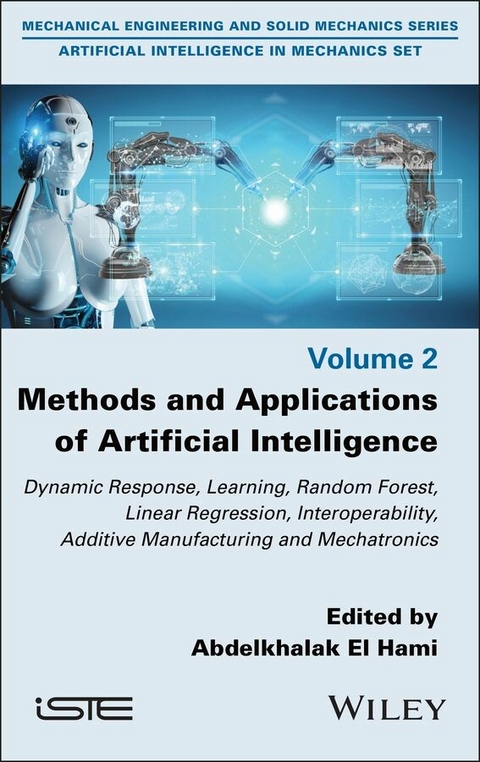
Methods and Applications of Artificial Intelligence (eBook)
348 Seiten
Wiley-Iste (Verlag)
978-1-394-35180-0 (ISBN)
Artificial Intelligence (AI) is currently one of the most talked-about technologies, both among scientists and in public media. Several factors have contributed to its development in recent years. The first is access to vast quantities of data, such as in the industrial field, the advent of Industry 4.0, which promotes automation and data sharing in several technologies. Another factor is the continuous improvement in computing power thanks to the development of ever more powerful processors and the optimization of algorithms. With these two limitations removed, the focus of most AI developments is on the quality of predictions. The integration of AI into the industrial domain represents an exciting new frontier for innovation.
Just as AI has transformed many other sectors, its application to mechanical technologies enables significant improvements in design, manufacturing and quality control processes: from computer-aided design (CAD) to printing parameter optimization, defect detection and real-time monitoring. This type of technology requires computer systems, data with management systems and advanced algorithms which can be used by AIs.
In mechanical engineering, AI offers many possibilities in mechanical construction, predictive maintenance, plant monitoring, robotics, additive manufacturing, materials, vibration, etc.
Methods and Applications of Artificial Intelligence is dedicated to the methods and applications of AI in mechanical engineering. Each chapter clearly sets out the techniques used and developed and accompanies them with illustrative examples. The book is aimed at students but is also a valuable resource for practicing engineers and research lecturers.
Abdelkhalak El Hami is a university professor at INSA Rouen Normandie, France. He is the author/co-author of over sixty books and is responsible for several European educational and/or research projects. He is a specialist in the optimization, reliability and AI of multiphysical systems.
Artificial Intelligence (AI) is currently one of the most talked-about technologies, both among scientists and in public media. Several factors have contributed to its development in recent years. The first is access to vast quantities of data, such as in the industrial field, the advent of Industry 4.0, which promotes automation and data sharing in several technologies. Another factor is the continuous improvement in computing power thanks to the development of ever more powerful processors and the optimization of algorithms. With these two limitations removed, the focus of most AI developments is on the quality of predictions. The integration of AI into the industrial domain represents an exciting new frontier for innovation. Just as AI has transformed many other sectors, its application to mechanical technologies enables significant improvements in design, manufacturing and quality control processes: from computer-aided design (CAD) to printing parameter optimization, defect detection and real-time monitoring. This type of technology requires computer systems, data with management systems and advanced algorithms which can be used by AIs. In mechanical engineering, AI offers many possibilities in mechanical construction, predictive maintenance, plant monitoring, robotics, additive manufacturing, materials, vibration, etc. Methods and Applications of Artificial Intelligence is dedicated to the methods and applications of AI in mechanical engineering. Each chapter clearly sets out the techniques used and developed and accompanies them with illustrative examples. The book is aimed at students but is also a valuable resource for practicing engineers and research lecturers.
1
Dynamic of PP-GF70 Using an Intelligent Method
1.1. Introduction
During a high-speed accident, a car is subjected to gradual stresses that generate localized crumpling and plastic hinges leading to significant deformations throughout its many subsystems. The structure is locally deformed when materials reach their yield stress or the critical breakage loads, which creates localized structural deformations during the wave propagation transit time, and then mass and stress effects. This is due to the transient response and inertia. Crashes are dynamic phenomena that last between 100 and 160 milliseconds (Bois et al. 2004).
In case of temporal loading, the crash phenomenon generally depends on time. If the applied force is cyclic and the frequency is below one-quarter of the natural frequency of the structure, the problem is quasi-static. Dynamic analysis is required if the load is applied more frequently or suddenly (Cook et al. 2002). The stiffness matrix for the dynamic computation is similar to that for static computation, but it also requires mass and damping matrices (El Hami and Radi 2017). The influence will be discussed in the collision analysis, where the structures are subjected to exceptionally high stresses for a short period of time. The collision phenomenon is discussed, which is a temporary response of the structure.
The response requires time integration of the differential equations of motion. The load applied to the structure produces several frequencies upon crash, and the response can only be computed for several multiples of the longest period. In this case, direct explicit integration may be appropriate. Various parameters are used to determine the impact strength of the structure depending on the nature of the impact, and during the construction of the entire car structure, this quality is considered as the most important. After a collision, this criterion describes the capacity of a structure to protect its passengers. The front, rear and side structures of a car have evolved in time to reduce the impact and preserve the integrity of the passenger compartment (Johnson and Mamalis 1978). The resistance to impact can be determined either in advance, using numerical models or experiments, or retrospectively, by examining accident-related data. Resistance to impact is assessed based on the examination of the structure deformation and energy absorbed during impact, the vehicle acceleration upon impact and also the risk of harm assessed using human body models.
Our study involves the use of crashworthiness to redimension the structure of our future cars, by integrating composite materials lighter than steel, which have a good mechanical and dynamic behavior. The work conducted in this chapter involves a comparison of the results of side impact between a steel body and a body that integrates a thermoplastic composite (PP-GF70). This material represents an innovative solution in several industries due to these mechanical and thermal advantages, and also to its manufacturing process. In the automotive industry, the race to save energy and reduce pollutant gas emissions drives an increasing interest of builders and equipment manufacturers in using low-density materials (Al-Maghribi 2008).
Figure 1.1. Side-crash simulation using a mobile barrier (Morancay and Winkelmuller 2009).
1.2. Crash analysis
The dynamic analysis uses the same stiffness matrix as the static analysis, but it also requires mass and dampening matrices. For a given loading amplitude, the dynamic response can be higher or lower than the static response. It will be much more significant for cyclical loading with a frequency near the natural frequency of the structure (ESI Group 2012).
If loading excites only some of the lowest frequencies and the response must be computed over a period of time equal with several multiples of the longest vibration period, as it is the case for seismic loading, the mode-superposition method or an implicit direct integration method may be appropriate (ESI Group 2012).
In the crash analysis, structures are subjected to extremely strong forces during the short-impact time. Here, we are looking for a transient response known as response history. The solution requires time integration of the differential equations of motion. During the crash, the loading excites many frequencies and the response has to be computed only on several multiples of the longest period. In this type of case, an explicit direct integration may be appropriate (ESI Group 2012).
1.2.1. Dynamic equations
1.2.1.1. General equation
The equation governing the structural dynamics, derived below, provides general expressions for structural mass and dampening. The equation of motion is derived by requiring that the work done by external loads is equal to the sum of work absorbed by dissipative and inertial forces for all virtual displacement. For a single element of volume V and surface S, this equilibrium of work becomes (ESI Group 2012),
where
- {F}: body forces;
- {Φ}: traction surface;
- {P}i and {δu}i are the prescribed concentrated loads at nodes and their displacements;
- {δu} and {δε} are the virtual displacements and their corresponding strains.
FE discretization yields (ESI Group 2012),
where:
- [N]: shape functions (space functions);
- {d} is the nodal degrees of freedom (time functions).
Hence, equations [1.2] represent a local separation of variables. Combining equations [1.1] and [1.2] (ESI Group 2012) yields:
The first two integrals of equation [1.3] are identical as “coherent” elementary mass and damping matrices (ESI Group 2012):
The term “coherent” highlights the fact that these shapes directly derive from the EF discretization and use the same shape functions as the element force matrix. The internal force vector of the element {rint} is defined as forces and torques applied to elements with 6 d.o.f. per node to resist stresses inside the element (ESI Group 2012):
A similar notation is used to identify forces and torques applied to nodes following the application of external loads on the element (ESI Group 2012):
The expression in square brackets in equation [1.3] should be eliminated for the equation to be valid for an arbitrary {δd}. According to the notations of equations [1.4]–[1.6], equation [1.3] yields (ESI Group 2012):
Equations [1.5] and [1.7] are valid for the properties of linear and nonlinear materials. If the material is linear elastic, then the loads associated with the element stresses are
{rint} = [K] {d}, where [k] is the classic element strength matrix. The global shapes for a structure with multiple elements are:
1.2.1.2. Direct integration methods
The determination of the response history using a step-by-step integration of dynamic equations is known as direct integration. The response is evaluated at instants separated by time intervals ∆t. Therefore, we calculate the structural displacements at instants ∆t, 2 ∆t, 3 ∆t, …, n ∆t, etc. At n time steps, the equation of motion (equation [1.7] or equation [1.9]) is:
or
Time discretization is made using finite difference approximations of time derivatives. Direct integration methods calculate the conditions at the time step n + 1 from the equation of motion, with a difference expression and the conditions known at one or several previous time steps. Algorithms can be classified as explicit or implicit. An explicit algorithm uses a difference expression of the general form that contains only historical information on its right-hand side
The difference expression is combined with the equation of motion, equation [1.10] at the time step n. An implicit algorithm uses an expression that differs from the general form (ESI Group 2012):
which is combined with the equation of motion at the time step n + 1.
1.2.1.3. Explicit analysis and implicit analysis
In the practical application, significant differences between explicit and implicit methods are related to stability and economy. Explicit methods are conditionally stable, which means there is critical time step ∆tcr that should not be exceeded, otherwise, the numerical process could “explode” and become unstable. As ∆tcr is quite small, many time steps are required, but each one is rapidly executed. Implicit methods are unconditionally stable, which means that calculations remain stable irrespective of the size of ∆t (although accuracy is impacted). In explicit methods, the matrix of coefficients of {D}n+1 can be rendered diagonal, so that...
| Erscheint lt. Verlag | 22.1.2025 |
|---|---|
| Reihe/Serie | ISTE Invoiced |
| Sprache | englisch |
| Themenwelt | Technik ► Maschinenbau |
| Schlagworte | Additive Manufacturing • Artificial Intelligence • Dynamic Response • Interoperability • linear regression • Mechatronics • random forest |
| ISBN-10 | 1-394-35180-1 / 1394351801 |
| ISBN-13 | 978-1-394-35180-0 / 9781394351800 |
| Informationen gemäß Produktsicherheitsverordnung (GPSR) | |
| Haben Sie eine Frage zum Produkt? |
 EPUB (Adobe DRM)
Kopierschutz: Adobe-DRM
Adobe-DRM ist ein Kopierschutz, der das eBook vor Mißbrauch schützen soll. Dabei wird das eBook bereits beim Download auf Ihre persönliche Adobe-ID autorisiert. Lesen können Sie das eBook dann nur auf den Geräten, welche ebenfalls auf Ihre Adobe-ID registriert sind.
Details zum Adobe-DRM
Dateiformat: EPUB (Electronic Publication)
EPUB ist ein offener Standard für eBooks und eignet sich besonders zur Darstellung von Belletristik und Sachbüchern. Der Fließtext wird dynamisch an die Display- und Schriftgröße angepasst. Auch für mobile Lesegeräte ist EPUB daher gut geeignet.
Systemvoraussetzungen:
PC/Mac: Mit einem PC oder Mac können Sie dieses eBook lesen. Sie benötigen eine
eReader: Dieses eBook kann mit (fast) allen eBook-Readern gelesen werden. Mit dem amazon-Kindle ist es aber nicht kompatibel.
Smartphone/Tablet: Egal ob Apple oder Android, dieses eBook können Sie lesen. Sie benötigen eine
Geräteliste und zusätzliche Hinweise
Buying eBooks from abroad
For tax law reasons we can sell eBooks just within Germany and Switzerland. Regrettably we cannot fulfill eBook-orders from other countries.
aus dem Bereich