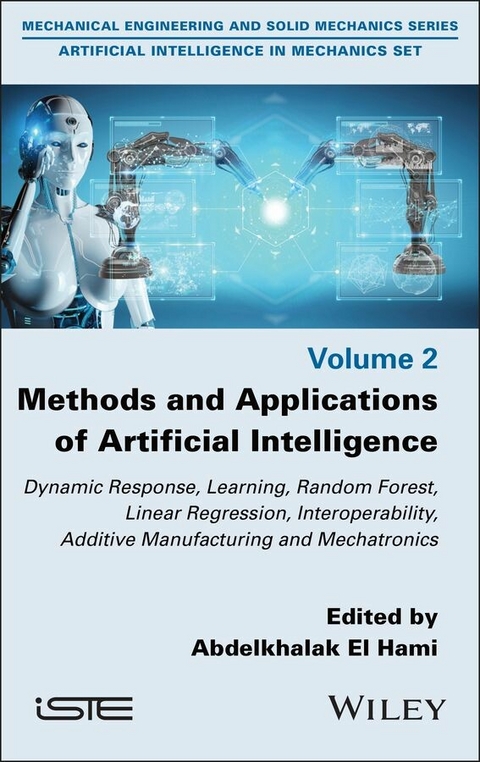
Methods and Applications of Artificial Intelligence (eBook)
253 Seiten
Wiley-Iste (Verlag)
978-1-394-35179-4 (ISBN)
Artificial Intelligence (AI) is currently one of the most talked-about technologies, both among scientists and in public media. Several factors have contributed to its development in recent years. The first is access to vast quantities of data, such as in the industrial field, the advent of Industry 4.0, which promotes automation and data sharing in several technologies. Another factor is the continuous improvement in computing power thanks to the development of ever more powerful processors and the optimization of algorithms. With these two limitations removed, the focus of most AI developments is on the quality of predictions. The integration of AI into the industrial domain represents an exciting new frontier for innovation.
Just as AI has transformed many other sectors, its application to mechanical technologies enables significant improvements in design, manufacturing and quality control processes: from computer-aided design (CAD) to printing parameter optimization, defect detection and real-time monitoring. This type of technology requires computer systems, data with management systems and advanced algorithms which can be used by AIs.
In mechanical engineering, AI offers many possibilities in mechanical construction, predictive maintenance, plant monitoring, robotics, additive manufacturing, materials, vibration, etc.
Methods and Applications of Artificial Intelligence is dedicated to the methods and applications of AI in mechanical engineering. Each chapter clearly sets out the techniques used and developed and accompanies them with illustrative examples. The book is aimed at students but is also a valuable resource for practicing engineers and research lecturers.
Abdelkhalak El Hami is a university professor at INSA Rouen Normandie, France. He is the author/co-author of over sixty books and is responsible for several European educational and/or research projects. He is a specialist in the optimization, reliability and AI of multiphysical systems.
Artificial Intelligence (AI) is currently one of the most talked-about technologies, both among scientists and in public media. Several factors have contributed to its development in recent years. The first is access to vast quantities of data, such as in the industrial field, the advent of Industry 4.0, which promotes automation and data sharing in several technologies. Another factor is the continuous improvement in computing power thanks to the development of ever more powerful processors and the optimization of algorithms. With these two limitations removed, the focus of most AI developments is on the quality of predictions. The integration of AI into the industrial domain represents an exciting new frontier for innovation. Just as AI has transformed many other sectors, its application to mechanical technologies enables significant improvements in design, manufacturing and quality control processes: from computer-aided design (CAD) to printing parameter optimization, defect detection and real-time monitoring. This type of technology requires computer systems, data with management systems and advanced algorithms which can be used by AIs. In mechanical engineering, AI offers many possibilities in mechanical construction, predictive maintenance, plant monitoring, robotics, additive manufacturing, materials, vibration, etc. Methods and Applications of Artificial Intelligence is dedicated to the methods and applications of AI in mechanical engineering. Each chapter clearly sets out the techniques used and developed and accompanies them with illustrative examples. The book is aimed at students but is also a valuable resource for practicing engineers and research lecturers.
| Erscheint lt. Verlag | 10.1.2025 |
|---|---|
| Reihe/Serie | ISTE Invoiced |
| Sprache | englisch |
| Themenwelt | Technik ► Maschinenbau |
| Schlagworte | Additive Manufacturing • Artificial Intelligence • Dynamic Response • Interoperability • linear regression • Mechatronics • random forest |
| ISBN-10 | 1-394-35179-8 / 1394351798 |
| ISBN-13 | 978-1-394-35179-4 / 9781394351794 |
| Informationen gemäß Produktsicherheitsverordnung (GPSR) | |
| Haben Sie eine Frage zum Produkt? |
 PDF (Adobe DRM)
Kopierschutz: Adobe-DRM
Adobe-DRM ist ein Kopierschutz, der das eBook vor Mißbrauch schützen soll. Dabei wird das eBook bereits beim Download auf Ihre persönliche Adobe-ID autorisiert. Lesen können Sie das eBook dann nur auf den Geräten, welche ebenfalls auf Ihre Adobe-ID registriert sind.
Details zum Adobe-DRM
Dateiformat: PDF (Portable Document Format)
Mit einem festen Seitenlayout eignet sich die PDF besonders für Fachbücher mit Spalten, Tabellen und Abbildungen. Eine PDF kann auf fast allen Geräten angezeigt werden, ist aber für kleine Displays (Smartphone, eReader) nur eingeschränkt geeignet.
Systemvoraussetzungen:
PC/Mac: Mit einem PC oder Mac können Sie dieses eBook lesen. Sie benötigen eine
eReader: Dieses eBook kann mit (fast) allen eBook-Readern gelesen werden. Mit dem amazon-Kindle ist es aber nicht kompatibel.
Smartphone/Tablet: Egal ob Apple oder Android, dieses eBook können Sie lesen. Sie benötigen eine
Geräteliste und zusätzliche Hinweise
Buying eBooks from abroad
For tax law reasons we can sell eBooks just within Germany and Switzerland. Regrettably we cannot fulfill eBook-orders from other countries.
aus dem Bereich