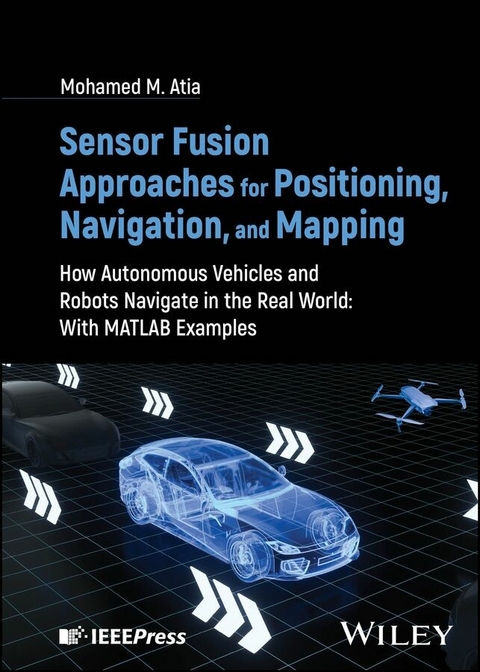
Sensor Fusion Approaches for Positioning, Navigation, and Mapping (eBook)
1019 Seiten
Wiley-IEEE Press (Verlag)
978-1-394-15528-6 (ISBN)
Unique exploration of the integration of multi-sensor approaches in navigation and positioning technologies.
Sensor Fusion Approaches for Positioning, Navigation, and Mapping discusses the fundamental concepts and practical implementation of sensor fusion in positioning and mapping technology, explaining the integration of inertial sensors, radio positioning systems, visual sensors, depth sensors, radar measurements, and LiDAR measurements. The book includes case studies on ground wheeled vehicles, drones, and wearable devices to demonstrate the presented concepts.
To aid in reader comprehension and provide readers with hands-on training in sensor fusion, pedagogical features are included throughout the text: block diagrams, photographs, plot graphs, examples, solved problems, case studies, sample codes with instruction manuals, and guided tutorials.
Rather than simply addressing a specific sensor or problem domain without much focus on the big picture of sensor fusion and integration, the book utilizes a holistic and comprehensive approach to enable readers to fully grasp interrelated concepts.
Written by a highly qualified author, Sensor Fusion Approaches for Positioning, Navigation, and Mapping discusses sample topics such as:
- Mathematical background, covering linear algebra, Euclidean space, coordinate frames, rotation and transformation, quaternion, and lie groups algebra.
- Kinematics of rigid platforms in 3D space, covering motion modeling in rotating and non-rotating frames and under gravity field, and different representations of position, velocity, and orientation.
- Signals and systems, covering measurements, and noise, probability concepts, random processes, signal processing, linear dynamic systems, and stochastic systems.
- Theory, measurements, and signal processing of state-of-the-art positioning and mapping sensors/systems covering inertial sensors, radio positioning systems, ranging and detection sensors, and imaging sensors.
- State Estimation and Sensor Fusion methods covering filtering-based methods and learning-based approaches.
A comprehensive introductory text on the subject, Sensor Fusion Approaches for Positioning, Navigation, and Mapping enables students to grasp the fundamentals of the subject and support their learning via ample pedagogical features. Practicing robotics and navigation systems engineers can implement included sensor fusion algorithms on practical platforms.
Mohamed M. Atia, Associate Professor, Department of Systems and Computer Engineering, Carleton University, Ottawa, Ontario, Canada. Dr. Atia received a PhD in Electrical and Computer Engineering from Queen's University at Kingston in 2013. Before joining academia, he worked in industry developing signal processing and artificial intelligence algorithms for a wide range of applications including natural language processing, speech recognition, and multi-sensors positioning, navigation, and mapping systems.
Unique exploration of the integration of multi-sensor approaches in navigation and positioning technologies. Sensor Fusion Approaches for Positioning, Navigation, and Mapping discusses the fundamental concepts and practical implementation of sensor fusion in positioning and mapping technology, explaining the integration of inertial sensors, radio positioning systems, visual sensors, depth sensors, radar measurements, and LiDAR measurements. The book includes case studies on ground wheeled vehicles, drones, and wearable devices to demonstrate the presented concepts. To aid in reader comprehension and provide readers with hands-on training in sensor fusion, pedagogical features are included throughout the text: block diagrams, photographs, plot graphs, examples, solved problems, case studies, sample codes with instruction manuals, and guided tutorials. Rather than simply addressing a specific sensor or problem domain without much focus on the big picture of sensor fusion and integration, the book utilizes a holistic and comprehensive approach to enable readers to fully grasp interrelated concepts. Written by a highly qualified author, Sensor Fusion Approaches for Positioning, Navigation, and Mapping discusses sample topics such as: Mathematical background, covering linear algebra, Euclidean space, coordinate frames, rotation and transformation, quaternion, and lie groups algebra. Kinematics of rigid platforms in 3D space, covering motion modeling in rotating and non-rotating frames and under gravity field, and different representations of position, velocity, and orientation. Signals and systems, covering measurements, and noise, probability concepts, random processes, signal processing, linear dynamic systems, and stochastic systems. Theory, measurements, and signal processing of state-of-the-art positioning and mapping sensors/systems covering inertial sensors, radio positioning systems, ranging and detection sensors, and imaging sensors. State Estimation and Sensor Fusion methods covering filtering-based methods and learning-based approaches. A comprehensive introductory text on the subject, Sensor Fusion Approaches for Positioning, Navigation, and Mapping enables students to grasp the fundamentals of the subject and support their learning via ample pedagogical features. Practicing robotics and navigation systems engineers can implement included sensor fusion algorithms on practical platforms.
Preface
Background
The early industrial revolutions of the first (eighteenth century), second (nineteenth century), and third (twentieth century) were marked by the invention of machines, transportation means, and computer/communication systems, respectively. The fourth industrial revolution that is currently evolving and shaping our twenty‐first century is marked by two key aspects: autonomy and connectivity. The invention of micro‐electromechanical systems (MEMS) sensors, digital imaging sensors, the deployment of global navigation satellite systems (GNSSs), fifth generation (5G) networks, and the advances in semiconductor manufacturing has created an unprecedented opportunity to develop intelligent autonomous systems that can perform complex, challenging tasks in different fields such as agriculture, farming, transportation, construction, health, and services such as snow removal, lawn mowing, cleaning, warehouse operations, package delivery, not to mention space exploration and settlement on the moon or Mars. Sensor fusion algorithms that support full autonomy is the fuel that powers these new emerging technologies and applications. To support full autonomy, positioning, navigation, and mapping are vital features that any robotic platform or intelligent system must have to navigate in the physical world. Although many books address different navigation and mapping systems, most resources address specific sensor technology. A few books address the problem using a sensor fusion approach, where various sensors are integrated into one system. The fusion of multiple sensors has the benefit of maximizing the overall accuracy and mitigating the limitations of each individual sensor. This book explains fundamental sensor fusion concepts for positioning, navigation, and mapping. In addition, the book describes the concept of operations, mathematical models, and the signal processing of navigation and mapping sensors and technologies. The book integrates common navigation sensor technologies and fusion algorithms in one source with examples and sample code projects for maximum clarity.
Scope of the Book
Positioning, navigation, and mapping can be categorized into low level and high level. Low‐level positioning means determining objects' location, velocity, and orientation, while low‐level navigation refers to estimating objects' trajectories. Low‐level mapping refers to the point‐based mapping of the environment. High‐level positioning, navigation, and mapping include higher level tasks such as object recognition, scene understanding, path planning, and collision avoidance. The book concerns low‐level positioning, navigation, and mapping technologies and their integration. Positioning, navigation, mapping technologies, sensors, and systems are broad and diverse. Each sensor, technology, or system is a sophisticated research area by itself. The book provides introductory‐level knowledge about the most used sensors and positioning, navigation, and mapping technologies. Then, the book explains sensor fusion methods and algorithms with applications on different platforms, such as wheeled vehicles, aerial vehicles, and legged robotic platforms. The book collects the critical building blocks in math, physics, estimation, and signal processing that contribute to building accurate positioning, navigation, and mapping systems.
MATLAB Projects' Repository
The book provides MATLAB projects to demonstrate the concepts and explain the implementation details of sensor fusion systems/algorithms for different platforms. The code, data, and instructions of the projects can be found in the following GitHub link:
https://github.com/SensorFusionBook
MATLAB Version Compatibility
The projects and examples in this book were developed and tested using a specific version of MATLAB. While MATLAB strives to maintain backward compatibility, some functions may become obsolete or exhibit different behavior in newer versions. If you encounter any version-related issues or unexpected behavior, please report them to SensorFusionBook@outlook.com. Your feedback is invaluable in addressing potential compatibility concerns and enhancing the usability of the provided resources.
Who Should Read This Book?
This book is designed for undergraduate/graduate students, researchers, and industry engineers working on developing positioning and mapping algorithms for robotics and autonomous vehicles using multiple integrated sensors. Integrating different multi‐rate sensors in one system in real time is quite challenging and requires solid knowledge of multidisciplinary topics. Being an expert in all interdisciplinary topics related to sensor technologies and positioning/mapping methods is almost impossible. However, having a minimum level of knowledge in these multidisciplinary topics is essential to developing reliable positioning and mapping algorithms for robotics and autonomous vehicles. Engineers focusing on one sensor technology or algorithmic method would benefit from the multidisciplinary topics discussed in this book. Understanding how other sensors work and how measurements are integrated would enhance collaborative work and highlight essential gaps in individual sensors.
Motivations
Despite the importance of the topic of sensor fusion and the significant impact of precise positioning, navigation and mapping on autonomous vehicles and intelligent robotics technologies, the author could not easily find a single book that combines these many varied topics which constitute sensor fusion for autonomous systems positioning, navigation, and mapping. Although some books cover individual topics in location, positioning, navigation, and mapping technology, most books address a specific sensor or problem domain with little focus on the big picture of sensor fusion and integration. The topic of sensor fusion for positioning, navigation, and mapping is usually overlooked due to the complex details of each sensor or technology. As the number of sensors and technologies has significantly increased, the topic of sensor fusion has become complex and requires a separate textbook to explain its concepts adequately. Here are some additional reasons that motivated the author to write this book:
- There are a few books on sensor fusion that provide a balance between theory and actual implementation of sensor fusion methods. Unfortunately, the books that explain the theoretical foundation usually lack the experience of practical implementation and the books that explain implementation details typically lack a solid theoretical foundation.
- As sensor fusion combines different (but related) topics (linear algebra, signal processing, probability, random variable, stochastic processes, and estimation), researchers usually face significant challenges and struggle to build the necessary mathematical and physical background and systems implementation skills.
- The dominant fusion methods in the literature are based on conventional estimation theory. While there is a significant leap in machine learning and artificial intelligence, the application of these tools in sensor fusion has not been extensively explained in a book.
Book Structure
- Chapter 1 provides an essential background of critical mathematical concepts and definitions related to Euclidean geometry, such as points, vectors and vector space, matrices, linear algebra, Lie algebra, coordinate frames, and the transformation of frames. The chapter explains the Earth’s coordinate frames and the transformation between local and global frames. The chapter also describes the derivations of differential equations of motion of rigid objects in 3D space.
- Chapter 2 explains the basics of signals and systems, including probability concepts, random processes, Fourier analysis, stochastic linear dynamic systems, differential equations, transfer functions, state space models, linearization of nonlinear systems, and the basics of digital signal processing that are commonly used in the field of positioning, navigation, and mapping.
- Chapter 3 presents most sensor fusion methods' theoretical and mathematical foundations. Common optimization and filtering algorithms, including Kalman filtering (KF), Extended Kalman filter (EKF), particle filtering (PF), and Graph optimization, are explained. The chapter also includes a brief introductory description of machine learning and artificial intelligence since they became popular tools for performing sensor fusion.
- Chapter 4 is dedicated to inertial sensors, inertial measurement units (IMU), and inertial navigation systems (INS). The theory of operation and the common errors of inertial sensors (accelerometers and gyroscopes) and magnetic sensors are explained and analyzed using practical data and tools such as Allan variance. Fundamental concepts about 3D position/velocity/orientation modeling using differential equations that process inertial measurement are explained. Concepts are further illustrated using MATLAB code samples.
- Chapter 5 explains the basic concepts of radio positioning and navigation systems. The fundamental concepts include navigation signal structure, time of arrival estimation, positioning signal acquisition and tracking, phase look loops, frequency look loops, and pseudo‐range estimation. The concepts are demonstrated using the popular global satellite navigation system (GNSS) technology, taking the Global Positioning System (GPS) as an...
| Erscheint lt. Verlag | 3.1.2025 |
|---|---|
| Sprache | englisch |
| Themenwelt | Technik ► Elektrotechnik / Energietechnik |
| Schlagworte | Global Navigation Satellite Systems • GNSS • inertial navigation systems • Inertial Sensors • INS • Optimization • ranging sensors • Signals and Systems • Simultaneous Localization and Mapping • SLAM • State Estimation • vision sensors |
| ISBN-10 | 1-394-15528-X / 139415528X |
| ISBN-13 | 978-1-394-15528-6 / 9781394155286 |
| Informationen gemäß Produktsicherheitsverordnung (GPSR) | |
| Haben Sie eine Frage zum Produkt? |
 EPUB (Adobe DRM)
Kopierschutz: Adobe-DRM
Adobe-DRM ist ein Kopierschutz, der das eBook vor Mißbrauch schützen soll. Dabei wird das eBook bereits beim Download auf Ihre persönliche Adobe-ID autorisiert. Lesen können Sie das eBook dann nur auf den Geräten, welche ebenfalls auf Ihre Adobe-ID registriert sind.
Details zum Adobe-DRM
Dateiformat: EPUB (Electronic Publication)
EPUB ist ein offener Standard für eBooks und eignet sich besonders zur Darstellung von Belletristik und Sachbüchern. Der Fließtext wird dynamisch an die Display- und Schriftgröße angepasst. Auch für mobile Lesegeräte ist EPUB daher gut geeignet.
Systemvoraussetzungen:
PC/Mac: Mit einem PC oder Mac können Sie dieses eBook lesen. Sie benötigen eine
eReader: Dieses eBook kann mit (fast) allen eBook-Readern gelesen werden. Mit dem amazon-Kindle ist es aber nicht kompatibel.
Smartphone/Tablet: Egal ob Apple oder Android, dieses eBook können Sie lesen. Sie benötigen eine
Geräteliste und zusätzliche Hinweise
Buying eBooks from abroad
For tax law reasons we can sell eBooks just within Germany and Switzerland. Regrettably we cannot fulfill eBook-orders from other countries.
aus dem Bereich