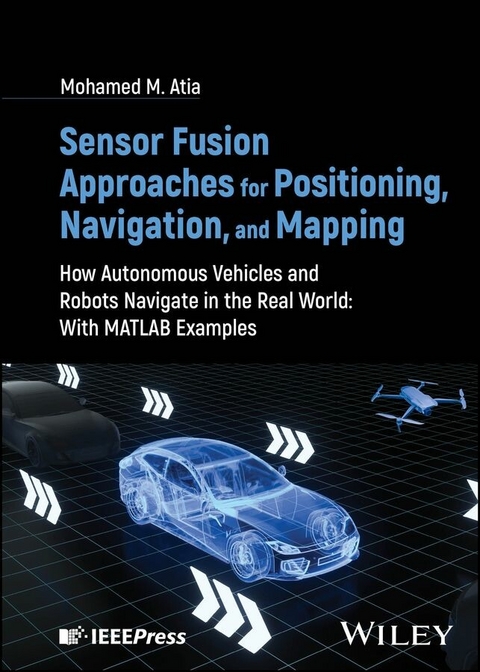
Sensor Fusion Approaches for Positioning, Navigation, and Mapping (eBook)
540 Seiten
Wiley-IEEE Press (Verlag)
978-1-394-15527-9 (ISBN)
Unique exploration of the integration of multi-sensor approaches in navigation and positioning technologies.
Sensor Fusion Approaches for Positioning, Navigation, and Mapping discusses the fundamental concepts and practical implementation of sensor fusion in positioning and mapping technology, explaining the integration of inertial sensors, radio positioning systems, visual sensors, depth sensors, radar measurements, and LiDAR measurements. The book includes case studies on ground wheeled vehicles, drones, and wearable devices to demonstrate the presented concepts.
To aid in reader comprehension and provide readers with hands-on training in sensor fusion, pedagogical features are included throughout the text: block diagrams, photographs, plot graphs, examples, solved problems, case studies, sample codes with instruction manuals, and guided tutorials.
Rather than simply addressing a specific sensor or problem domain without much focus on the big picture of sensor fusion and integration, the book utilizes a holistic and comprehensive approach to enable readers to fully grasp interrelated concepts.
Written by a highly qualified author, Sensor Fusion Approaches for Positioning, Navigation, and Mapping discusses sample topics such as:
- Mathematical background, covering linear algebra, Euclidean space, coordinate frames, rotation and transformation, quaternion, and lie groups algebra.
- Kinematics of rigid platforms in 3D space, covering motion modeling in rotating and non-rotating frames and under gravity field, and different representations of position, velocity, and orientation.
- Signals and systems, covering measurements, and noise, probability concepts, random processes, signal processing, linear dynamic systems, and stochastic systems.
- Theory, measurements, and signal processing of state-of-the-art positioning and mapping sensors/systems covering inertial sensors, radio positioning systems, ranging and detection sensors, and imaging sensors.
- State Estimation and Sensor Fusion methods covering filtering-based methods and learning-based approaches.
A comprehensive introductory text on the subject, Sensor Fusion Approaches for Positioning, Navigation, and Mapping enables students to grasp the fundamentals of the subject and support their learning via ample pedagogical features. Practicing robotics and navigation systems engineers can implement included sensor fusion algorithms on practical platforms.
Mohamed M. Atia, Associate Professor, Department of Systems and Computer Engineering, Carleton University, Ottawa, Ontario, Canada. Dr. Atia received a PhD in Electrical and Computer Engineering from Queen's University at Kingston in 2013. Before joining academia, he worked in industry developing signal processing and artificial intelligence algorithms for a wide range of applications including natural language processing, speech recognition, and multi-sensors positioning, navigation, and mapping systems.
Unique exploration of the integration of multi-sensor approaches in navigation and positioning technologies. Sensor Fusion Approaches for Positioning, Navigation, and Mapping discusses the fundamental concepts and practical implementation of sensor fusion in positioning and mapping technology, explaining the integration of inertial sensors, radio positioning systems, visual sensors, depth sensors, radar measurements, and LiDAR measurements. The book includes case studies on ground wheeled vehicles, drones, and wearable devices to demonstrate the presented concepts. To aid in reader comprehension and provide readers with hands-on training in sensor fusion, pedagogical features are included throughout the text: block diagrams, photographs, plot graphs, examples, solved problems, case studies, sample codes with instruction manuals, and guided tutorials. Rather than simply addressing a specific sensor or problem domain without much focus on the big picture of sensor fusion and integration, the book utilizes a holistic and comprehensive approach to enable readers to fully grasp interrelated concepts. Written by a highly qualified author, Sensor Fusion Approaches for Positioning, Navigation, and Mapping discusses sample topics such as: Mathematical background, covering linear algebra, Euclidean space, coordinate frames, rotation and transformation, quaternion, and lie groups algebra. Kinematics of rigid platforms in 3D space, covering motion modeling in rotating and non-rotating frames and under gravity field, and different representations of position, velocity, and orientation. Signals and systems, covering measurements, and noise, probability concepts, random processes, signal processing, linear dynamic systems, and stochastic systems. Theory, measurements, and signal processing of state-of-the-art positioning and mapping sensors/systems covering inertial sensors, radio positioning systems, ranging and detection sensors, and imaging sensors. State Estimation and Sensor Fusion methods covering filtering-based methods and learning-based approaches. A comprehensive introductory text on the subject, Sensor Fusion Approaches for Positioning, Navigation, and Mapping enables students to grasp the fundamentals of the subject and support their learning via ample pedagogical features. Practicing robotics and navigation systems engineers can implement included sensor fusion algorithms on practical platforms.
| Erscheint lt. Verlag | 31.12.2024 |
|---|---|
| Sprache | englisch |
| Themenwelt | Technik ► Elektrotechnik / Energietechnik |
| Schlagworte | Global Navigation Satellite Systems • GNSS • inertial navigation systems • Inertial Sensors • INS • Optimization • ranging sensors • Signals and Systems • Simultaneous Localization and Mapping • SLAM • State Estimation • vision sensors |
| ISBN-10 | 1-394-15527-1 / 1394155271 |
| ISBN-13 | 978-1-394-15527-9 / 9781394155279 |
| Informationen gemäß Produktsicherheitsverordnung (GPSR) | |
| Haben Sie eine Frage zum Produkt? |
 PDF (Adobe DRM)
Kopierschutz: Adobe-DRM
Adobe-DRM ist ein Kopierschutz, der das eBook vor Mißbrauch schützen soll. Dabei wird das eBook bereits beim Download auf Ihre persönliche Adobe-ID autorisiert. Lesen können Sie das eBook dann nur auf den Geräten, welche ebenfalls auf Ihre Adobe-ID registriert sind.
Details zum Adobe-DRM
Dateiformat: PDF (Portable Document Format)
Mit einem festen Seitenlayout eignet sich die PDF besonders für Fachbücher mit Spalten, Tabellen und Abbildungen. Eine PDF kann auf fast allen Geräten angezeigt werden, ist aber für kleine Displays (Smartphone, eReader) nur eingeschränkt geeignet.
Systemvoraussetzungen:
PC/Mac: Mit einem PC oder Mac können Sie dieses eBook lesen. Sie benötigen eine
eReader: Dieses eBook kann mit (fast) allen eBook-Readern gelesen werden. Mit dem amazon-Kindle ist es aber nicht kompatibel.
Smartphone/Tablet: Egal ob Apple oder Android, dieses eBook können Sie lesen. Sie benötigen eine
Geräteliste und zusätzliche Hinweise
Buying eBooks from abroad
For tax law reasons we can sell eBooks just within Germany and Switzerland. Regrettably we cannot fulfill eBook-orders from other countries.
aus dem Bereich