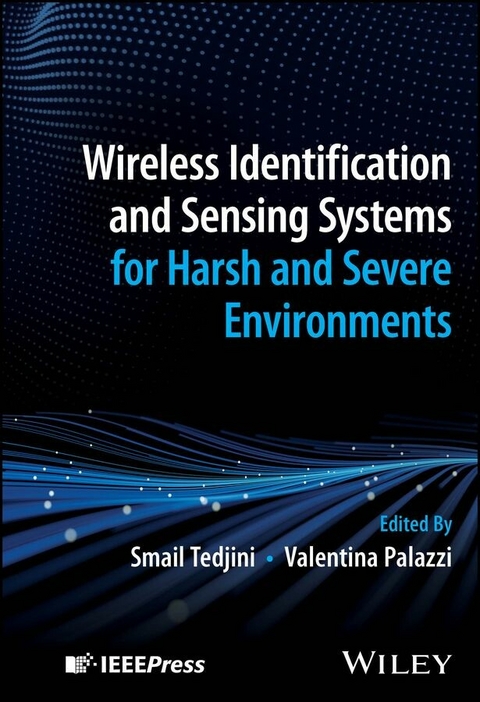
Wireless Identification and Sensing Systems for Harsh and Severe Environments (eBook)
417 Seiten
Wiley-IEEE Press (Verlag)
9781394169085 (ISBN)
Comprehensive resource reviewing the state of the artin wireless identification and sensing systems, proposing several examples of applications
While complying with RF standard and regulations, Wireless Identification and Sensing Systems for Harsh and Severe Environments covers the recent advances in wireless and radio-frequency identification (RFID) systems where severe electromagnetic behavior and harsh conditions are taken into consideration, providing the reader with design rules and methodologies to obtain satisfactory performance and avoid the typical oversights and mistakes that can be made when first approaching this topic.
In addition to examples of real implementations, the book gives a general overview of RFID and wireless technologies as well as their pros and cons in terms of expected performance and future directions of technologies. The perspective and evolution towards IoT solutions and artificial intelligence (AI) are pointed out.
The book furthermore addresses chipless RFID frameworks from the theoretical perspective as well as that of implementation, including examples from scientific literature and commercial solutions. It also describes surface acoustic wave (SAW) sensors in wired and wireless configurations and developments needed to implement the technology.
Wireless Identification and Sensing Systems for Harsh and Severe Environments includes discussion of:
- Frequency diversity for robust Ultra-High Frequency (UHF)-RFID communication, a key technology for future sensor and actuator devices in the Internet of Things, and harmonic transponders for tracking and sensing
- Resonator and reflective delay line configurations, and chipless RFID technology for operations in harsh environments
- Potential of battery-less near-field communication (NFC) sensors using mobile phones as readers in severe environments
- Chipless RFID channel modeling, considering the spatial multipath channel, 3D bi-static Radar Cross Section (RCS) tag model, and analogue effects
Providing comprehensive coverage of the subject and examples of successful implementations of wireless solutions exploiting RFID technologies and enabling systems for the Internet of Things (IoT), Wireless Identification and Sensing Systems for Harsh and Severe Environments is an essential resource for engineers and PhD students in wireless and RFID technologies.
Prof. Smail Tedjini, PhD, is the Founder in 1996 and past Director of the LCIS Lab and is very active in RFID and wireless systems. Now, he is a Project Manager within the ORSYS group that he founded 20 years ago and led until 2014. He co-authored the Wiley title Non-Linearities in Passive RFID Systems: Third Harmonic Concept and Applications (2018).
Dr. Valentina Palazzi, PhD, is a Researcher with the High Frequency Electronics Laboratory at the University of Perugia. She was Vice Chair of the IEEE Microwave Theory and Technology Society (MTT-S) Technical Committee (TC)- 26 'RFID, Wireless Sensor and IoT' for the term 2020-2021.
Comprehensive resource reviewing the state of the artin wireless identification and sensing systems, proposing several examples of applications While complying with RF standard and regulations, Wireless Identification and Sensing Systems for Harsh and Severe Environments covers the recent advances in wireless and radio-frequency identification (RFID) systems where severe electromagnetic behavior and harsh conditions are taken into consideration, providing the reader with design rules and methodologies to obtain satisfactory performance and avoid the typical oversights and mistakes that can be made when first approaching this topic. In addition to examples of real implementations, the book gives a general overview of RFID and wireless technologies as well as their pros and cons in terms of expected performance and future directions of technologies. The perspective and evolution towards IoT solutions and artificial intelligence (AI) are pointed out. The book furthermore addresses chipless RFID frameworks from the theoretical perspective as well as that of implementation, including examples from scientific literature and commercial solutions. It also describes surface acoustic wave (SAW) sensors in wired and wireless configurations and developments needed to implement the technology. Wireless Identification and Sensing Systems for Harsh and Severe Environments includes discussion of: Frequency diversity for robust Ultra-High Frequency (UHF)-RFID communication, a key technology for future sensor and actuator devices in the Internet of Things, and harmonic transponders for tracking and sensingResonator and reflective delay line configurations, and chipless RFID technology for operations in harsh environments Potential of battery-less near-field communication (NFC) sensors using mobile phones as readers in severe environmentsChipless RFID channel modeling, considering the spatial multipath channel, 3D bi-static Radar Cross Section (RCS) tag model, and analogue effects Providing comprehensive coverage of the subject and examples of successful implementations of wireless solutions exploiting RFID technologies and enabling systems for the Internet of Things (IoT), Wireless Identification and Sensing Systems for Harsh and Severe Environments is an essential resource for engineers and PhD students in wireless and RFID technologies.
| Erscheint lt. Verlag | 3.1.2025 |
|---|---|
| Sprache | englisch |
| Themenwelt | Technik ► Elektrotechnik / Energietechnik |
| Schlagworte | 3D bi-static RCS tag model • chipless RFID framework • radio-frequency identification systems • rfid nfc • rfid under stress • spatial multipath channel • surface acoustic wave (SAW) sensors • UHF-RFID communication • UWB chipless RFID channel modeling |
| ISBN-13 | 9781394169085 / 9781394169085 |
| Informationen gemäß Produktsicherheitsverordnung (GPSR) | |
| Haben Sie eine Frage zum Produkt? |
 PDF (Adobe DRM)
Kopierschutz: Adobe-DRM
Adobe-DRM ist ein Kopierschutz, der das eBook vor Mißbrauch schützen soll. Dabei wird das eBook bereits beim Download auf Ihre persönliche Adobe-ID autorisiert. Lesen können Sie das eBook dann nur auf den Geräten, welche ebenfalls auf Ihre Adobe-ID registriert sind.
Details zum Adobe-DRM
Dateiformat: PDF (Portable Document Format)
Mit einem festen Seitenlayout eignet sich die PDF besonders für Fachbücher mit Spalten, Tabellen und Abbildungen. Eine PDF kann auf fast allen Geräten angezeigt werden, ist aber für kleine Displays (Smartphone, eReader) nur eingeschränkt geeignet.
Systemvoraussetzungen:
PC/Mac: Mit einem PC oder Mac können Sie dieses eBook lesen. Sie benötigen eine
eReader: Dieses eBook kann mit (fast) allen eBook-Readern gelesen werden. Mit dem amazon-Kindle ist es aber nicht kompatibel.
Smartphone/Tablet: Egal ob Apple oder Android, dieses eBook können Sie lesen. Sie benötigen eine
Geräteliste und zusätzliche Hinweise
Buying eBooks from abroad
For tax law reasons we can sell eBooks just within Germany and Switzerland. Regrettably we cannot fulfill eBook-orders from other countries.
aus dem Bereich