


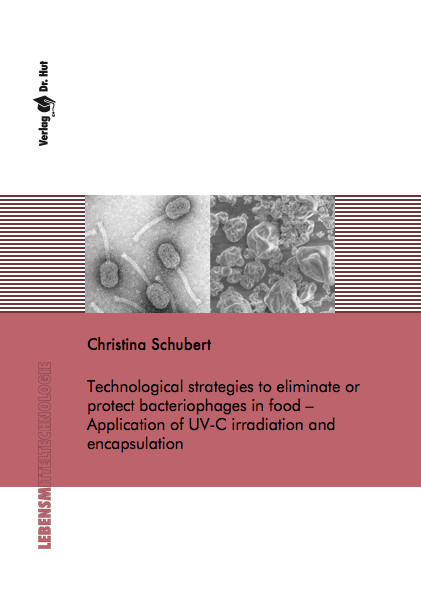
Technological strategies to eliminate or protect bacteriophages in food – Application of UV-C irradiation and encapsulation
Seiten
2024
Dr. Hut (Verlag)
9783843955003 (ISBN)
Dr. Hut (Verlag)
9783843955003 (ISBN)
- Titel nicht im Sortiment
- Artikel merken
Starter culture-infecting bacteriophages are a major threat in dairies because they lead to fermentation failures and severe product defects. Especially the by-product whey is highly contaminated. In this thesis, an orthogonal process consisting of membrane filtration followed by UV-C irradiation was developed to reduce the risk of bacteriophages. Under suitable process conditions, whey with a bacteriophage titer < 10^2 plaque-forming units (pfu) per mL was produced. Besides lab-scale trials, continuous flow-through reactors showed the feasibility of upscaling. It was proven that irradiated whey did not exhibit any genotoxic, cytotoxic or mutagenic activity in vitro. However, the product had a cowish-like off-flavor, the elimination of which should be pursued in the future, through optimized reactor designs ensuring more gentle treatment and deodorizing measures.
In contrast, bacteriophages are also suitable to kill pathogenic bacteria. Their use as antibacterial therapy is intended to counteract intestinal disorders. For the unharmed delivery to the gut, they must be protected from gastric acidic. Therefore, an encapsulation method based on in situ complexation of alginate, calcium ions and milk proteins by spray drying was established. The powdered capsules (particle size: ~10 µm) had bacteriophage titers of 10^7 pfu/g, resisted in simulated gastric solution, dissolved in intestinal solution, and ensured the vitality of bacteriophages for months. These investigations serve as the basis for a human feasibility study using bacteriophage K5 and its probiotic host Escherichia coli Nissle 1917 as model system, in which the transfer of the encapsulated bacteriophages to their destination in the intestine and their contribution to a healthier life should be verified.
In contrast, bacteriophages are also suitable to kill pathogenic bacteria. Their use as antibacterial therapy is intended to counteract intestinal disorders. For the unharmed delivery to the gut, they must be protected from gastric acidic. Therefore, an encapsulation method based on in situ complexation of alginate, calcium ions and milk proteins by spray drying was established. The powdered capsules (particle size: ~10 µm) had bacteriophage titers of 10^7 pfu/g, resisted in simulated gastric solution, dissolved in intestinal solution, and ensured the vitality of bacteriophages for months. These investigations serve as the basis for a human feasibility study using bacteriophage K5 and its probiotic host Escherichia coli Nissle 1917 as model system, in which the transfer of the encapsulated bacteriophages to their destination in the intestine and their contribution to a healthier life should be verified.
| Erscheinungsdatum | 07.09.2024 |
|---|---|
| Reihe/Serie | Lebensmitteltechnologie |
| Verlagsort | München |
| Sprache | englisch |
| Maße | 148 x 210 mm |
| Gewicht | 341 g |
| Themenwelt | Technik ► Lebensmitteltechnologie |
| Schlagworte | bacteriophages • encapsulation • UV-C irradiation |
| ISBN-13 | 9783843955003 / 9783843955003 |
| Zustand | Neuware |
| Informationen gemäß Produktsicherheitsverordnung (GPSR) | |
| Haben Sie eine Frage zum Produkt? |
Mehr entdecken
aus dem Bereich

aus dem Bereich
Technologie, Chemie, Mikrobiologie, Analytik, Bedeutung, Recht
Buch | Hardcover (2023)
Verlag Eugen Ulmer
CHF 169,00
A Laboratory Manual
Buch | Softcover (2022)
John Wiley & Sons Inc (Verlag)
CHF 103,00


