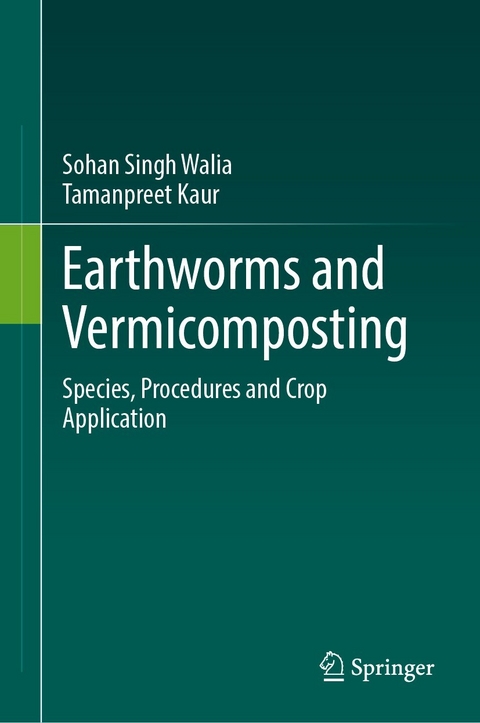
Earthworms and Vermicomposting (eBook)
XIII, 148 Seiten
Springer-Verlag
978-981-99-8953-9 (ISBN)
This book explains the lifecycle of earthworms, biological features, multiplication of worms, species of earthworms that are suitable for vermicomposting, different sources of vermicompost, nutrient recovery and different procedures for making of vermicompost and importance of application of vermicompost in cereal, fruit and vegetable crops.
The tremendous increase in population, urbanization, industrialization and agricultural production results in accumulation quantities of solid wastes. This has created serious problem in the environment. In order to dispose this waste safely it should be converted effectively. This is achieved by bio-composting and vermicomposting of farm, urban and agro-industrial waste. It is being increasing realized that composting is an environment friendly process, convert wide variety of wastes into valuable agricultural inputs. Compost is excellent source of humus and plant nutrients, on application of which improve soil biophysical properties and organic matter status of the soil. India generates about 350 million tonnes of agricultural waste every year. Agricultural wastes include crop residues, weeds, leaf litter, sawdust, forest waste, and livestock waste. Under appropriate conditions, worms eat agricultural waste and reduce the volume by 40 to 60%. Vermicompost produced by the activity of earthworms is rich in macro and micro-nutrients, vitamins, growth hormones, enzymes such as proteases, amylases, lipase, cellulase and chitinase and immobilized microflora.
This book will assist farmers, students and scholars to guide them about lifecycle of earthworms, biological features, multiplication of worms, species of earthworms that are suitable for vermicomposting and different procedures for making of vermicompost. This book will also benefit students of agriculture at graduate and post graduate level as students have a designated course on vermicomposting.
| Erscheint lt. Verlag | 10.1.2024 |
|---|---|
| Zusatzinfo | XIII, 148 p. 1 illus. |
| Sprache | englisch |
| Themenwelt | Naturwissenschaften ► Biologie ► Mikrobiologie / Immunologie |
| Naturwissenschaften ► Biologie ► Ökologie / Naturschutz | |
| Technik ► Umwelttechnik / Biotechnologie | |
| Weitere Fachgebiete ► Land- / Forstwirtschaft / Fischerei | |
| Schlagworte | Earthworms • Nutrient recovery • organic soil fertility • Vermicomposting • Vermitechnology |
| ISBN-10 | 981-99-8953-1 / 9819989531 |
| ISBN-13 | 978-981-99-8953-9 / 9789819989539 |
| Informationen gemäß Produktsicherheitsverordnung (GPSR) | |
| Haben Sie eine Frage zum Produkt? |
 PDF (Wasserzeichen)
DRM: Digitales Wasserzeichen
Dieses eBook enthält ein digitales Wasserzeichen und ist damit für Sie personalisiert. Bei einer missbräuchlichen Weitergabe des eBooks an Dritte ist eine Rückverfolgung an die Quelle möglich.
Dateiformat: PDF (Portable Document Format)
Mit einem festen Seitenlayout eignet sich die PDF besonders für Fachbücher mit Spalten, Tabellen und Abbildungen. Eine PDF kann auf fast allen Geräten angezeigt werden, ist aber für kleine Displays (Smartphone, eReader) nur eingeschränkt geeignet.
Systemvoraussetzungen:
PC/Mac: Mit einem PC oder Mac können Sie dieses eBook lesen. Sie benötigen dafür einen PDF-Viewer - z.B. den Adobe Reader oder Adobe Digital Editions.
eReader: Dieses eBook kann mit (fast) allen eBook-Readern gelesen werden. Mit dem amazon-Kindle ist es aber nicht kompatibel.
Smartphone/Tablet: Egal ob Apple oder Android, dieses eBook können Sie lesen. Sie benötigen dafür einen PDF-Viewer - z.B. die kostenlose Adobe Digital Editions-App.
Buying eBooks from abroad
For tax law reasons we can sell eBooks just within Germany and Switzerland. Regrettably we cannot fulfill eBook-orders from other countries.
aus dem Bereich